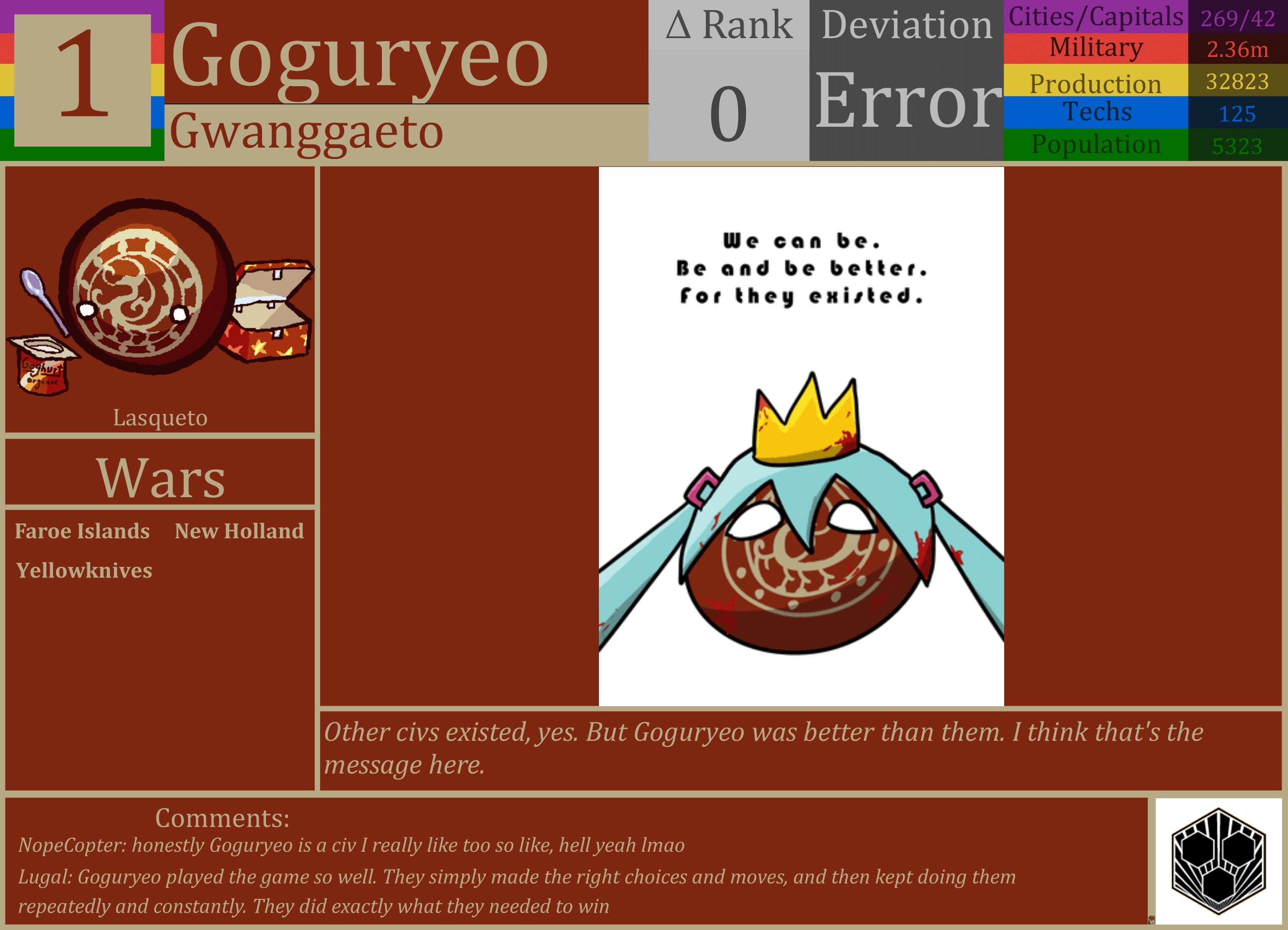
Power Rankings: Episode 46 – S4

April 04, 2025

Power-Rankers

Abstract

Power Rankings! The rankings…of power! Dun dun dunnnn!

Viewing: Vertical
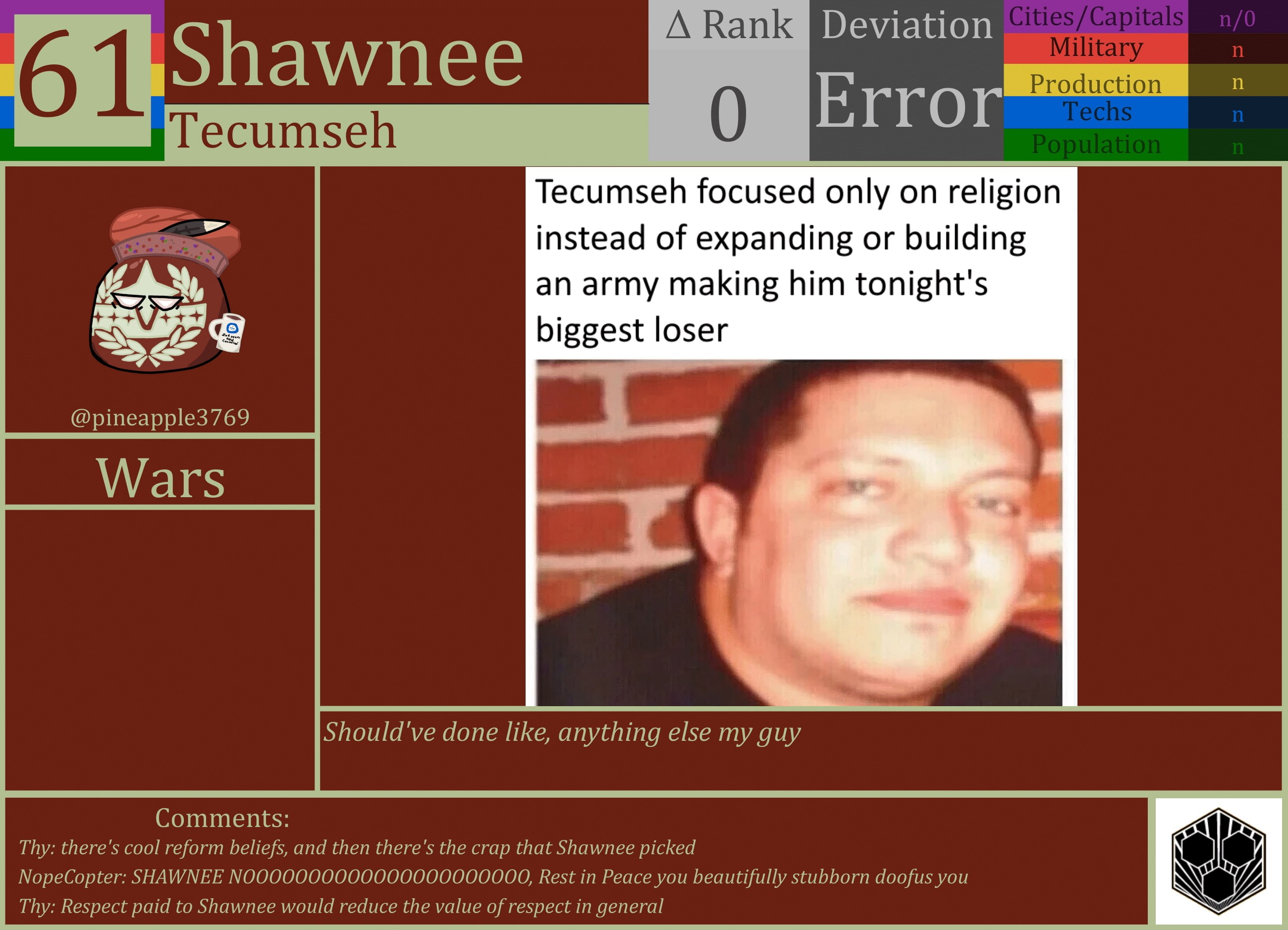
Shawnee
1 / 0
CBR In-Game Screenshot of Shawnee

1: Shawnee

Orange:

Alright first eulogy time! So, the Shawnee had a rough game to say the least. They were almost immediately attacked and had their second city taken, only ever focusing on a religion that didn’t even go anywhere. By the time they even thought about making a second settler, they got their only spot blocked by Thule. Really they were forever limping along, no chance of being anything, just a matter of time before Osage came back. And that’s what happened. Though right before then they did get into a fight with Mexico and for a brief moment had two cities again, a stunning display for the worst civ. But it was not to last, Osage came in right after and while they put on a valiant defense, it was nothing compared to the Osage hordes. So with that, they fell, first on the chopping block. It’s impressive they lasted 13 parts. Cheers for that, may the next one drop quicker.
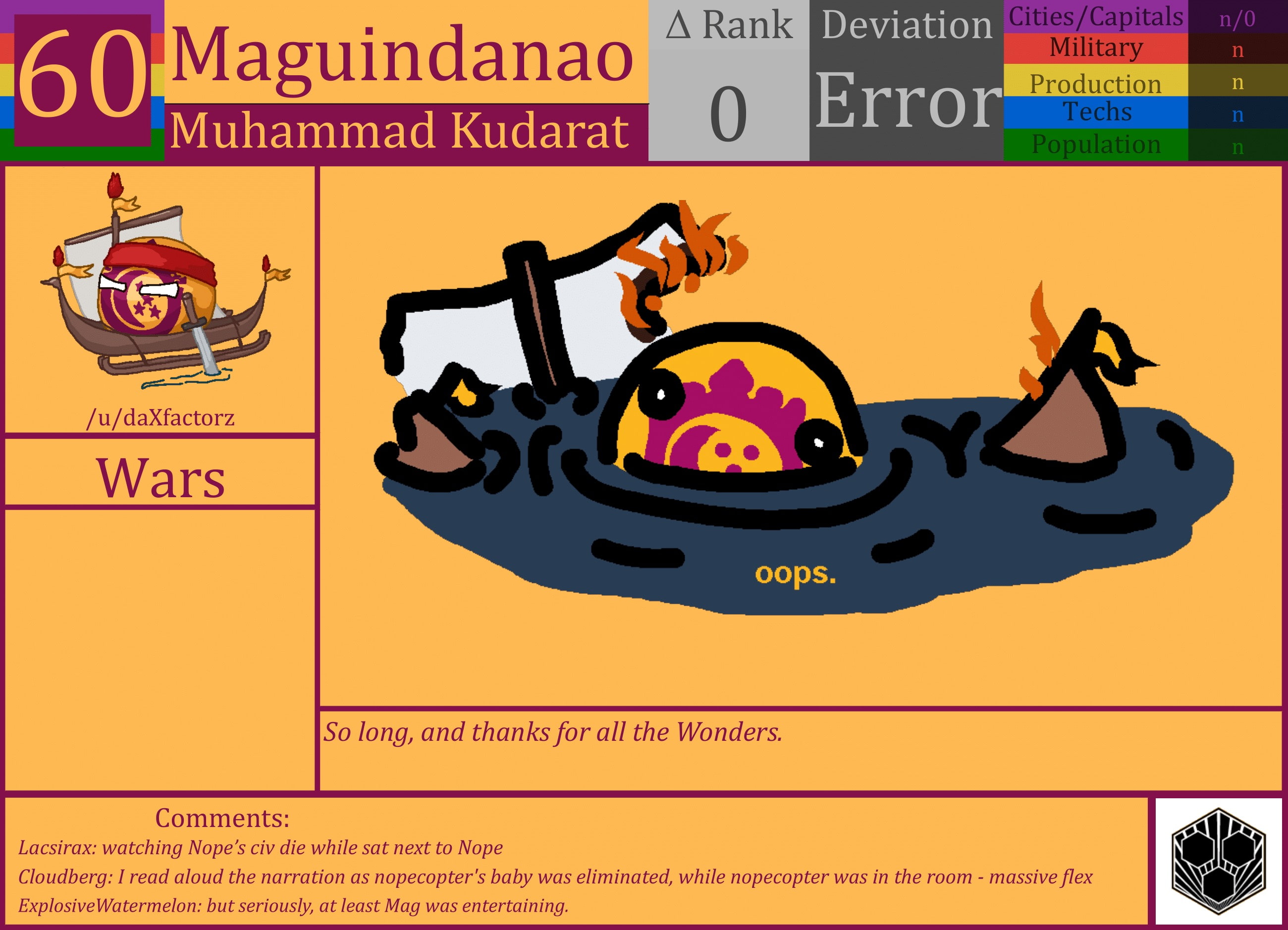
CBR In-Game Screenshot of Maguindanao

2: Maguindanao

NopeCopter:

After a long and brutal coalition war, Maguindanao has finally fallen and been eliminated in 60th place, a position that they realistically didn’t deserve. Initially given a staggering 28th place in the Episode 0 Power Rankings, Maguindanao certainly played an interesting game - while they did settle, they did so slower than usual, which was a problem as both Singapore and the Wahgi decided to settle much more than normal. Maguindanao then also decided to spend most of their production building wonders rather than units, a decision that (despite netting Maguindanao a few big wins) made a lot of people cast their doubts on the Filipino civ.

However, Maguindanao seemingly turned all that around when they dropped their one-two punch of an EXCELLENT religion for their uniques and a war on Wahgi that looked to even the odds in the region. Unfortunately, Maguindanao’s critical lack of Production saw the war stall after only one city capture, and before long the war was a drain on Maguindanao that only left them more vulnerable to invasion. Unlike some other civs I could name, however (cough cough Rozvi), Maguindanao did eventually secure peace (presumably) and began to build up a military. Despite looking like more of an equal to presumed bottom-feeder Singapore than expected, Maguindanao looked to be in a good position to turn things around… outside of their abysmal Production score, at least.

This all came tragically crashing down, however, with a series of major wars one after the other. A holy war against Siam and Dai Viet saw Maguindanao secure a couple of cities but wore down their fleet, the war with Singapore right afterward took out the rest of their navy and almost lost them multiple cities, and then with their abysmal Production score, this left them completely defenseless when Zheng, the Wahgi, and the Noongar all struck at once. Maguindanao was torn to bits, although in the end it was rival pirate civ Zheng that took basically all of the spoils, and the relentless nature of their enemies and a near-total lack of units saw Maguindanao wiped entirely off the map long before their time.
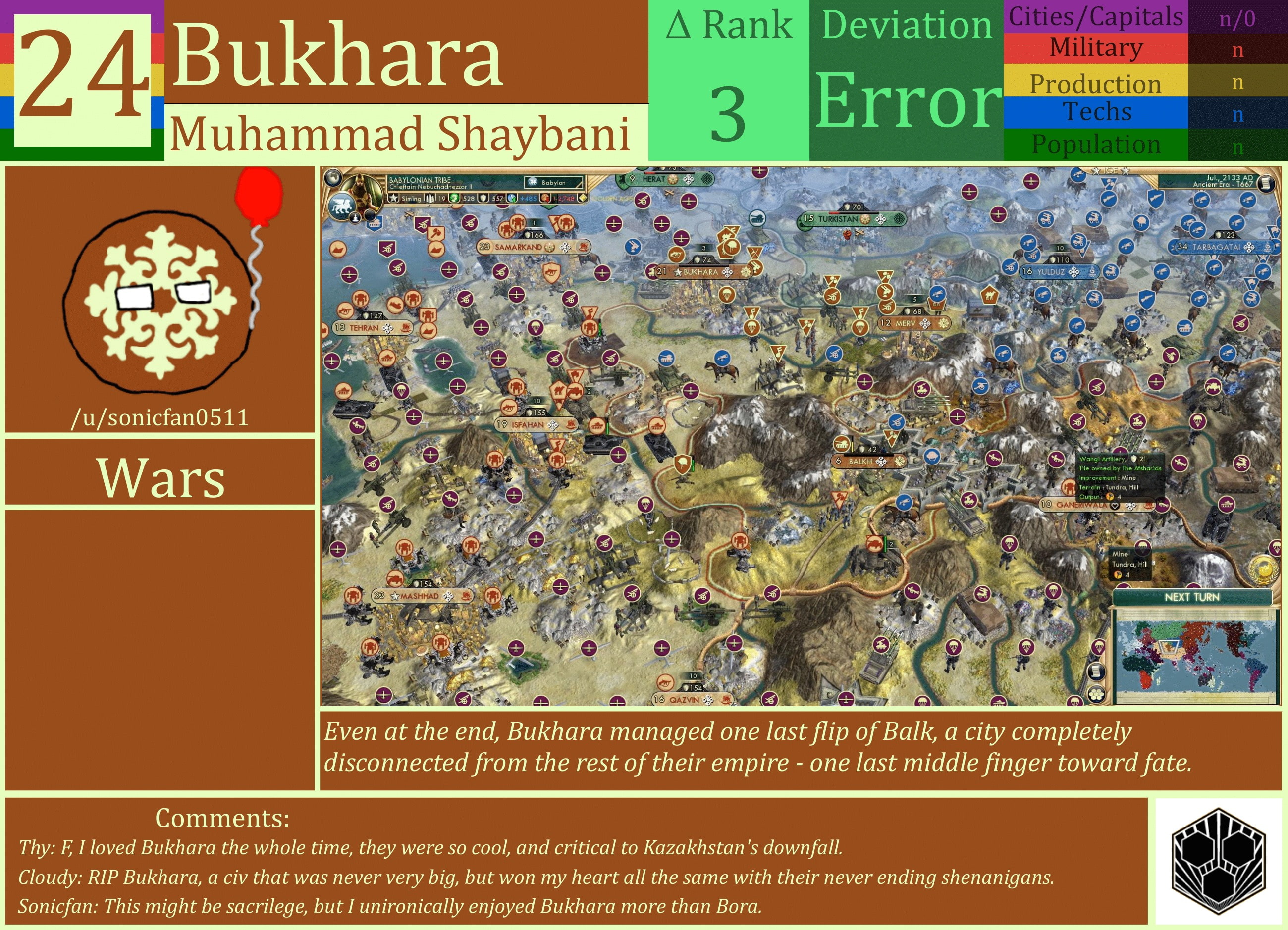
In a funny way, Maguindanao’s journey mimicked that of the very first Filipino civ, Mk. 2’s Philippines, with a fairly impressive albeit shaky empire that was torn to shreds by an invasion from all sides. When it comes to Mk. 2 Philippines, one thing that’s always stuck with me was a quote someone chose to attach to them, from Star Trek of all places: “It is possible to commit no mistakes and still lose. That is not a weakness; that is life.” While I don’t think Maguindanao made no mistakes (in fact they made several), I do think that their early demise came down far more to unfortunate circumstances than their own incompetence. But that’s how things go in the CBR. At least they burned bright and went down fighting. So long, my idiot child, and may the next Filipino civ rank above the bottom 10.

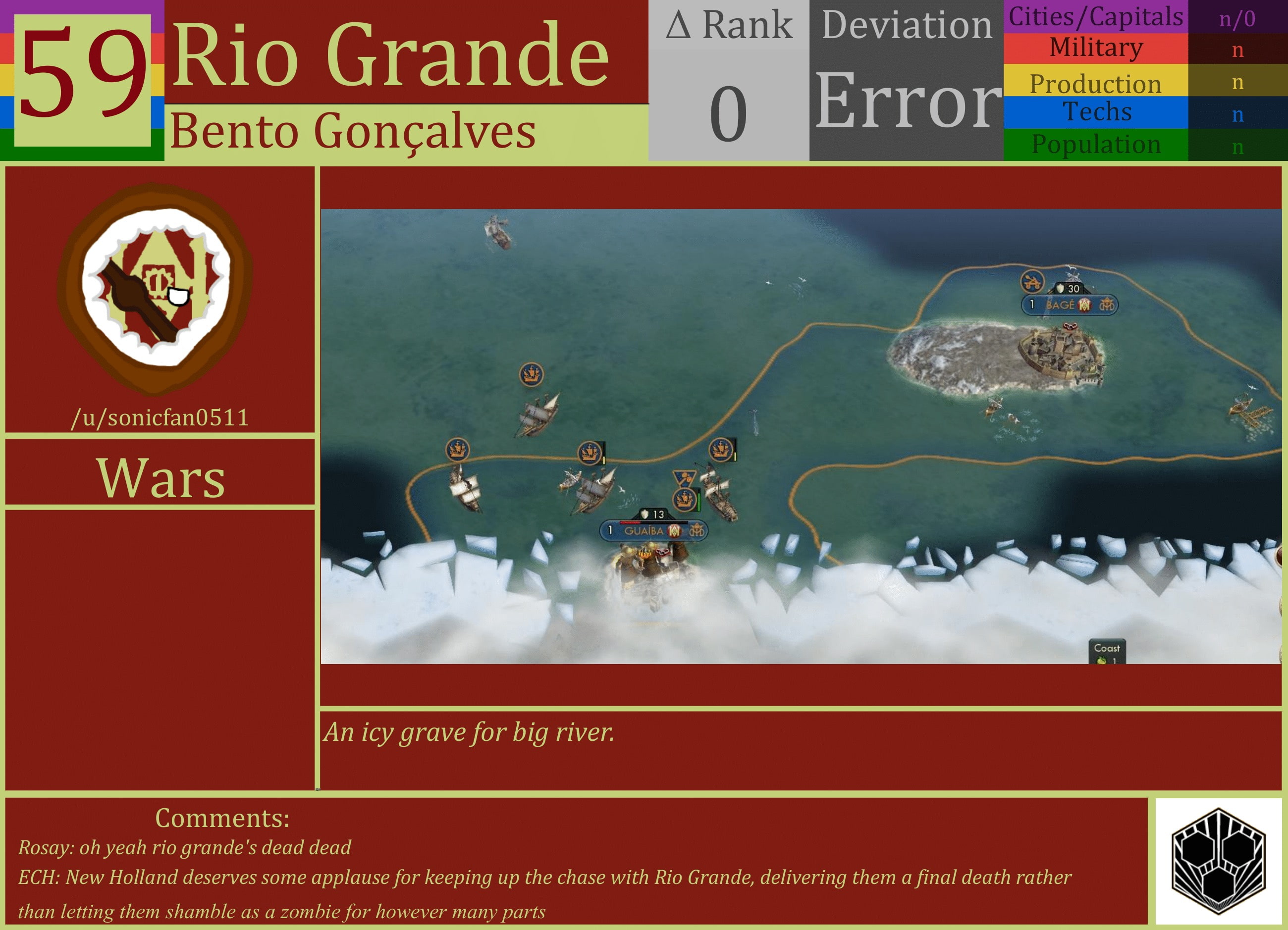
CBR In-Game Screenshot of Rio Grande

3: Rio Grande

Leman:

Chased to the ends of the Earth by New Holland, Rio Grande finds themselves eliminated in 59th place. A far cry from the 32nd place that the PRs had predicted. Rio Grande wasn’t on paper a bad civilization, but it had a slew of fundamental problems that most other civs don’t really have to face. The most glaringly obvious, and what ultimately ended up being the problem that ended their game, was their obscenely powerful neighbors. Tiwanaku and New Holland (though both not looking very powerful today) are both top tier civilizations that have spent most of the game comfortably within the top ten. Any civ, no matter how powerful, is going to struggle when pitted against neighbors of that caliber. Matters were not helped when Rio Grande found itself forward settled by Bora-Bora of all civilizations. Cramped and backed into a corner, it was only a matter of time before the two South American titans tore Rio Grande limb from limb. Rio Grande prolonged their elimination by hiding down south, but New Holland was able to hunt them down.  
And there we have it. The story of Rio Grande. Dead before cow boats. RIP.

CBR In-Game Screenshot of Rozvi

4: Rozvi

Shaggy:

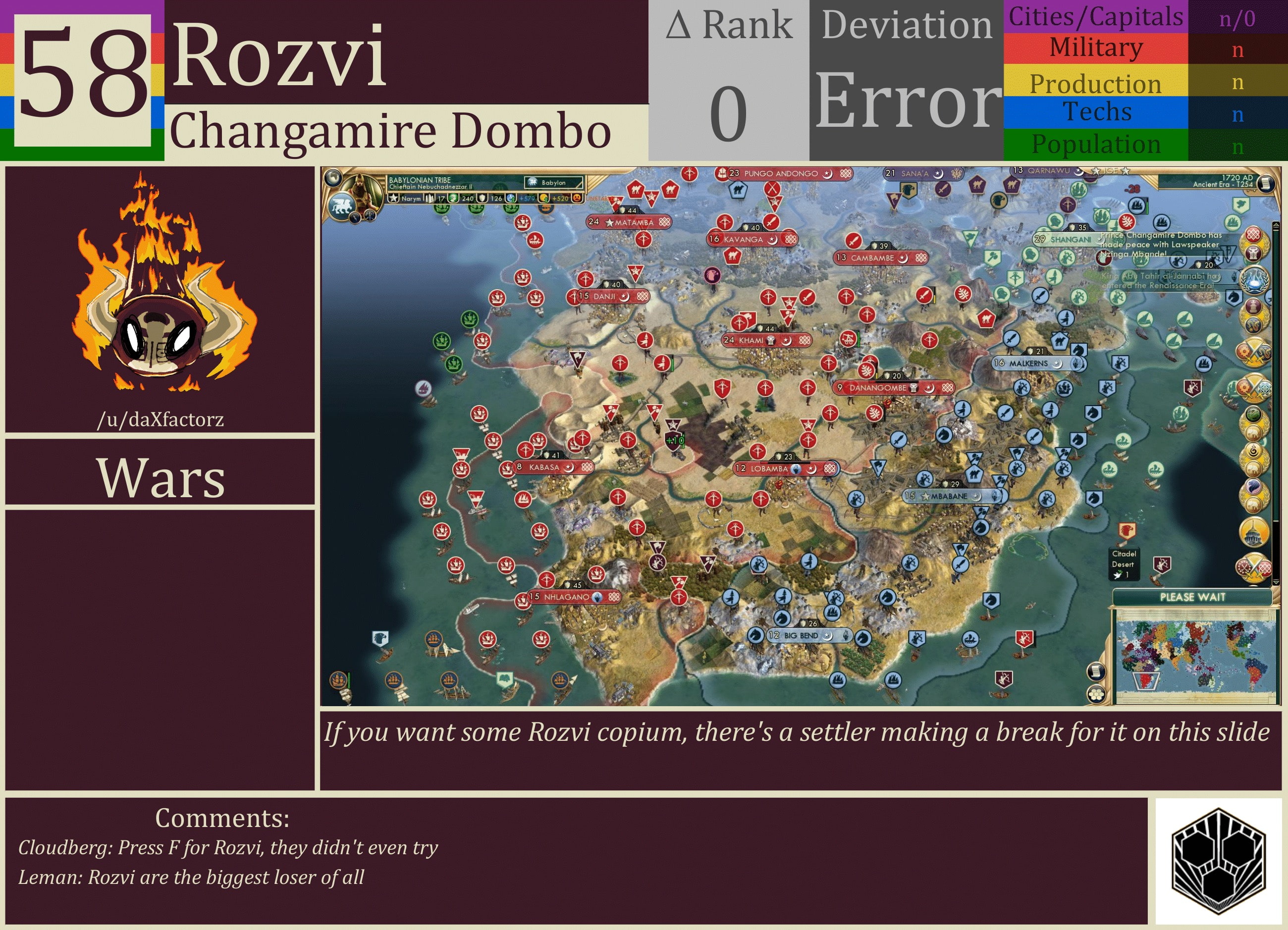
Oh, Rozvi. I had such high hopes for you in the part 0 rankings. Well, high-ish hopes, top 40 hopes. I wanted them to consume Eswatini early and duke it out with Mogadishu for South African supremacy while Ndongo looked elsewhere. But alas, after getting rumped pretty early on, the meme of Rozvi tech being stuck in the past has been their doom as their troops and cities got ripped to shreds by Ndongo like so much paper. They were dealt a bad hand and barely tried. F

CBR In-Game Screenshot of Harappa

5: Harappa

NopeCopter:

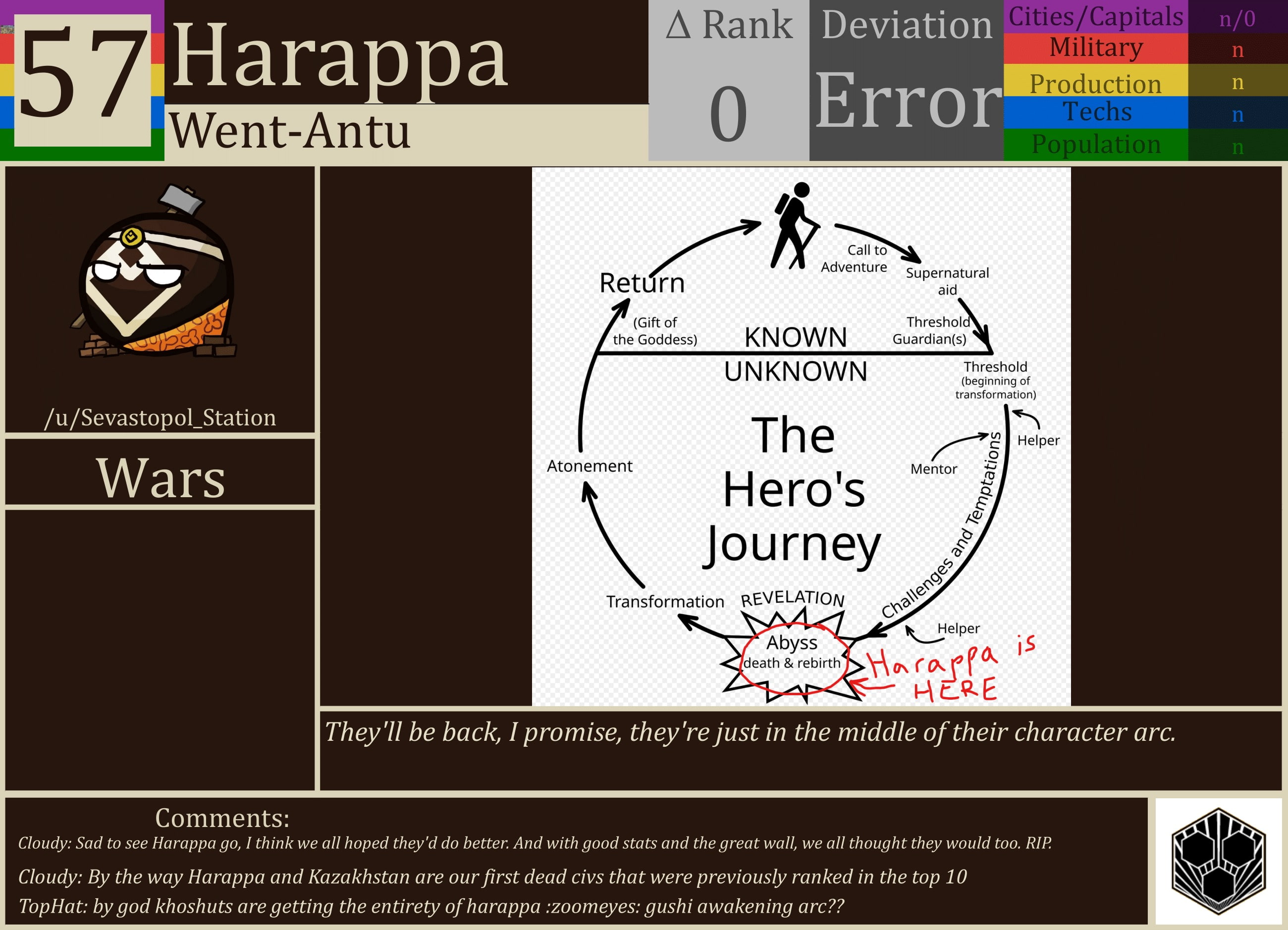
Here lies Harappa, one of the most silently tragic figures of the CBR. Not only did they serve as a sort of representative of the game’s oldest mods going in, but their reputation as a competent AI and their excellent starting position really did make them seem like they’d end up a worthy successor to X2’s Punjab and X3’s Afghanistan. Their start gave no reason for anyone to doubt that assessment, either - they expanded quickly, seizing northern India and boxing Vijayanagara in while the Khoshuts left all the most fertile land in the area wide open.But then… then they just sort of hit the brakes at exactly the wrong time. Their first attempt at a war with Vijayanagara went nowhere, Vijayanagara grabbed enough land to make themselves look good, the Khoshuts effectively blocked Harappa out of a Ganges-based empire, and most importantly, the Afsharids expanded so violently that Harappa’s continued existence suddenly looked a lot less certain. By the time the Settler machine got back online, North India was completely full, and Harappa was forced to start grabbing land in the Himalayas and random islands (plus a bold city in Oman). They had a monstrous army but tried to use it on Bukhara rather than someone they could actually threaten (like the suddenly-humbled Afsharids or the still-underwhelming Vijayanagara), but between their various disparate colonies, their massive army, their presumed free meal to the south, and the Great Wall, they were at the very least not going anywhere any time soon. In fact, they actually looked really strong - their tech count was high, and they had the positioning to grow with the Hindu Kush mountains blocking the incompetent Afsharids.

Unfortunately, Harappa’s wanton expansion made them more than a few enemies, and they fumbled almost all of their overseas colonies right off the bat. They lost their Omani city in a war they declared on the Qarmatians, and a coalition that kicked off right afterward allowed the presumed irrelevant Vijayanagara to take Sri Lanka, ending hopes of a Harappan naval empire. The war against Vijayanagara in particular was a serious upset, as Harappa’s image of the dominant force in South Asia was shattered by Vijayanagara’s ability to put in serious work with worse stats and less-advanced units - mainly because Vijayanagara built a navy and Harappa didn’t. The real blow came at the end of the war, though, where Harappa’s larger military finally turned the tide and seemed ready to absolutely tear through the ill-defended northern Vijayanagara cities… only for Harappa to declare peace before taking anything. And then, before Harappa could build back up and take another shot, the Afsharids invaded.

The Afsharid invasion, while not nearly as devastating as it could have been, really was the final nail in the coffin for this former powerhouse. The Afsharid war record had been… spotty, to put it nicely, so to see them manage to take two cities off Harappa (one through the Great Wall, no less) was downright shocking. Harappa lived, of course, but the message had been sent - no mountains or wall could save Harappa from the Afsharids when they came back to finish the job, and Vijayanagara’s subsequent humiliation of the Afsharids only served to prove that they weren’t going to be Harappa food, either. The remaining Harappan island cities got picked off by Singapore and Mogadishu of all civs in the resulting opportunistic coalition as Harappa’s final attempt to take a city off Bukhara failed.

At this point, all that was left of Harappa was a four-city rump state, a shell of its former self, albeit a seemingly very safe one. Because of the city positioning (reminiscent of Burgundy’s famed core), neither the Afsharids or Vijayanagara could launch an effective assault, and the Khoshuts were, well, the Khoshuts. Plus, they still had the Great Wall. I’m sure many expected Harappa to be a stubborn long-lasting buffer state for a long time to come, especially with the Afsharids and VIjayanagara distracted, which made the final act of Harappa’s run all the more shocking. In the midst of another pointless war with Bukhara, the Afsharids, Vijayanagara, and even the Khoshuts all joined forces to finally put an end to their shared neighbor. The Afsharids and Vijayanagara even made peace with each other for it. Harappa’s army was eviscerated with shocking speed. The only thing more shocking than their sudden death was who profited. The Khoshuts, written off first as lazy for settling the mountains instead of the fertile Ganges and then as incompetent for giving up cities to the Dzungars and Siam, completely unable to even take a seemingly free Siamese city, managed to capture not one, not two, but ALL FOUR of Harappa’s remaining cities, completely shutting out both the Afsharids and Vijayanagara and almost doubling their size in one fell swoop. Perhaps their demise was fitting - a civilization that even after some initial failures was expected to rise to prominence purely because of the two weaklings they shared a subcontinent with ended up being food for those two weaklings to climb back to prominence.

And so ends the tale of Harappa… or so you’d think. However, the game-runner Lacs has promised that only a run where Harappa wins the game would actually be recorded. Harappa’s death is surely only temporary, and before long they will rise again in the ultimate come-from-behind victory… but even if they don’t, at least their death made for a shocking spectacle. Not a bad run overall, even if they did leave the game early.

CBR In-Game Screenshot of Kazakhstan

6: Kazakhstan

Leman:

Kazakhstan was a weird civ to rank at the games start. Historically, starts in Kazakhstan’s region have been fairly powerful, with lots of room to grow and expand before hitting their neighbors, but Kazakhstan had clear and evident flaws that made that strategy seem improbable. Civs in this region tend to be able to then use that early game advantage to catapult themselves into a strong position for the rest of the game. Season One’s Kazakhs were the most famous example of this. Kazakhstan, at first, seemed like they might be able to use this same playbook to have a solid enough game.

They started out settling far and wide, getting up to a fairly respectable double-digit city count. However, this didn’t really amount to much and the cracks were evident early on. Their empire wasn’t really a powerful, cohesive blob, but instead, to quote Altima’s prediction in PR 0,  “a weird snakey strip between giants.” Kazakhstan was clearly shown to be playing second fiddle to Selkups’ much more robust empire. That wasn’t to say there weren’t opportunities for Kazakhstan, but it was clear that Kazakhstan was large, but not strong or defensible.

They did manage to defend well enough early on, holding their own against Selkups for a while. However, Kazakhstan’s terrible defensive position was revealed in the middle of the game, when literally every one of Kazakhstan’s neighbors decided to declare war on them, and unceremoniously carved them up in about a dozen turns. If you don’t remember, Kazakhstan’s big, weird, snakey empire now belongs to: Latvia, the Selkups, the Afsharids, the Dzungars, Bukhara, but most of all Kazan.

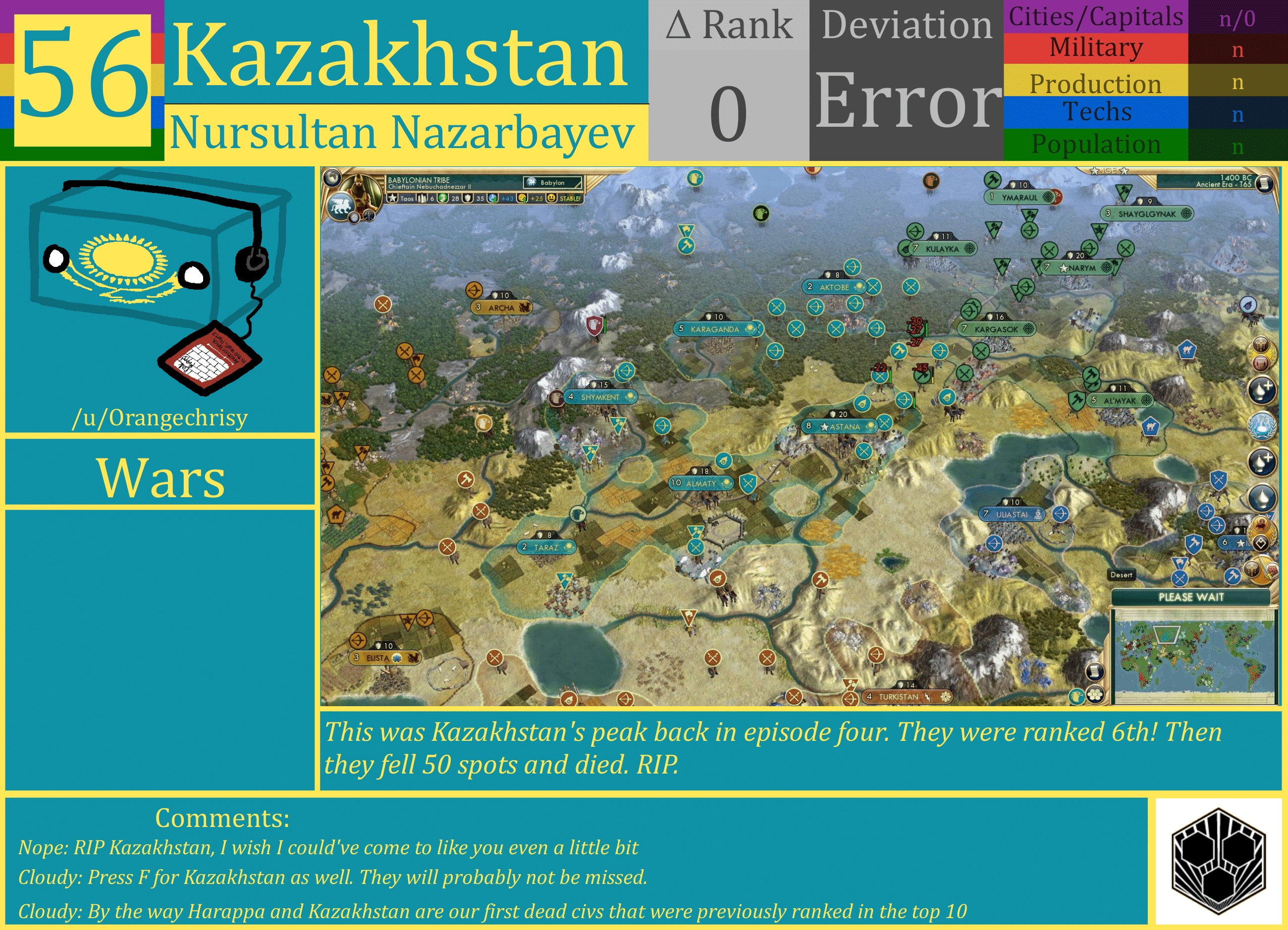
While Selkups were the anvil, Kazan was the hammer, mercilessly tearing apart the dying corpse of Kazakhstan, managing to take the lion’s share of cities. They eventually left Nursultan to rot in the worst position a civ can be left in, a single pointless arctic city, waiting to die. Luckily for Kazakhstan, Kazan, after consolidating the old Kazakh empire, was merciful and decided to finish what every civ in Asia started, killing off Kazakhstan on turn 286, in 56th place. RIP, you weird snakey strip.

CBR In-Game Screenshot of Crow

7: Crow

Rosay:

With Seneca being the biggest disappointment in North America, Crow’s was kinda overlooked, but make no mistake: Crow didn’t just drop the ball, they chucked that shit straight off the Empire State Building. Like seriously those two were destined to dominate North America, and now they’re just lucky they used to share a continent with Shawnee to make themselves look slightly less godawful in the post-battle royale stats, whenever that may be.

CBR In-Game Screenshot of Dai Viet

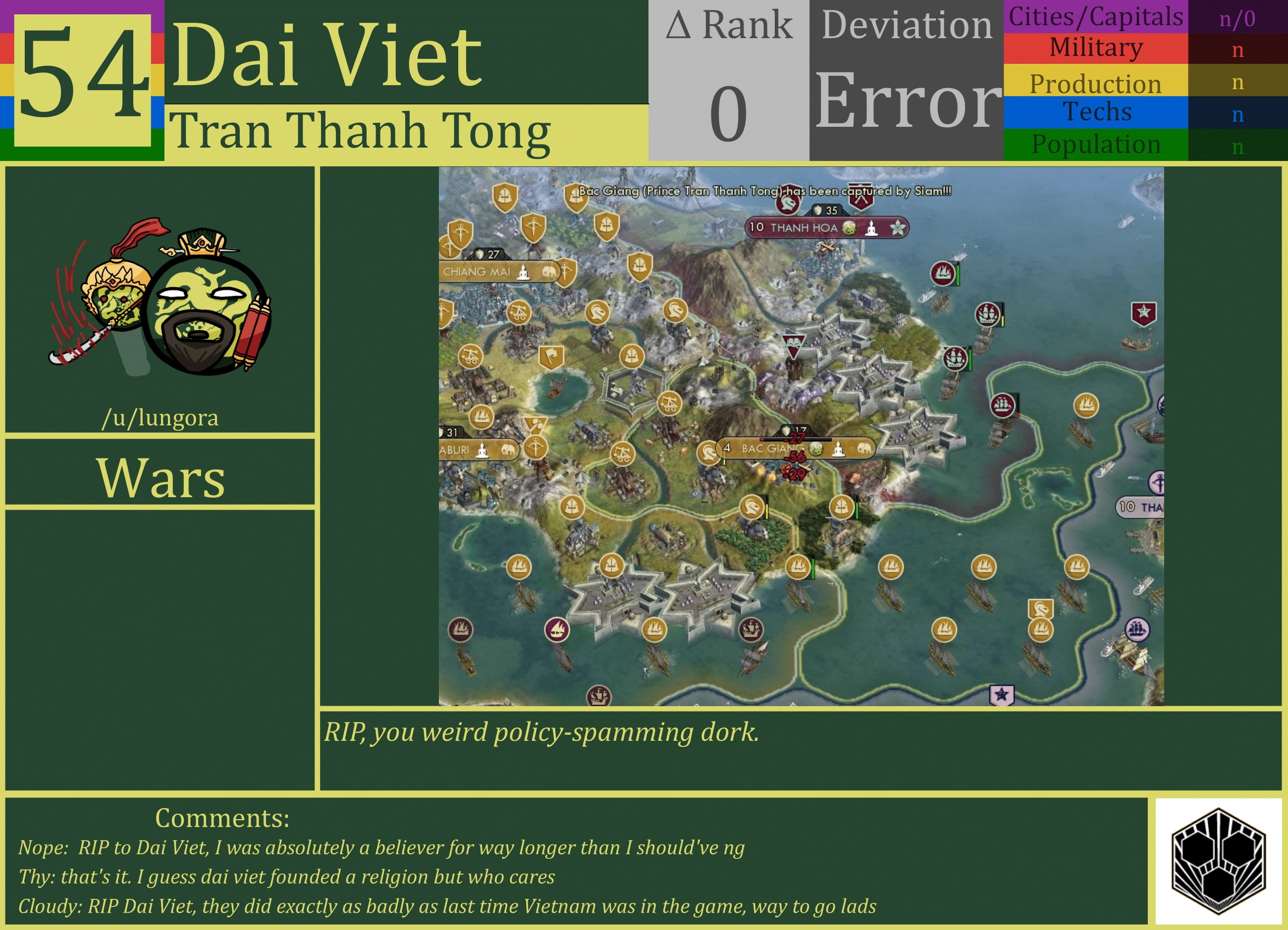
8: Dai Viet

Leman:

Dai Viet’s journey comes to an end at the hands of an opportunistic Siam, and not their eternal tormentor, Zheng. Dai Viet didn’t have an exciting journey, but it was an interesting one. They spent their time focusing on culture, first and foremost, stacking up dozens of social policies – in fact, on their death, Dai Viet had the fourth most social policies of any civ. But they did this at the expense of other aspects of their game such as city settling, which Dai Viet did okay at, and production, which Dai Viet did terribly at.

The problem with this whole strategy was twofold. First off, Dai Viet’s next-door neighbor, Siam, just did it better, combining their excellent culture with solid science and reasonable production and military. Second, this game is about conquering, not about culture. While Dai Viet didn’t exactly neglect its military building a surprising number of solid military wonders, they never were able to build a production base or get a technological edge to really play the game the way it needed to be played. So, when Zheng showed up with their advanced fleet of Frigates, Dai Viet and no way to put up a defense. In the course of two wars, Dai Viet dropped four of their seven cities to Zheng, lost another to Singapore, and gave another away to Khoshuts in a desperate attempt to stay alive, before finally being snuffed out by Siam.

Overall Dai Viet played a somewhat unique game, but not a very good one. So there ends another Vietnamese civ that failed to live up to the Trung Sister’s legacy. RIP.

CBR In-Game Screenshot of Florida

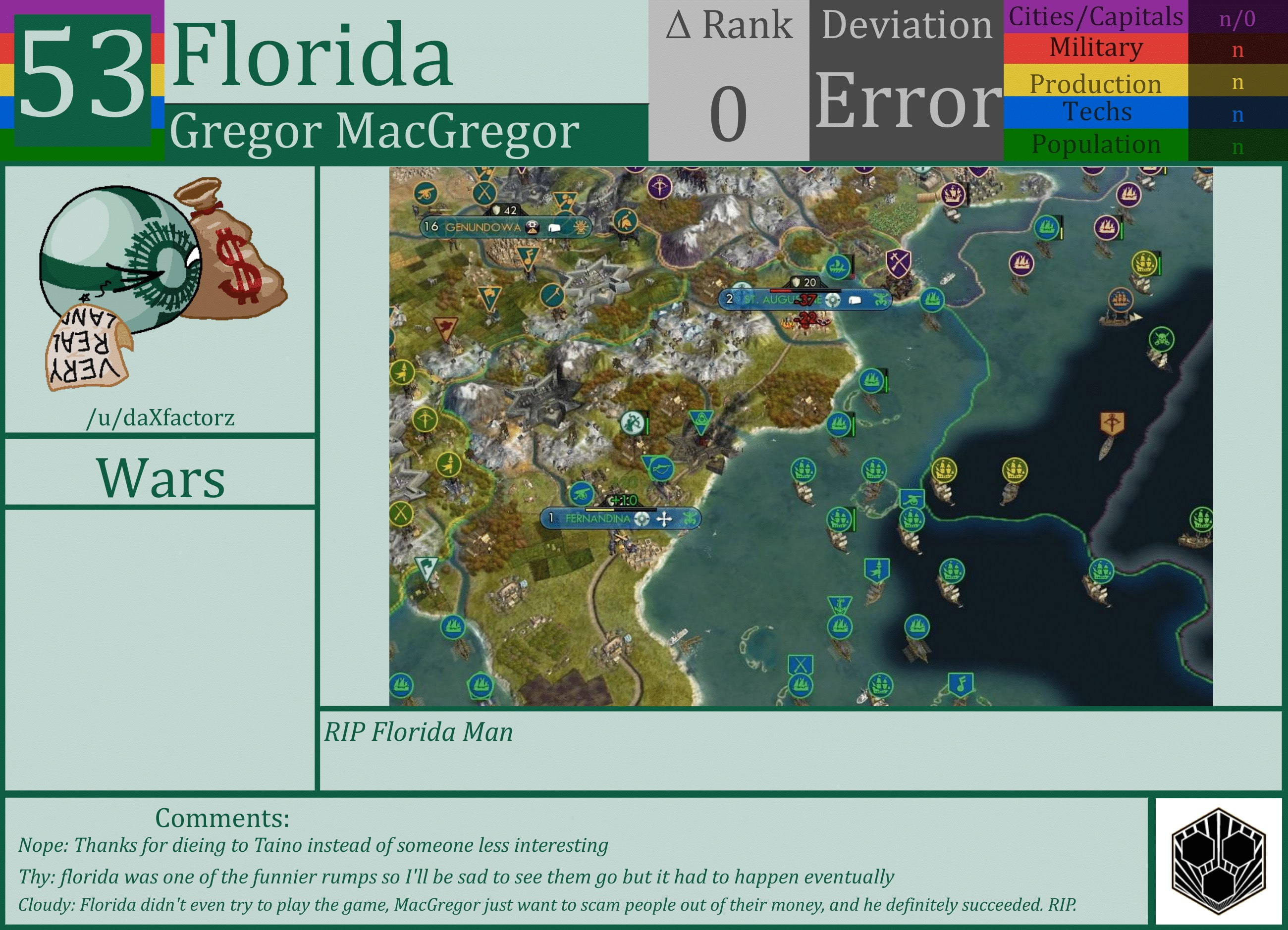
9: Florida

Leman:

Gonna be honest, you guys should have seen this coming. Florida was penned as awful from the moment it was voted in – a weak starting location, underpowered uniques, and a leader that failed to play the game properly. All this adds up to a civ that was mostly expected to be weak and completely lived up to that expectation.

Florida’s history included little more than the settling of no more than three cities. Those cities were picked off one by one, by Taino of all civs, until they were left with none.  Their highlight came when they gave a city to Osage, after a fairly good defense, only to watch it be captured and burned by Seneca, letting Florida cheekily resettle their city. Sounds like a scam MacGregor would pull. Too bad it wasn’t very good.

CBR In-Game Screenshot of Mamluks

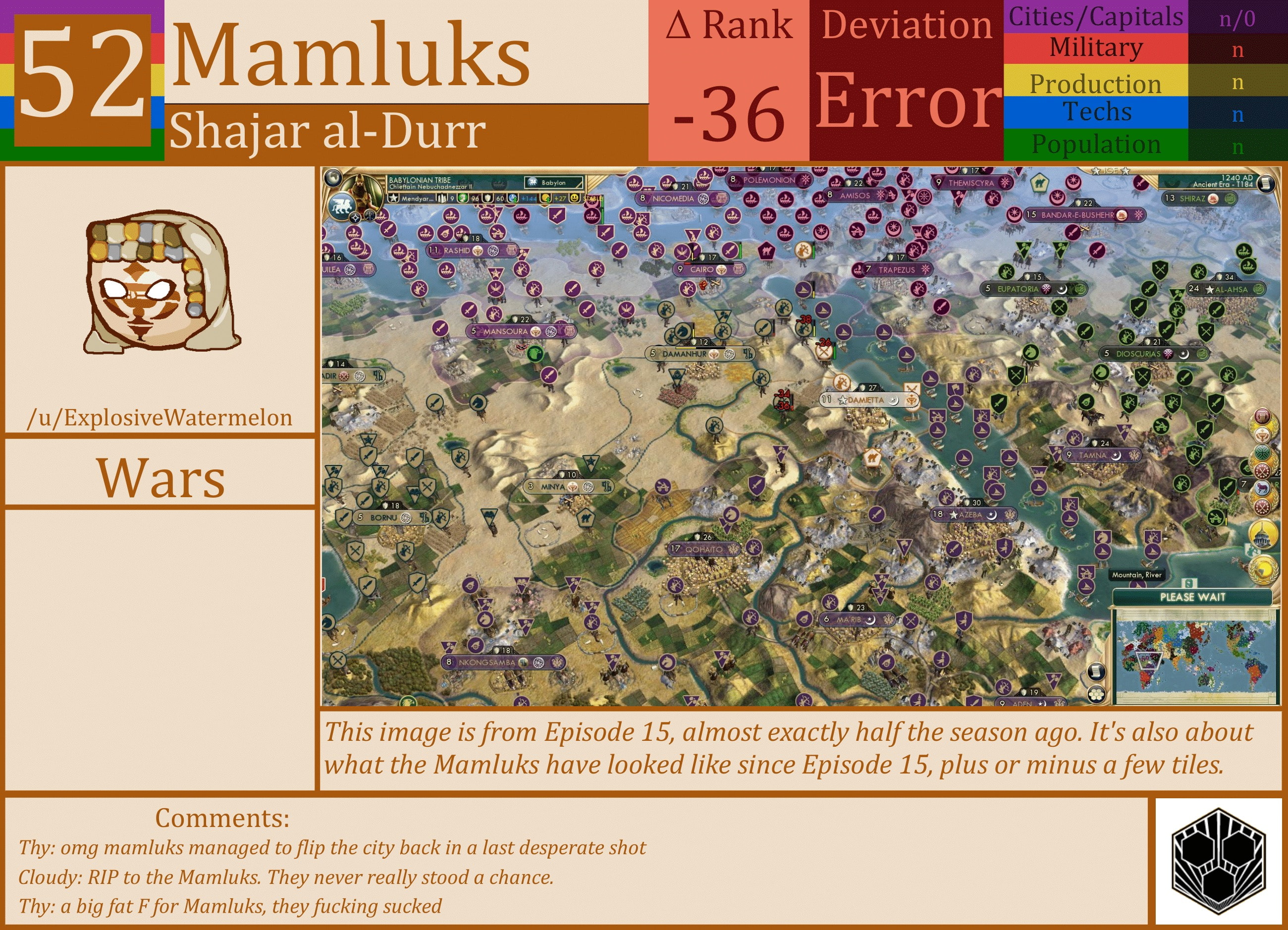
10: Mamluks

NopeCopter:

And so ends the tale of the Mamluks, another Nile civ slain tragically early. Unlike Egypt or the Ptolemies, though, the Mamluks… kind of earned their fate, if I’m being honest. Initially ranked around the middle of the pack, the Mamluks had some hopes pointed toward them despite their mediocre start for one simple reason: Saba-D’mt, often a fairly competent civ, had completely and utterly fumbled the opening turns. This was a perfect opportunity for them to expand and take an early lead, especially as they had forward-settled Saba-D’mt and had all the room in the world to themselves… but of course, they didn’t do that. The Mamluks refused to settle a single other city for around four more episodes as Saba-D’mt slowly recovered and their other neighbors slowly got scarier, to the point where the Mamluks were the ONLY civilization in the Episode 5 Popularity Poll to not get any support whatsoever. Eventually the Mamluks did begin settling again, but by this point they were already behind - their stats were weak, Saba-D’mt was having the glow-up of the century, and their new cities were mostly worthless desert. It seemed like a killer invasion from Saba-D’mt was inevitable, and on Episode 7, they were indeed invaded… but not by Saba-D’mt.

Of all civilizations, a trapped and battle-hungry Rome was the one to strike at the free food the Mamluks had become. The city of Rashid was an easy beachhead to take, but nobody expected the Romans to go much further until they actually carted their army across the Mediterranean and besieged Mansoura. The Mamluks just didn’t have the military to fight back. The Romans continued their attack toward the Mamluk core, taking Damanhur along the Nile River and threatening Cairo, and it all seemed over… but then the Romans began to run out of troops. The forces in Africa split between attacking the Nile and the worthless desert city of Minya, and they neglected to send reinforcements, giving the Mamluks enough time to build up a proper military and begin retaking their former cities. By the end of Episode 11, Rome had two units in Africa, and the Mamluk forces were ready to surround and retake Mansoura. Disappointing for the viewers, maybe, but the Mamluks were ready to reclaim their lost glory. And then Kanem-Bornu arrived.

The Mamluk forces failed to retake Mansoura, and their once again exhausted military was completely unprepared for a Kanembu invasion from across the Sahara. Minya fell easily, and before long the Romans finally sent reinforcements to finish the job, too. Kanem-Bornu secured Damanhur while Rome finally took Cairo, leaving the Mamluks with only the coastal city of Damietta. However, neither the Romans or Kanem-Bornu could actually maneuver through the difficult terrain around the city, and so the Mamluks were able to live on as a classic city-state rump state.

It was as a city-state that the Mamluks lived out the latter half of their existence, with Rome and Kanem-Bornu occasionally taking another crack at the city but always coming up short. They passed several other, more successful civs on the rankings just by virtue of not dying. It seemed clear that only an invasion from Saba-D’mt could finally put them down for good. However, after yet another failed assault on Damietta by Kanem-Bornu, the city was weakened just enough for a different civilization to finish the job: Pontus, another civilization that had become infamous for doing nothing. How fitting. And so the Mamluks were finally allowed to rest, freed from a prison of their own incompetence. May they find some other AI game to try and regain their honor in. F.

CBR In-Game Screenshot of Royal Hungary

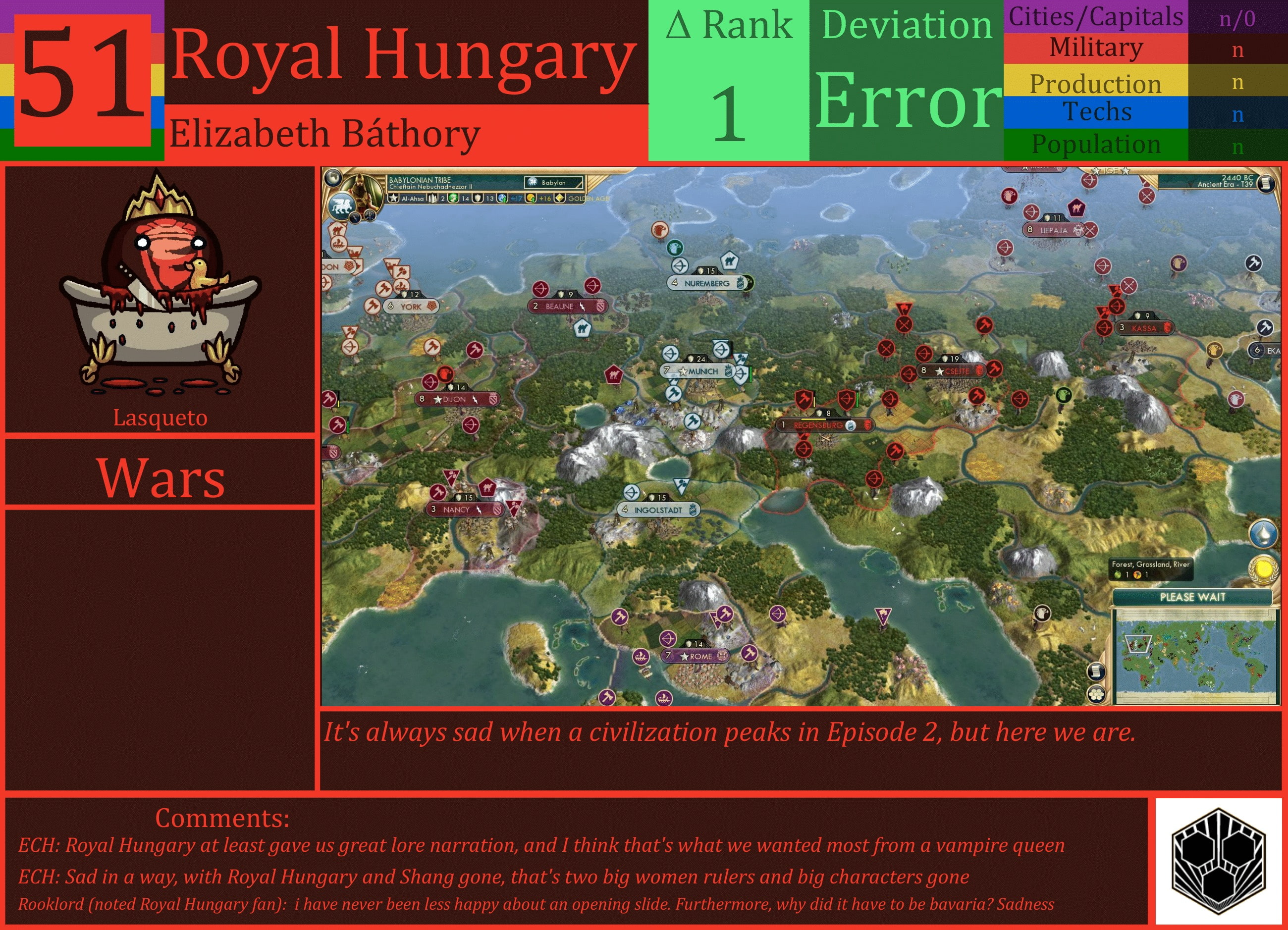
11: Royal Hungary

NopeCopter:

And so ends the tale of Royal Hungary, perhaps simultaneously the most and least gritty civ on the cylinder. Initially predicted to do… not so well, things already seemed to be turning against Royal Hungary when both Bavaria and Latvia hit the ground running - a rarity in test games. But everything changed when Royal Hungary pulled a staple of legendary civs: pouring all their production into military early on, and successfully taking an early city capture off an overly-expansive neighbor (in this case, Bavaria). The capture of Regensburg, coupled with a bit more settling, seemed to turn opinions around heavily on Royal Hungary, and this brought them to their all-time high Power Ranking of 19. This… unfortunately didn’t last, however, as Latvia grew much stronger much quicker than the starving and stagnant Royal Hungary. Their top-of-the-game military sat around with a well-fortified Bavaria eager to launch invasions in one direction, and a Latvia and Makhnovia they didn’t bother to exploit on the other. And then as if that wasn’t bad enough, they didn’t even bother to expand much further, allowing Pontus and Rome to settle most of the Balkans.

Things turned around slightly for Royal Hungary when they finally decided to take the empty and undefended Pontic forward-settle of Gaziura, but it took them so long that Latvia was able to take a city off of them in turn, putting a bit of a sour note on the whole affair. This also decisively trapped Royal Hungary, without a great direction to expand into. They didn’t really do anything for a good few episodes after this point until Makhnovia of all civs launched another invasion which eventually took Kassa, alongside a Roman siege that eventually took the coastal city of Gyor. At this point, the pattern was set of Royal Hungary fighting a bitter but ultimately fruitless war that cost them exactly one city, and so when Bavaria finally returned for revenge, it wasn’t  exactly a great sign. And indeed, before long, Bavaria had not only retaken Regensburg but even threatened the capital of Csjete, though that was turned around in a surprisingly effective defense and (eventual) counterattack.

Royal Hungary spent the last third of its existence as a two-city rump state trapped between mid-tier powers, hardly a satisfying existence. One more gutsy attack on Bavaria alongside Latvia failed to go anywhere, and then Royal Hungary finally ended their long, tiring, back-and-forth war with Bavaria by… giving up one of their two remaining cities. Agonizing. At least they ended a war with Latvia without losing anything. Thankfully for what little dignity Royal Hungary had left, Bavaria returned to finish the job not long after, and the stake was driven into the vampire’s heart after centuries of trying to stem the bleeding.

This ends the tale of Royal Hungary, a civilization with an eternally impressive military but not much else, always ranked near the bottom, struggling to survive as foreign powers took chunk after chunk out of their modest domain. It’s a shame it had to be this way. F.

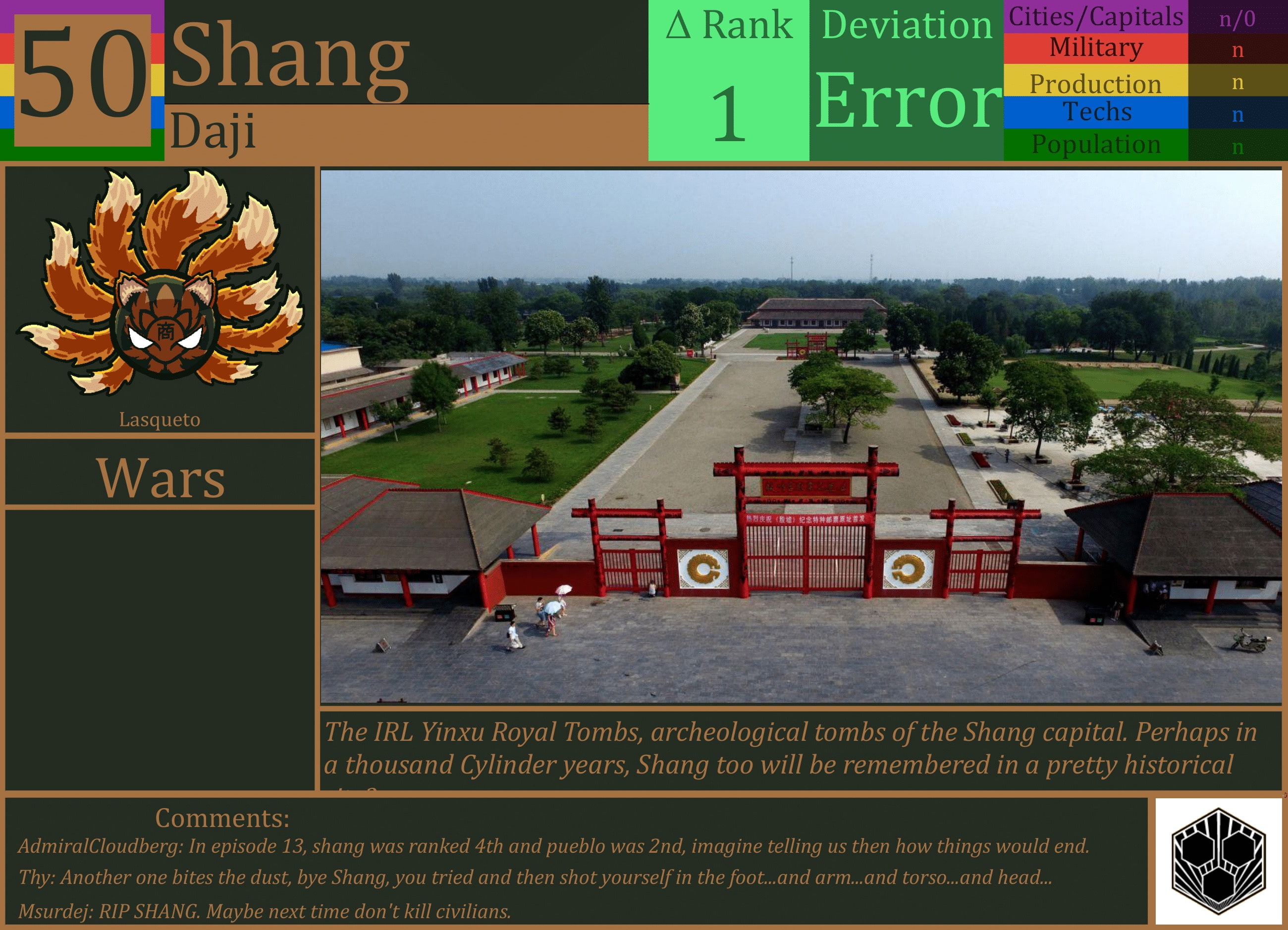
CBR In-Game Screenshot of Shang

12: Shang

ECH:

Shang will, as the annals of CBR history are written, go down as an entirely distinct competitor. Much in the same way so many mass murderers tend to be distinct, in Daji’s case. A distinct start, expected to flounder in the competitive environment of East Asia, only to pump out settlers and immediately jump from expectations of 47th in Episode 0 to 6th by the end of Episode 1. A distinct rise, taking that immediate early momentum and seemingly entirely validating it with more settles, stat growth, and some of the first successful warring of the game against their Mongol neighbors, earning them the rank of 1st in Episode 2 and 3, and staying put in the top 10 for 11 more episodes after. A distinct martial prowess, taking advantage of their early spearman UU to fill a good carpet and keep their threat level high.

A distinct fall, as first a coalition between rising star Goguryeo and continual sidekick Ikko Ikki toppled Shang’s assumed supremacy of the region, and then, most dramatically, their Unique Ability became a tool of national deterioration as Daji elected to not just murder her city pops for luxuries, but to do it to an extent that we began noting cities in anarchy for dozens, then later 50+, turns, crippling her civ in a way I cannot think I’ve seen before from a major player. A distinctly uncertain stagnation, as Shang dropped from 4th to 17th to 32nd from Episode 13 to 15, before become a floating civ between the low 30’s and high 40’s, their unique situation leaving PRs uncertain of their future capabilities and liable to oddly large swings for a civ doing literally nothing. And finally a distinct finale, as for the briefest of moments it appeared like Daji was making a sincere comeback, outdated but showing the same vigour of her 1st-place days, before all the murder and wine! A good old invasion of battered Mongolia, what could g- Oh, Goguryeo’s declared war? Oh, they’re about this? Oh, Goguryeo really is multiple eras ahead of her forces. Oh, Goguryeo has planes. Oh, Shang’s dead. From 39th in E20 to 27th in E25 to dead at 50th in E30, what a distinct final stretch of life. Godspeed, you bloodthirst fox spirit.

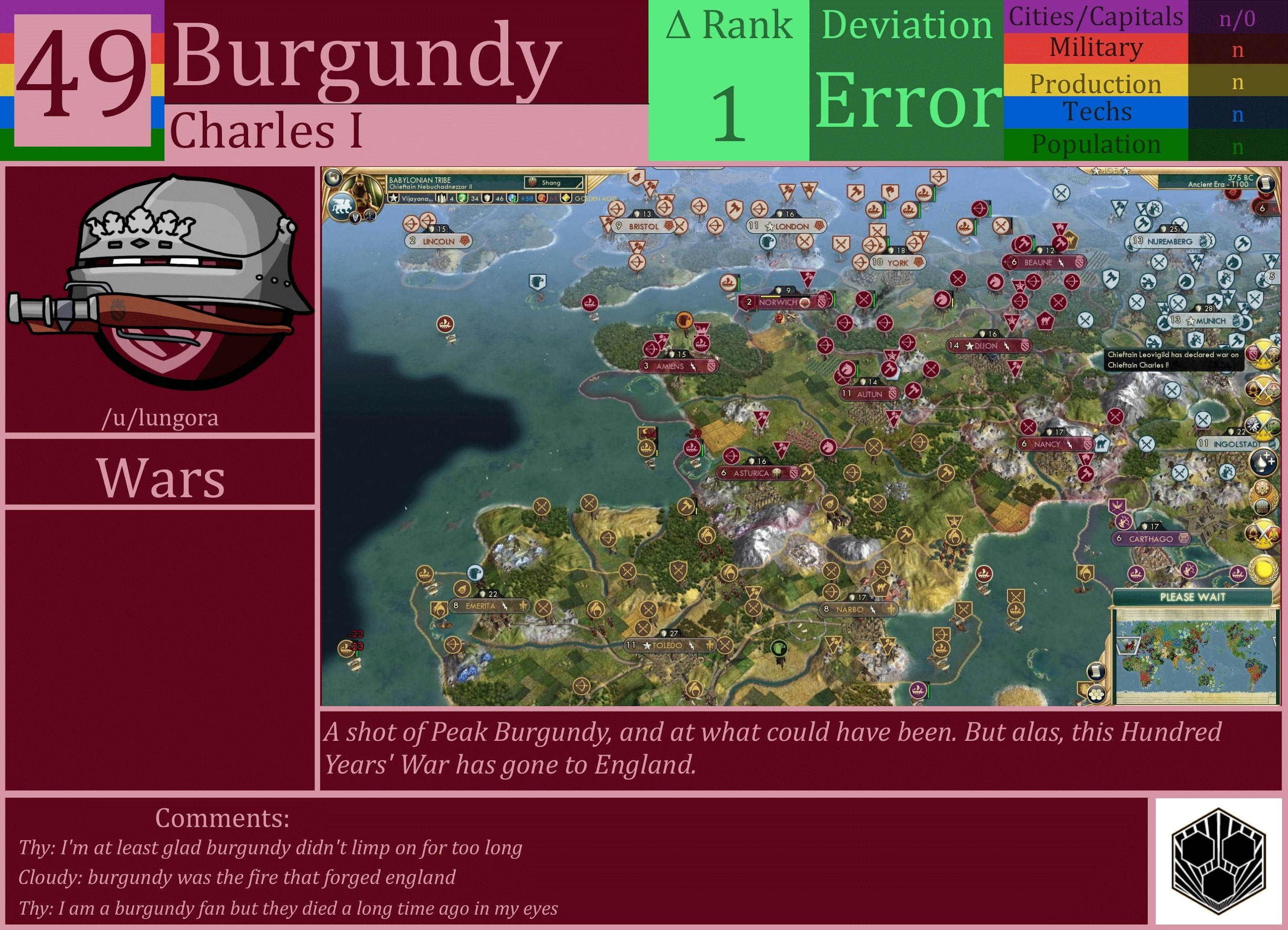
CBR In-Game Screenshot of Burgundy

13: Burgundy

NopeCopter:

Burgundy was a civ defined by struggle, a constant need to fight for their survival in one of the most brutal regions on the cylinder. After a brief period of Bavarian dominance in Episode 1, Burgundy’s quick settling and defense against an early Visigothic invasion earned them some early favor in the region. This would be followed by a full-on invasion from Bavaria, which allowed Burgundy to capture the recently gifted city of Asturica (a city that would soon become infamous) and cement themselves as the top dogs of Western Europe by decisively rebuffing the Bavarian assault. These two wars set the tone for Burgundy’s game - constant invasions from all directions by slightly weaker neighbors that Burgundy was always able to fight off… at least for a while. They settled their way to the largest empire in the area, and things seemed to be looking good. And they seemed to be looking even better when, after a brief period of peace, England invaded with a woefully unprepared mainland force that left their precious two mainland cities ripe for the taking. Burgundy was going to the top (or at least the middle of the pack, which for Western Europe might as well be the top).

…But then the war turned into an unexpected meatgrinder, and both the Visigoths and the terrifying Faroes launched invasions of Burgundy (both of which seemed scary at the time). Burgundy struggled to get out of the war with England to focus on these new threats, and by the time the dust settled, England happened to be in control of both of their mainland holdings. It was a rough and frankly kind of embarrassing end to the war, but hey, they could always come back to take the cities off England once they were in a better position. Surely this failure wouldn’t have any major consequences down the line for them. In any case, the Visigoths and Faroes both turned out to be completely incompetent, and Burgundy finally got some much needed peace.

This peace lasted for all of three episodes or so, until suddenly Burgundy was faced with a joint invasion by all three of their major neighbors, clearly hoping to make up for their past failures by using strength in numbers. This boss rush of a coalition was spearheaded by Bavaria, who quickly captured the city of Beaune as the British navy sacked Amiens and the Visigoths tried yet again to retake Asturica. Burgundy held strong for a while (and even managed peace with Bavaria), but England eventually captured Amiens and seemed poised to capture Asturica as well… before an untimely peace deal left the Visigoths on their own. Asturica was saved and Burgundy seemed to have made it out of the war battered but alive. And then Bavaria came back. Granted, this war didn’t go anywhere, but it did drain Burgundy’s reserves even more, which was bad considering the Visigoths were also still at the gates, and England was recovering quite nicely. (Oh, and Rome took their backup Sahara colony of Nevers, which meant that now they HAD to hold in Europe if they wanted to stay in the game.)

Unfortunately for Burgundy, while they did eventually fend off Bavaria once more, they just couldn’t stay at peace with even one of their neighbors for long, and the worst-case scenario occurred: England, armed with both of their uniques, invaded. The war was long and bloody, but England’s better military tech and production-sapping abilities prevailed, and Burgundy lost Autun and Asturica in the war. A brief period of peace was followed by another war where Burgundy seemed to maybe have a chance at an underdog victory as they retook Autun from an overextended and exhausted England, but the war quickly turned against them as it went on, and the capital of Dijon fell. Burgundy was left as a one-city rump for just long enough to maximize the sting before a third and final English invasion finally put Burgundy out of their misery.

How might Burgundy’s run have gone if they had just taken those English footholds early on? Heck, if they’d taken just one of them? Or if they’d been able to keep just one of their borders peaceful? It’s hard to say. Burgundy’s neighbors were all quite militarized, so expansion would have been difficult - they probably wouldn’t have been a top power. But perhaps their impressive grit and determination wouldn’t have been worn down quite so quickly, either. Unfortunately, sometimes competent civilizations just get unlucky and die before their time. I’d say Burgundy is one of those civilizations. May they have better luck some other time. F.

CBR In-Game Screenshot of Pueblo

14: Pueblo

Orange:

I had been a fan of Pueblo from the start, I’m obligated to be given they’re an indigenous civ in the southwest US, just how it is. But they really are a cool civ. The UA has an absolutely kick-ass name, Gods of the Rotten Wood, and it makes their units better at sieging for each religious building in the city they’re attacking. They combined this with a religion that has two religious buildings, which IIRC gives them a +10% or +20% siege bonus, and they spread this religion throughout North America, dominating the continent with Kachina. They further pushed their dominance by settling a ton and putting themselves on top of the statistics early on. They got to 4th in part 2, and stayed in the top 4 through part 18.

Despite the power they had, Pueblo could never make good on what they presented. Their initial war with Osage was, fine, I guess, but nothing ever followed it up. Osage was a sitting duck and Pueblo just, stopped. This stagnation went deep, they failed to do anything while they had the lead and things only began to change when the Yellowknives attacked. While YK only grabbed two hard to defend blocked off cities, this triggered the end for Pueblo. From there, it was just a slow fall. Continued failing to attack Osage while Osage slowly grew, stagnating in the stats letting others overtake them, losing Hawaii to Goguryeo, Yellowknives showing themselves as the strongest power in North America, and even Mexico showing that Pueblo was attackable from not another top power. A stumble, trip, and fall deep down to the bottom.

So here is where they lay, 48th. A brutal shame for a civ with so much potential. But this is what happens when you refuse to grow, when you refuse to take the opportunities given to you. You gotta want it more in this game, and Pueblo just didn’t want anything.

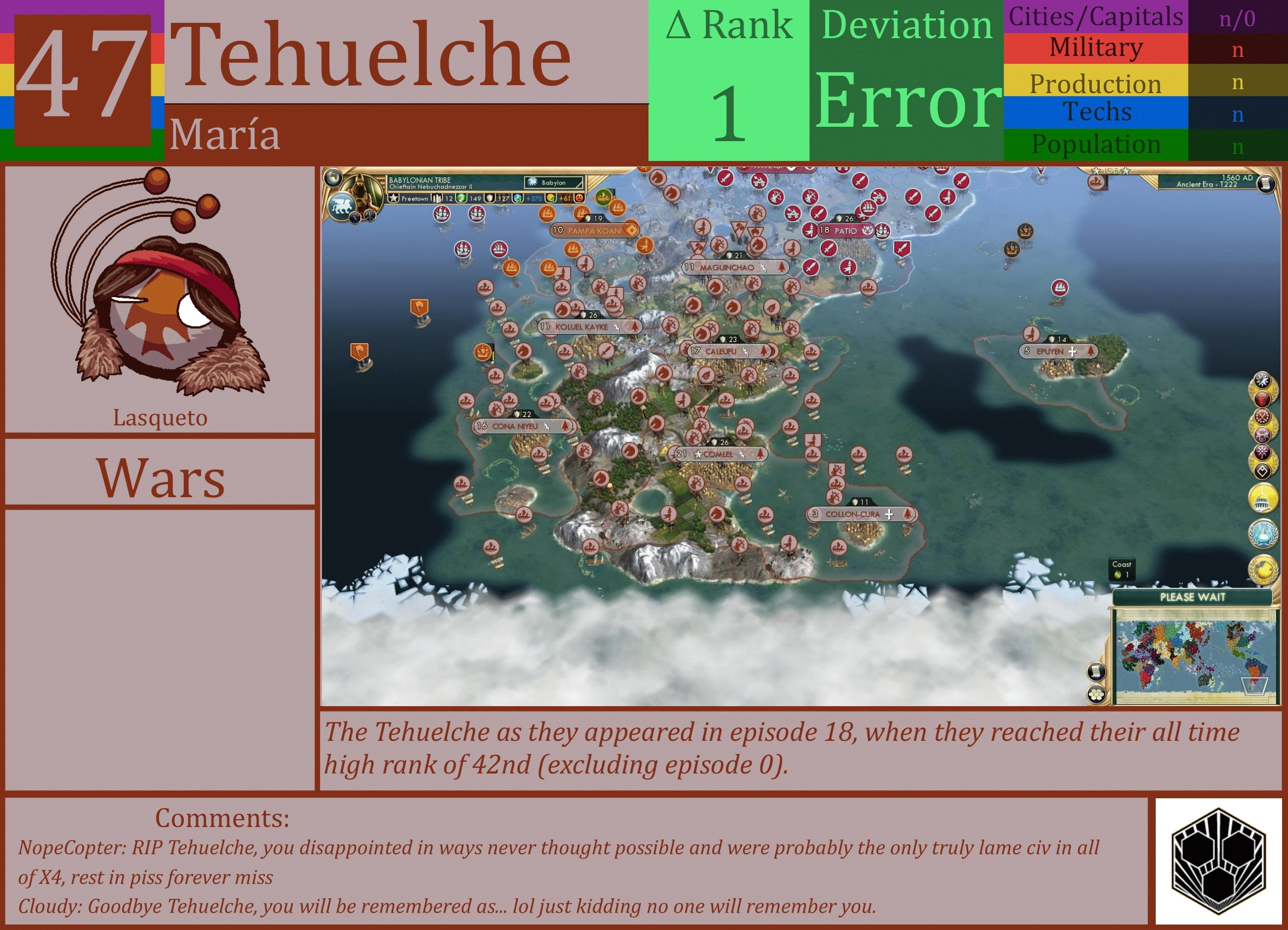
CBR In-Game Screenshot of Tehuelche

15: Tehuelche

Cloudy:

The fires of Tierra del Fuego have at last gone out.

The Tehuelche were in a challenging spot from the beginning. Although they had a relatively large amount of room to expand, their tundra starting location significantly inhibited their early growth, and some of the best lands they could have claimed ended up being settled by Bora-Bora. Tehuelche was quickly left behind in the stats and never caught up. Although they did participate in wars with Rio Grande, resulting in their occupation of several islands in the South Atlantic, these islands were later lost to New Holland without much of a fight. They also gave up a city to Mexico in a peace treaty, which was razed. Later on, Pacific civs began to gnaw at their west coast, and Tiwanaku pressed them from the north. An island city was lost to Palawa, then to Bora-Bora. By episode 30, Bora-Bora surrounded them on three sides, with a tech difference amounting to several eras. It was speculated that if Bora-Bora declared war, Tehuelche would be swiftly eliminated. Those predictions turned out to be correct, as all that remained of Maria’s modest empire was consumed in less than 10 turns. A fitting end for a civ that never really got off the ground in the first place.

CBR In-Game Screenshot of Alaouites

16: Alaouites

Cloudy:

The Alaouites started off relatively strong. Throughout the first several episodes, they were top 10 in military strength and sometimes production, and by episode 4 they had 6 cities, the same amount as Latvia, the Yellowknives, Ndongo, and Sierra Leone. Unfortunately, their path didn’t take them to the same place as those civs. In fact, for a while it looked like the Alaouites might have the advantage in a hypothetical battle for control of West Africa. But instead of using the huge army they had lurking in the Sahara, the Alaouites did nothing as their desert cities stagnated at low population counts and their neighbors started to overtake them. In episode 5, they were ranked 18th; but by episode 8, they were in the 40s. That’s because in episode 8 they finally declared war on Sierra Leone, only to fail to capture any cities. The Alaouites turned out to be terrible at war and didn’t know how to use melee units. Their city populations were still stagnating. By episode 10, they had lost three cities to various neighbors, and the writing was on the wall. Nevertheless, it took several long, excruciating wars for the Alaouites to finally die, as Sierra Leone painstakingly clawed off a city here and there with great difficulty. By the time they finally died, their peak was but a distant memory.

RIP Ismail ibn Sharif. He is survived by his 500 wives and 868 children.

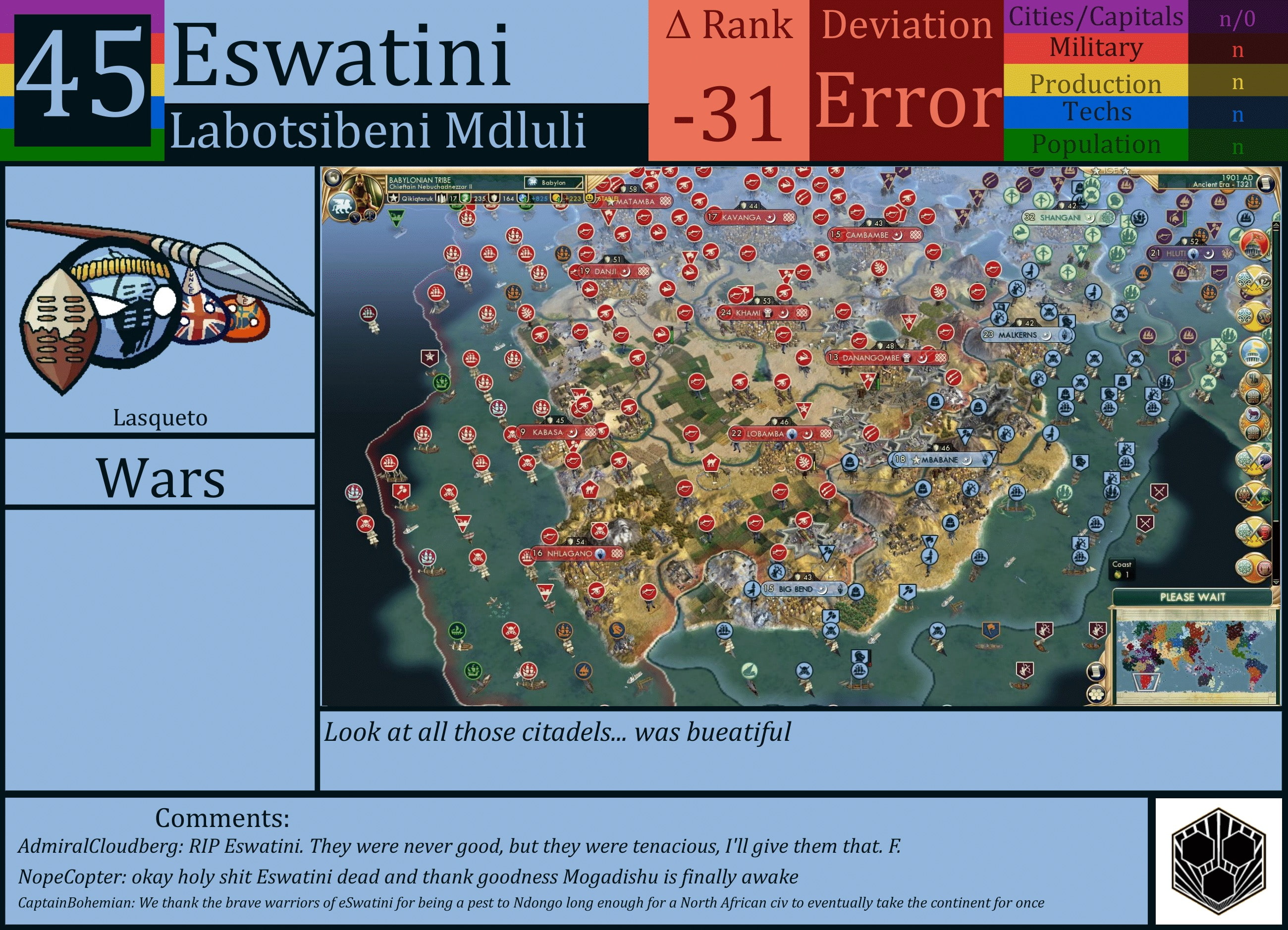
CBR In-Game Screenshot of Eswatini

17: Eswatini

Nathanmasse:

It wasn’t an easy game for Eswatini.  Trapped in southern Africa with Rozvi breathing down their neck, they tried to stake an early claim to a city inland from the coast but Rozvi would have none of it.  The city was quickly captured—in fact, one of the three first captures on turn 35—but in doing so, Rozvi was so weakened they could not stand up to their own invasion by Ndongo.  With access to the north cut off, Eswatini had little choice but to expand along the coast but this too was stymied by a war with Ndongo who—through either skillful or inept diplomacy, depending who you ask—received the city of Malkerns in the peace deal.  This was surely Eswatini’s lowest point and could have been the beginning of the end for them.

But they did not give up hope.  A fierce battle was waged in an attempt to retake the lost city of Lobamba from the Rozvi with little success.  Perhaps sensing that further inland expansion was off the table, Eswatini took to the sea and settled Madagascar and other small islands in the Indian Ocean which would become their final haven once the mainland fell.

These colonies needed to be defended and soon their navy would be the pride of Eswatini’s empire.  They struck north, briefly holding the Qarmatian colony of Safwan; consolidated in the east by taking another small Qarmatian colony; and even managed to retake Malkerns while fending off Ndongo’s main invasion from the west.  

Perhaps the most iconic legacy of Eswatini’s rivalry with first Rozvi and then Ndongo, was the intense fortifications built along their shared border.  No less than nine citadels dot the countryside and whose interlocking fields of fire kept Eswatini’s homeland secure for centuries.  

But alas, Eswatini always struggled with slow tech progression and outdated units which ultimately lead to their demise. The Part 0 Power Rankers were near enough correct when they said, “Outliving Rozvi would be only slightly impressive, as Eswatini’s own downfall would likely follow soon”.  Outnumbered, Eswatini fought bravely but lost their capital to Ndongo, and soon after were set upon by Saba D’mt which took their last mainland city.  Finally, Mogadishu also determined that Eswatini was not long for this world and quickly seized what remained of Eswatini’s island colonies.

And so, Eswatini passes into history with the final rank of 45th.  Not all that bad considering their stumbles and blunders in the early game, and honestly ahead of several civs I would have expected to outlast them.

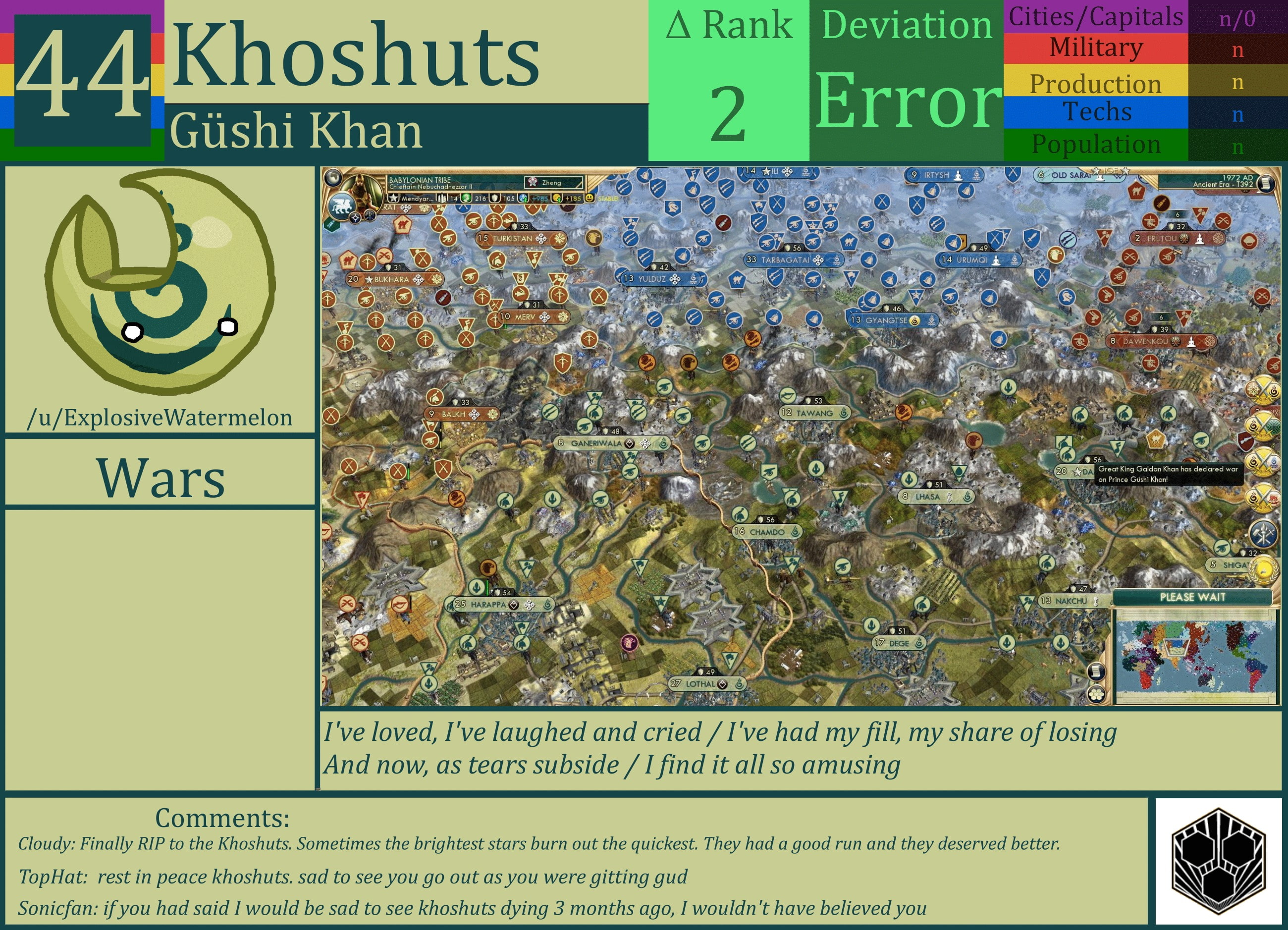
CBR In-Game Screenshot of Khoshuts

18: Khoshuts

NopeCopter:

And so ends the tale of the Khoshuts, and what an absolute ride it was. Initially voted in as a part of the Oirat trio alongside the Kalmyks and Dzungars, the Khoshuts actually got off to a solid start as they settled a large area relatively quickly… only for people to realize that they were completely ignoring the fertile land along the Ganges in favor of settling more fairly worthless Himalayan cities. This allowed Siam of all civs to secure the Ganges delta, and Harappa managed to gobble up a fair bit of land as well before the Khoshuts finally got the memo and started placing cities in places that actually had Food potential. Regardless of their odd settling habits, things were still looking fairly positive for the Khoshuts, and they were placed firmly around the top third… until the fateful war with their brothers the Dzungars. The more prepared Dzungar military easily took the undefended city of Gyangtse, but the real killer came in the peace deal, where the Khoshuts unceremoniously handed over the city of Lhasa - their second city, located right in the middle of their empire - for no reason whatsoever.

Obviously, this instantly turned all the hope for the Khoshuts into ridicule and frustration, and the Khoshuts sure didn’t seem eager to redeem themselves as they only launched a few token invasions of their more relevant neighbors, to no effect whatsoever. Even getting dragged into a three-way war with Siam and Dai Viet couldn’t make them remotely interesting as they aggressively failed to take the undefended Siamese city of Nakhon Ratchasima. They did almost kind of threaten to take a city off the Shang, but they followed this up with ANOTHER city gift, this time to Siam, so before long they had quickly become the biggest joke on the cylinder. An incompetent, ineffectual civ that seemed to actively WANT to lose, only kept safe by their position in the Himalayas (a position which became less effective with each city given away).

But then… then things began to change. The first sign was a city gift, not from the Khoshuts, but TO the Khoshuts, from Dai VIet - only for Dai Viet to immediately declare war on Siam to try and take Nakhon Ratchasima, kickstarting a Holy War that immediately put them back at war with Dai Viet. In essence, a free city for no actual peace. This did result in Siam just capturing the city gift for themselves, and the second Khoshut assault on Nakhon Ratchasima failed just as the first did, but it served as a hint that maybe, just maybe, the Khoshuts had something more going on behind that incompetent facade. The Khoshuts went silent for an episode after this, giving the sense that maybe their insane gambit was just a fluke, only to suddenly show their hand all at once in Episode 22. The Afsharids declared war on a weakened Harappa, seemingly poised to wipe them off the map, and the Khoshuts joined the fight as well - not something that seemed particularly relevant, given their prior war record.

Over the course of the next episode and a half, the Khoshuts proceeded to take and hold all four Harappan cities.

This was absolutely unprecedented, for such a minor power to effectively double their size by sniping an ENTIRE EMPIRE during a coalition war, and it instantly put the Khoshuts back on the map both figuratively and literally. The most insane part of the whole situation, however, was that it was only the beginning. Vijayanagara attempted to take the new Khoshut gains for themselves while they were vulnerable, but despite their tech advantage they were completely stalled out. Then, after a short reprieve, the Khoshuts were suddenly faced with a three-way coalition of the Afsharids, Dzungars, and Bukhara… which actually resulted in a net GAIN of one city as they not only held their borders but finally retook Lhasa from the Dzungars after so many turns of humiliation. This was followed up with yet another declaration of war against Siam, and unlike the previous ineffective stalemates, this time the Khoshuts were able to swoop in and quickly take not only Nakhon Ratchasima but also their OTHER gifted city of Shigatse. Granted, Siam was in the middle of being eviscerated by the Wahgi right after being torn up by Singapore, but this was still an efficient and effective war - the narrator of the episode even noted that the Khoshuts really could have gone further. Against all odds, Gushi Khan had done it: he had regained his honor and taken his empire from a laughing-stock to a fan favorite.

Unfortunately, no sooner had the Khoshuts regained their honor than their enemies finally decided to wipe them off the map for good. The Afsharids and Dzungars invaded once more, and this time, the Afsharids in particular were ready. It was a brutal lightning campaign, ignoring both the Great Wall and the mountainous defenses of the Khoshuts through excellent use of the Afshairds’ highly mobile units and brand-new air force. By the end of Episode 32, the Khoshuts had lost not only all of the former Harappan cities they’d taken from under the Afsharids’ noses, but they were poised to lose their hard-fought recapture of Lhasa, as well. They plummeted 16 spots in the Power Rankings. They were still placed above five other civilizations. By the end of the next episode, they were dead in 44th - before any of the critically-endangered rump states beneath them. It was a shocking display of the Afsharids’ efficiency, and a tragically sudden end to a civilization people had only just come to love.

At some point during this season, rotting away in the Himalayas amidst a sea of their own failures, the Khoshuts were given a choice: to continue to dimly smolder away in the mountains as just another ineffective mountain turtle, or to risk it all, veer straight off the road they’d been placed on, and burn so bright that nobody could possibly ignore them. The Khoshuts, thankfully for all of us, chose the latter. But the brightest flames burn out the quickest, and the Khoshuts were too good to stay with us for long. Do not fret. This was the choice they made. The reckless play of the Khoshuts in their final few episodes led to their early demise, but in exchange they gained a different sort of immortality that only a lucky few ever obtain in the CBR - a run no other civilization could ever replicate, a character arc that made them feel almost human, a piece of CBR lore to stand alongside the likes of Laos and Castile. The Khoshuts are the first Oirats to leave this mortal coil, but as the Kalmyks sit on two cities pecked away by Citadels and the Dzungars rot in their own mediocrity, they will surely be the last to leave our memory. F.

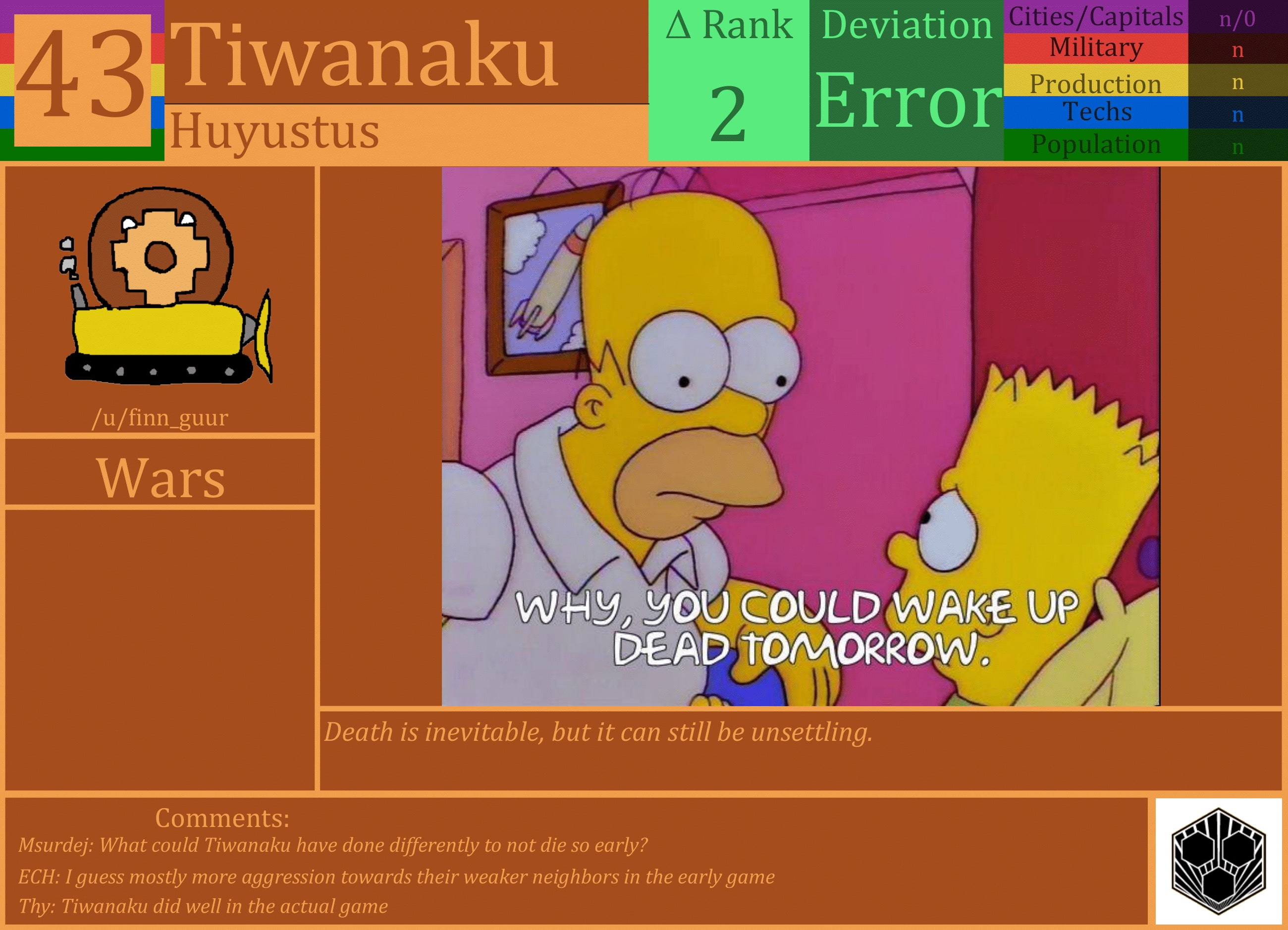
CBR In-Game Screenshot of Tiwanaku

19: Tiwanaku

Msurdej:

It's strange to think about death. Sometimes death comes slowly, others quite rapidly. I had two deaths occur in my life the week before Thanksgiving: one that I had been expecting for some time, one that was a sudden shock. Both were losses, and I will miss them.

In the CivBattleRoyale, we've had a lot of deaths recently. The last five parts (30-34), we've had more deaths than in the previous 29 parts. One of these deaths was Tiwanaku, a upset for what was once a top player. It took a bit of struggle, but by the end of part three, they had five cities, and three episodes later, they were in the top 5. But a coalition in episode 14 made them start to falter, leading into a downward spiral they never truly recovered from. Bora-Bora, New Holland, even Ecuador all took a piece of Hyustus's empire, leaving him trapped in the mountains until his death this episode. The star rose too high, and was ultimately unable to survive the haters. Rest in Peace Tiwanaku, you will be missed.F

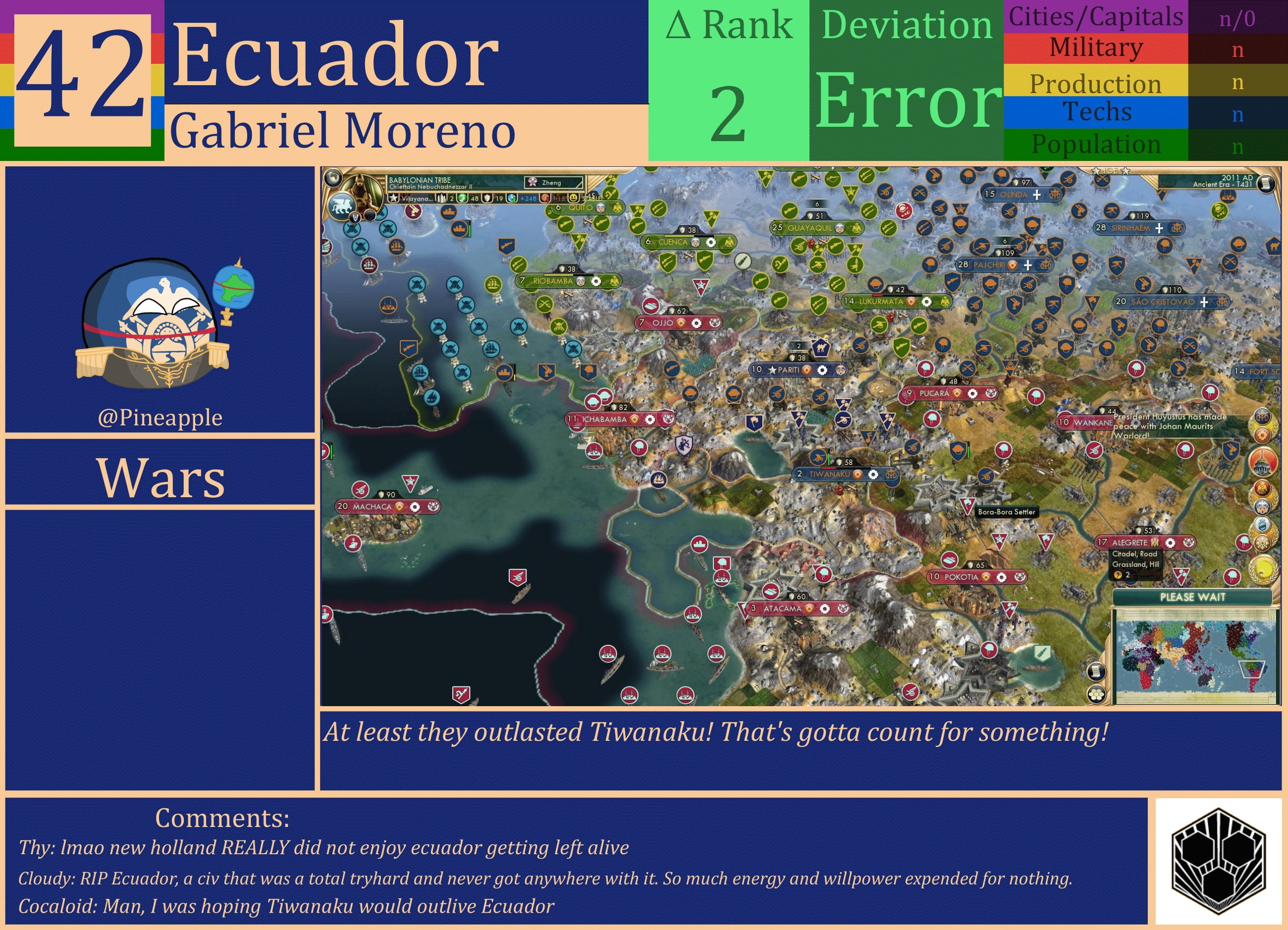
CBR In-Game Screenshot of Ecuador

20: Ecuador

NopeCopter:

After a brutal war with Mexico, Ecuador finally falls at the hands of New Holland, making them the second-placers of their continent by a margin of only a few turns. Ecuador was a strange civ, one defined by shockingly consistent mediocrity. It was an impressive sort of mediocrity, honestly - not born through a lack of trying, but rather of simply trying and failing at everything, while everything tried on them failed right back. A black hole of coolness. They were never outright bad, never so shit that they could really be counted out, but also never so good that people felt like they had a chance. Maintaining such a delicate balancing act all the way to the grave is legitimately impressive, and I think that deserves some respect.

Initially ranked near the middle of the pack in 36th, Ecuador got off to a fairly quiet start, settling a good few cities and locking down the northwest of their continent as best they could. They locked the Taino out of South America, and then fended off an invasion from top-5 power New Holland without much issue, the first thing that really turned some heads in their direction. They did allow Mexico to settle a small colony on the Venezuelan coast in the process (despite the two civs also being at war), but surely that wouldn’t ever be relevant, right?

By this point, Ecuador had cemented itself as, if not a likely winner on a continent with two other powerhouses, at the very least a stubborn civilization - the third wheel in the power struggle between New Holland and Tiwanaku, and one that was likely to stick around for some time even if they were never going to rule the continent. They momentarily dropped like a rock in the Power Rankings as the coalition against Rio Grande made their already terrifying neighbors even more powerful, only to rise right back up to the mid-20s as several other civs collapsed and their stats started to look really good for a mid-tier power - the story of Ecuador in a nutshell, really. They proceeded to have a few quiet episodes as South America as a whole focused on mauling Rio Grande and then going back to sleep. But Ecuador wasn’t merely sleeping - they were building up an army. And when their forces were sufficient, they turned on the sleepy, Worker-filled Tiwanaku in a move that genuinely seemed like it could result in an upset on the continent.

It was then that everyone would discover the true depths of Ecuador’s greatest flaw: their military incompetence. Sure, they’d failed to take Mexico’s colony, but there was some tricky terrain to navigate there. With their terrible target prioritization, weak unit composition, and general lack of war skills, they managed to fumble the war with Tiwanaku so hard that they barely even damaged any cities by the end of the second episode of war. They did eventually manage to slightly get their act together and flip Lukurmata… only to lose it and immediately sign peace despite Tiwanaku being stretched impossibly thin and at war with two other powerful civilizations. This, frankly, may have been the biggest fumble of a war in the entire game up to this point. They tried to recover by invading Mexico instead, but that war was even more pathetic, and ended in Ecuador just straight-up handing over the Galapagos to Mexico in the peace deal for no reason. While this was happening, New Holland was invading Tiwanaku again. Ecuador took a few episodes to quietly sulk in the corner before finally deciding to try invading Tiwanaku again (by which point they had already turned the tables on New Holland), and this time they looked even more prepared to run over Tiwanaku… with Muskets and Cannons, and even Bora-Bora for support surely they couldn’t fuck this one up.

Amazingly, Ecuador DID manage to not fuck up the war… at least, at first. Lukurmata fells with no issue, and both Pariti and Pucara were taking heavy damage by the end of Episode 27, although Tiwanaku reinforcements kept the cities safe for the moment. But then, Ecuador just… failed to actually take anything else. Their forces split up, stalled, and generally refused to actually take any more cities while Bora-Bora tore through Tiwanaku’s southern holdings. They eventually did manage to capture Pariti, but Bora-Bora got EVERYTHING else, save for Tiwanaku’s capital (which Ecuador subsequently tried and failed to take for themselves). In what was effectively a perfect scenario for Ecuador, they managed to come out of the total collapse of their southern neighbor - largely at their own hand, no less - with a gain of two cities.

As if the humiliation of another botched war wasn’t enough, Ecuador hardly had time to recover or even breathe before suddenly being faced with another war against Mexico. Of course, given the history of not just the conflicts between the two but also of the region throughout all of CBR history, nobody expected the war to go anywhere. But then, somehow, Mexico locked in. Using their tiny beachhead colony, some Caribbean islands, and the Galapagos as beachheads, they managed to move in not one but two entire land armies into Ecuadorian lands, conquering a sizable chunk of Ecuador’s empire (which, again, was almost entirely inland and situated across perhaps the most awkward land border on the map) even despite an influx of New Holland peacekeepers. And then they just. Kept. Going. By the end of Episode 33, Mexico had somehow pushed Ecuador all the way down to their hard-earned capture of Pariti, and while they didn’t elect to finish the job, New Holland was certainly happy to finally earn some payback for the humiliation they’d endured some 30 episodes prior. Ecuador’s final city was crushed without hesitation, just five turns after New Holland did the exact same to Tiwanaku’s final city - the one that Ecuador just could not take.

While recounting their history like this might make them sound terrible, it’s worth noting that they did spend nearly their entire run in the 20-30 range of the ranks. Until being reduced to a city-state, they never rose above 24 or below 37. Of course, 35th started to get pretty unimpressive, but before the war with Mexico they were still ranked in the high 20s. That commitment to sticking in the middle of the pack, always on the fringe of relevance, always threatening to do something meaningful… there’s an art to that. Ecuador was the great disruptor of South America, stopping New Holland from taking an early lead, weakening and distracting Tiwanaku so Bora-Bora could build their empire, and even dying to give Mexico a place in South America. They always got the short end of the stick, and not undeservedly so, but they had a deceptively large impact on the direction of the season given how little they actually did. And now their job is done - South America is a fucked-up continent with two foreign powers controlling massive swaths of land, an outcome nobody could have predicted. Ecuador can finally rest knowing that, although they may have been boring, the world they helped facilitate certainly isn’t. Maybe next time they could try a little harder to actually take cities though. F.

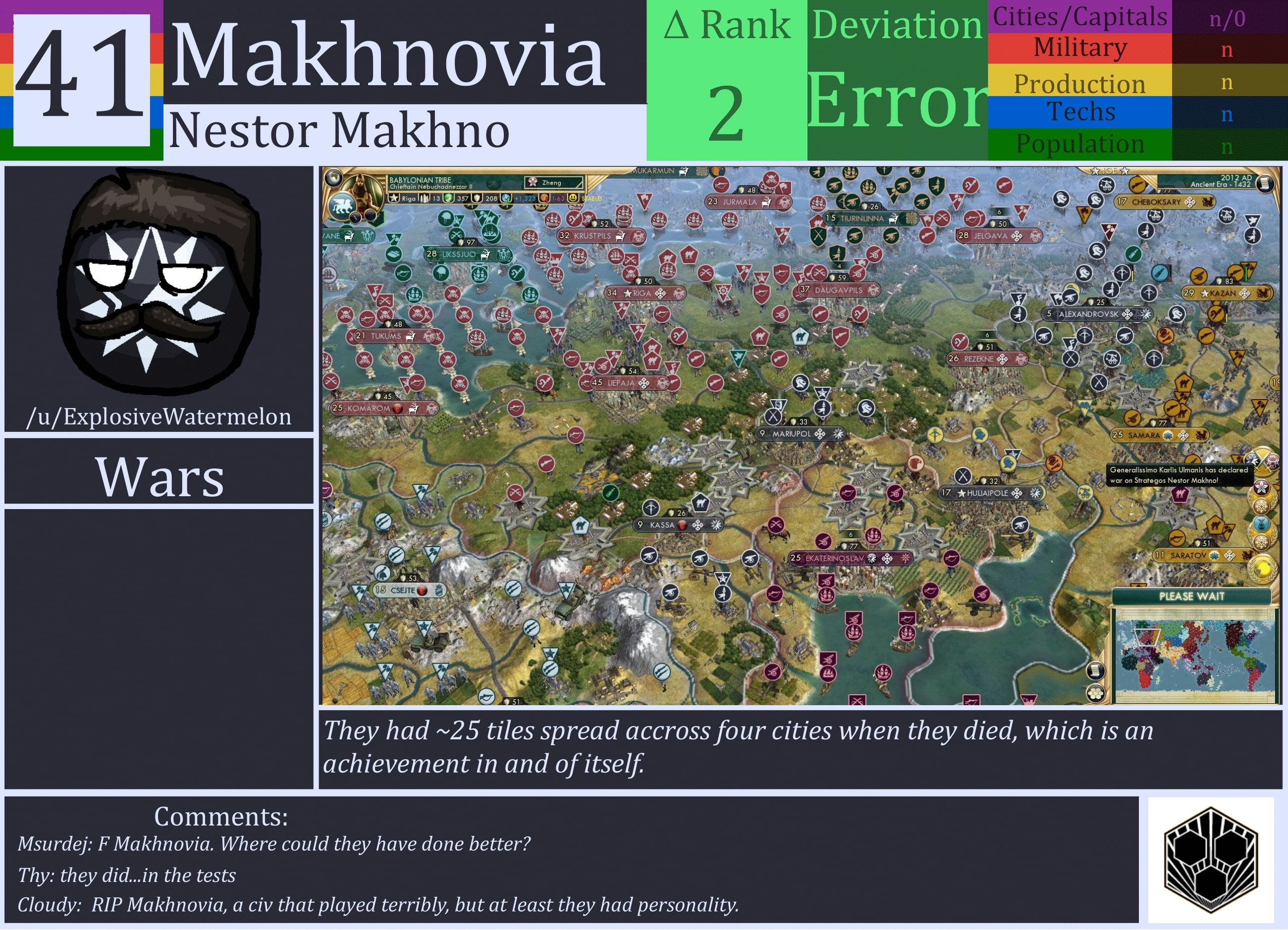
CBR In-Game Screenshot of Makhnovia

21: Makhnovia

Leman:

Makhnovia, the map’s ugliest nation, are dead. I’ll be honest, I expected a lot more out of Makhnovia. Billed as the funny anarchist civ, they have a powerful UA that should have let them really bully their neighbors. And given how weak some their neighbors were, Royal Hungary and Kalmyks in particular, I had expected Makhnovia to dominate their region and become a local powerhouse. Sort of like what Latvia actually achieved. Instead Makhnovia did little more than have some scrappy back-and-forth with Latvia (they took a Latvian city at one point!). This made them a mild fan favorite for about a minute or two. However, once the spotlight was off they dropped a city  to Pontus and were slowly devoured by citadels. At the time of their death Makhnovia was four completely separate exclaves that were easily conquered. Honestly, I’m glad they were put out of their misery. F

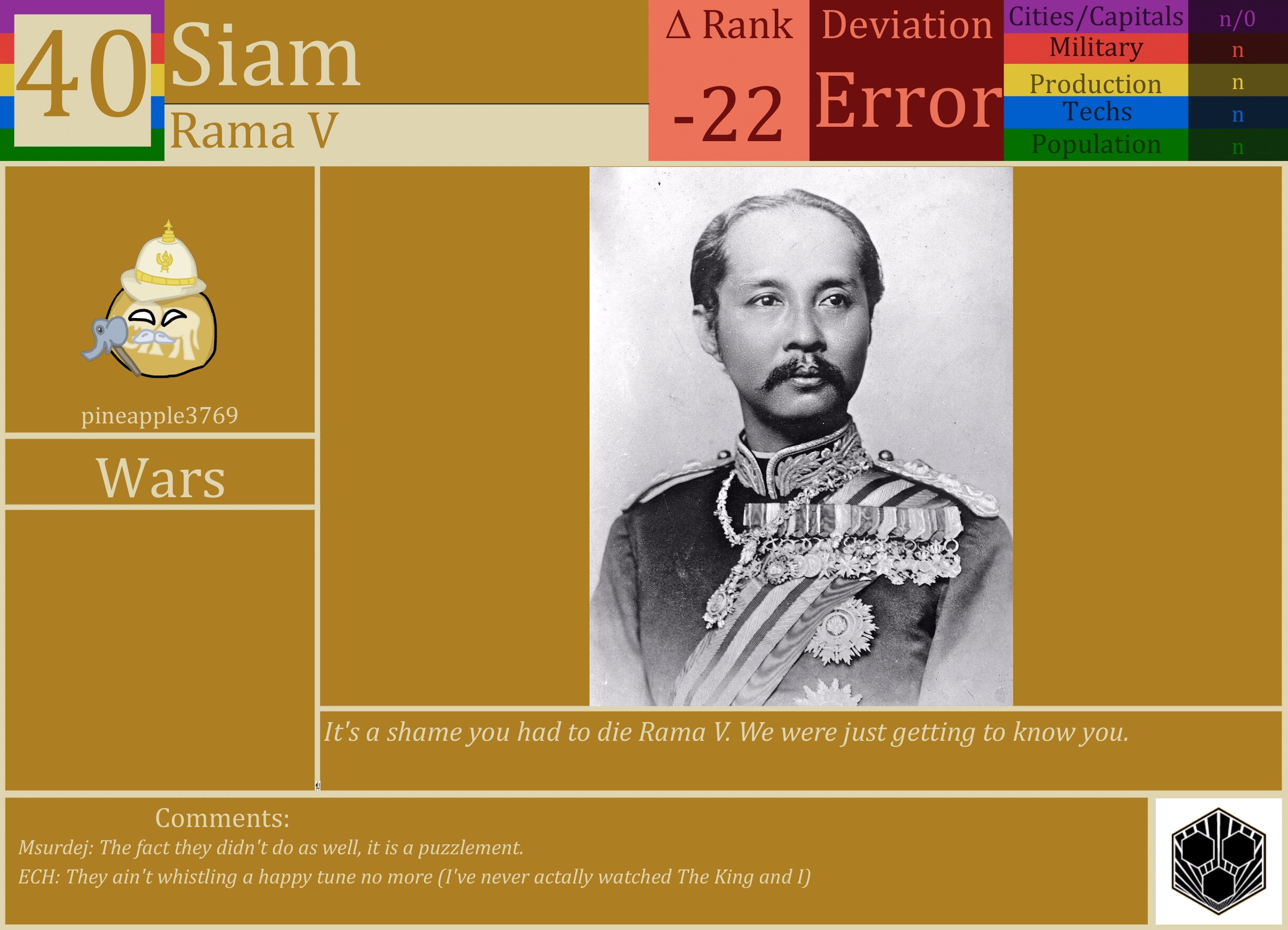
CBR In-Game Screenshot of Siam

22: Siam

Msurdej:

It's a rare episode when a civ dies, but ends up going up a rank, but here we are. We had high hopes for Siam this season, with an expansive UA and some weaker neighbors, we thought they'd be at least upper 20s. And for a time, it seemed like they were doing well as they expanded to be larger than their neighbors. At their peak, they had a strong command of Southeast Asia, top 10 science. There was even some discussion about putting them in the Top 10 amongst Power Rankers, even though their best placement ended up being 17th.

But it all started to falter with a failed invasion of Dai Viet. This, plus a shockingly competent Singapore, kept Siam in the high 20s. But then a war with pretty much all of Southeast Asia caused them to fall to the lower 20s and even 30s, their science strength evaporating as civs became more powerful and picked them apart.  The choice to go for Order was quickly shown to be a folly as Singapore marched right over them, With Wahgi coming in to finish the job...until Bo'lim gave them peace. But the peace was only a delay as this time, the Wahgi left no survivors. A good effort Rama, but ultimately futile.F

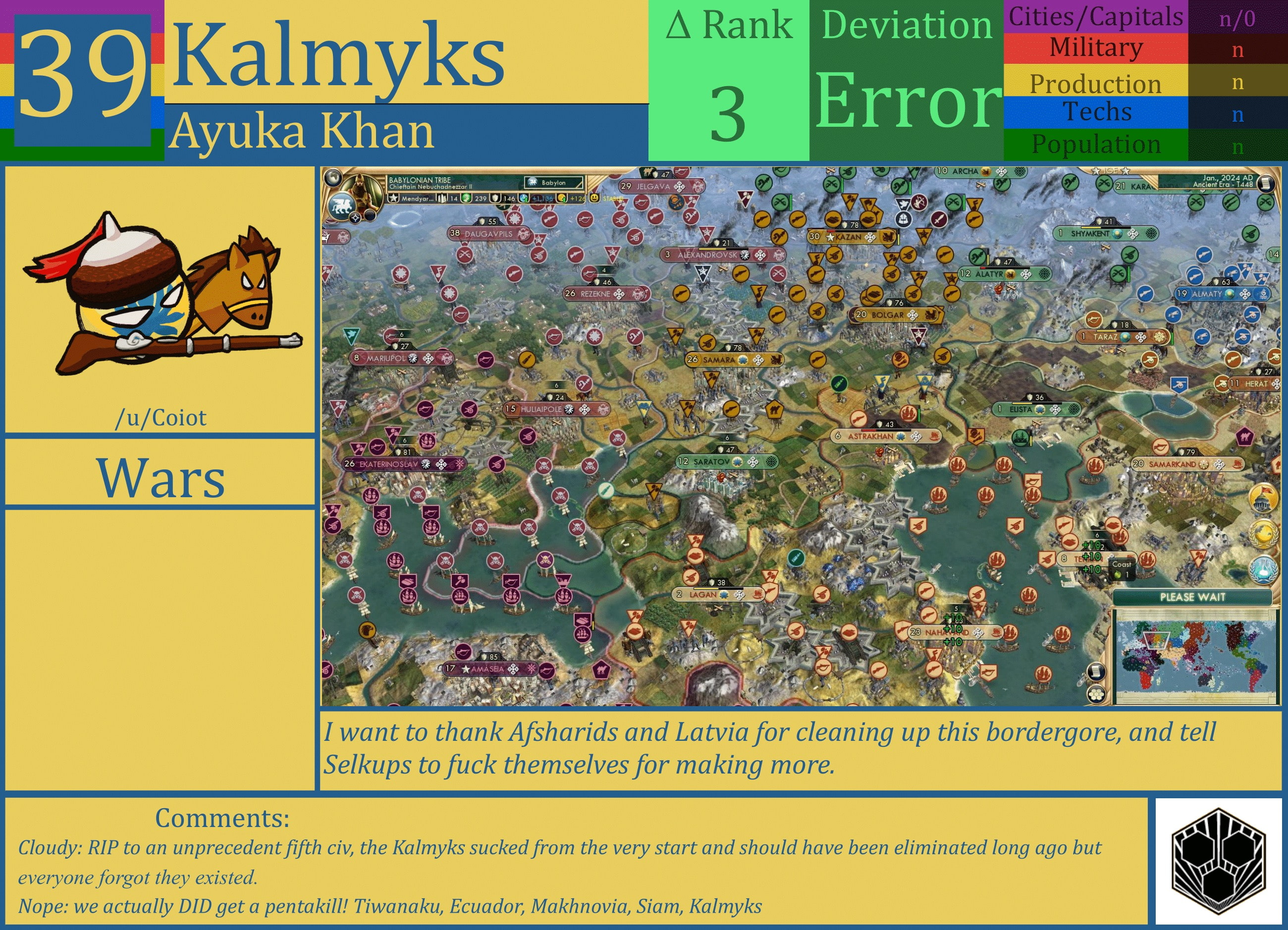
CBR In-Game Screenshot of Kalmyks

23: Kalmyks

Leman:

Kalmyks have a long, storied history of sucking absolute ass. Don’t expect an essay here. They slowly bled off cities to their enemies, dropping a few to Kazan, handing one over to Bukhara for no reason at all, and finally getting unceremoniously squashed by Afsharids as an afterthought to this episode. Kalmyks do leave behind a legacy though. They founded the largest religion on the cylinder, Vajrayana, which made them the happiest place on Earth. That’s not super great in a domination game, but I’m happy they were happy. Now they are dead. F

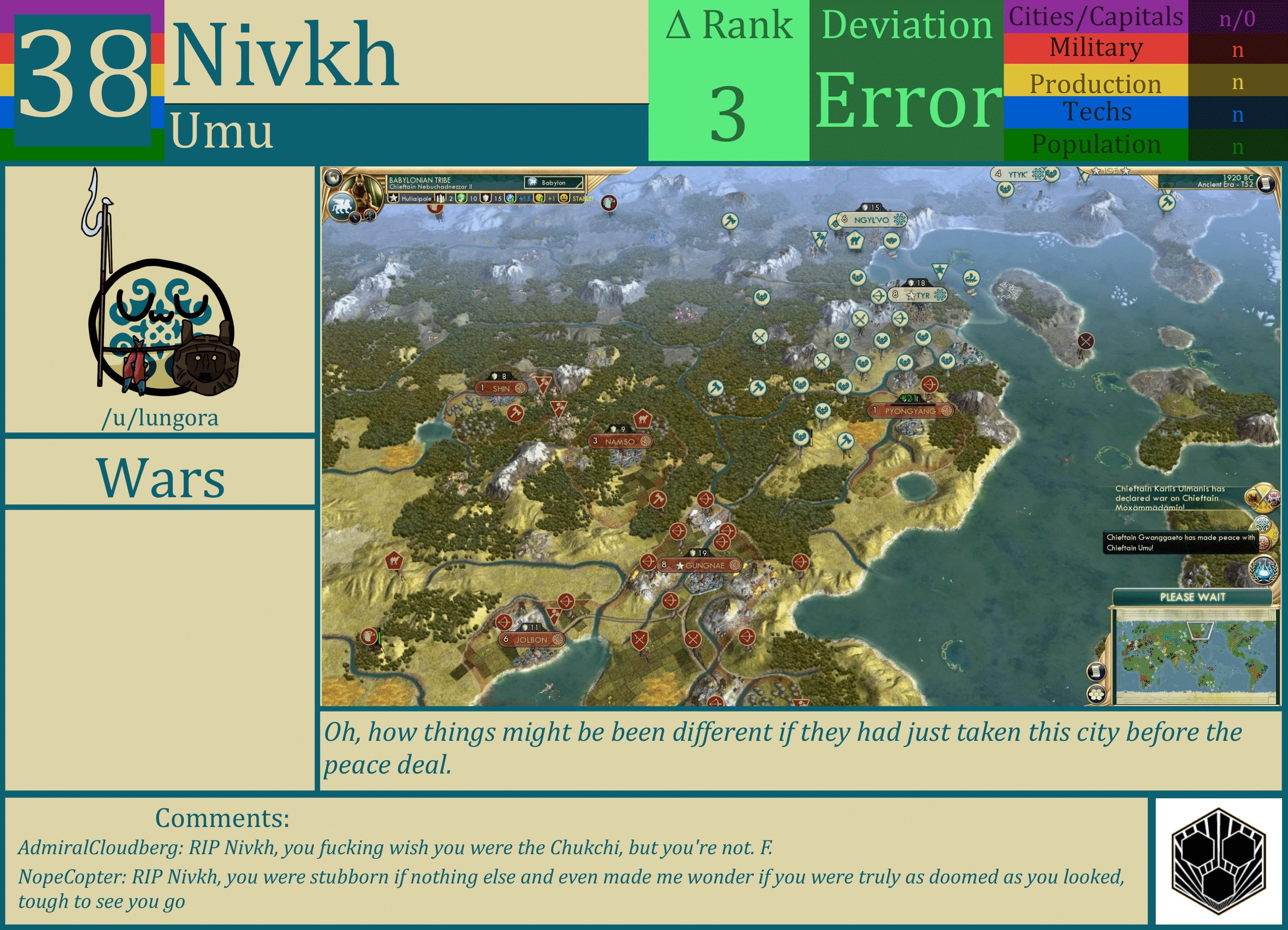
CBR In-Game Screenshot of Nivkh

24: Nivkh

Nathanmasse:

My heart goes out to Nivkh.  They started the season among the top 10 evoking the memory of Chukchi as an isolated civ in eastern Siberia and even rose a few ranks after the first episode when they declared a joint war with Shang against Goguryeo.  But it was all downhill from there.  

With Pyongyang on the ropes and surrounded they just… made peace and effectively threw the game away.  They focused hard on their military for the first few episodes and failed to punish Goguryeo for forward settling or settler spamming.  By the time they tried again at around turn 100 it was too late; Goguryeo horseman UU was more than a match for Nivkhs archer UU.


From this point there were few options left to them. They fought a somewhat successful war against Ikko-Ikki and secured the Kamchatka Peninsula and were even among the earlier adopters of the Autocracy ideology. But it was not enough to prevent the slow erosion of their empire by persistent attacks from Thule.  

Perhaps sensing weakness after Nivkh gave away a city to make peace with Thule, Goguryeo declared war and would not make the same mistake Nivkh made all those years ago.  It was a dogged defense and fought to the last man, but in the end they were eliminated in 38th place by their old rival.

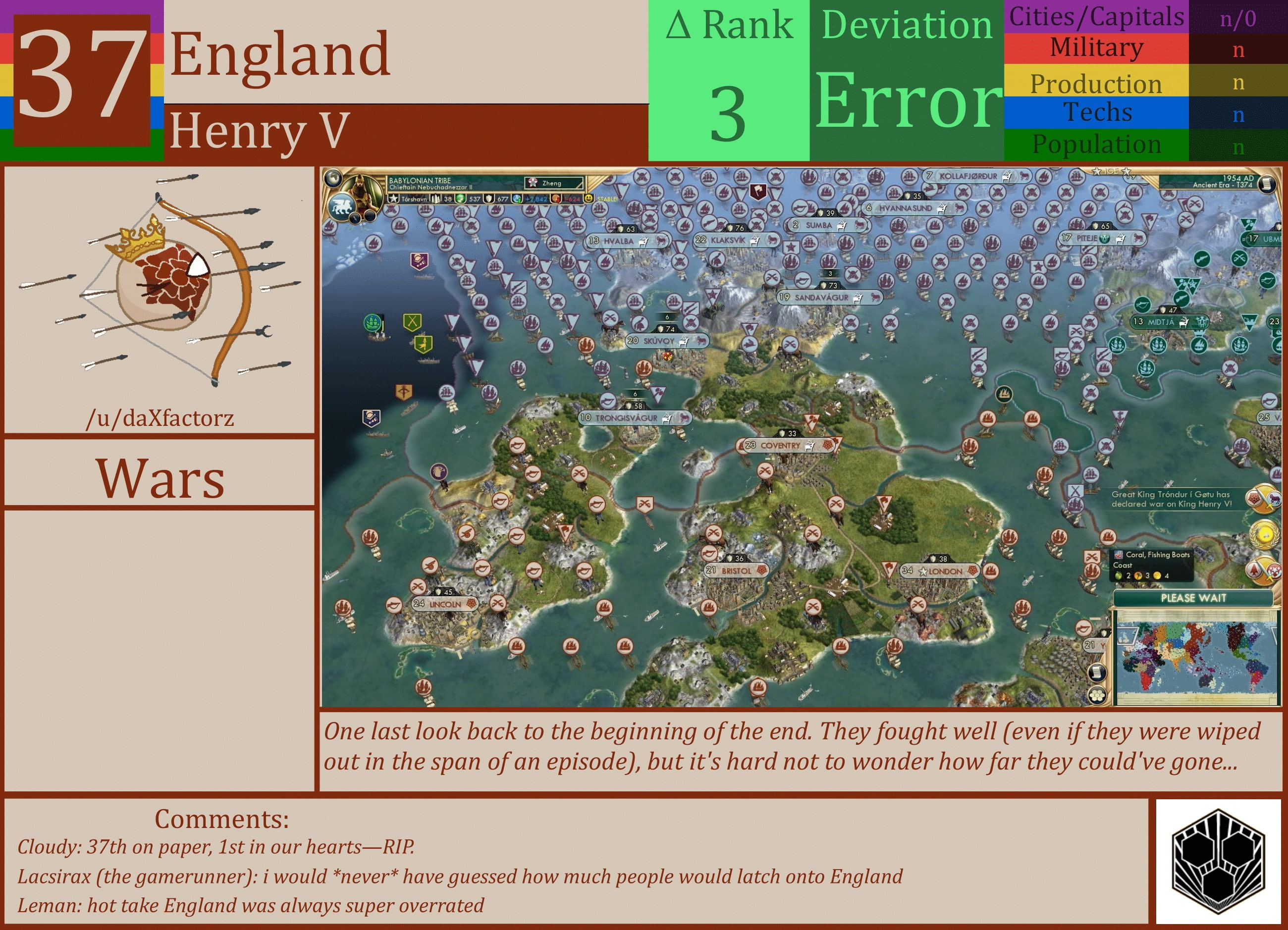
CBR In-Game Screenshot of England

25: England

NopeCopter:

The final death of England has come sooner than expected, with them not even getting a chance to rebuild and take out the Visigoths before getting cleaned up by the Faroes. Really, it’s a sad fate for such an iconic civilization, and one that could have hypothetically still pulled some shenanigans if left alone for another episode or two. Really, England is a prime example of a civ taken from us far too soon - though from the very beginning, I think everyone was aware that they were playing on borrowed time.

England’s status leading into the game was… difficult, to say the least. Voted in as part of a duo that wasn’t actually completed, England was the second-most-disliked civilization in the initial popularity polling (after Kazakhstan), at least in terms of people rooting against them, and they were ranked 46th on the Episode 0 Power Rankings - not because they were incapable of doing well, but because the Faroes so often eviscerated them. Few expected England to do well, and few wanted them to.

England’s start didn’t do them many favors, either - their ballsy forward settle onto the mainland was countered by the Faroes immediately settling Scotland, an even more terrifying prospect as the Faroes had just gotten an incredibly lucky start with multiple free techs from Ancient Ruins, and Burgundy’s rapid early settling made England’s forward settle seem even more foolish. An early flip of Beaune by the Visigoths made England’s position seem slightly better, but when they attempted to invade Burgundy in their moment of weakness, England fell victim to the classic blunder of splitting their forces and made peace before the end of the episode, quickly killing any hype they had amassed. This was followed by another ineffectual war, this time against the Visigoths, who were just a bit too tough to lose a city to half a dozen Triremes. While all this was happening, England continued to allow the Faroes to settle Scotland - a very, very bad call for a civilization that was throwing away units and still only had four cities to their name. England had shown themselves to be ambitious, aggressive, and opportunistic, but not exactly competent.

But England wasn’t done yet - no, they were just getting started. After pumping out a couple more settlers and trying to make up for lost time, they jumped right back into war with Burgundy, this time with two cities on the mainland to launch their invasion from. The only problem: Burgundy was the strongest civ in western Europe at this point, with six cities in very defensible positions and an army that dwarfed England’s mainland forces. Their navy of Triremes once again failed to take any cities, and the lines of battle were too long for England to concentrate their forces, and so before long the English troops were routed and Burgundy had captured Norwich. England reached their record-low PR ranking of 47, and by the next episode, even York was surrounded and looking ready to collapse.

This is the point at which any other civ would have lost their mainland colonies, taking a devastating blow to their production in the process, and been reduced to a sad little rump on the fringes of Europe. But England was not any other civ. Using their remaining navy, they continued to flip Norwich, and they managed to beat back the forces around York as well. War declarations from the Visigoths and Faroes drew enough of Burgundy’s attention that they couldn’t properly focus on the English colonies, and the Faroese armada (while ultimately ineffective) spooked Burgundy into making peace without either of England’s mainland cities. A great crisis had been averted, and England had avoided being punished for their reckless warmongering, but this just left another question: now what? England had shown that they were unable to defeat Burgundy, and the Visigoths and Faroes were unable to take even a single city off of them. Furthermore, Burgundy was much faster at rebuilding. The Visigoths were still far too difficult to take on navally, and a war against the Faroes was out of the question. This impressive salvaging of the war on Burgundy really only seemed to be delaying the inevitable. Heck, the Visigoths got to settle Ireland! The Visigoths! Not only was England’s Power Ranking in the gutter, but even their popularity was dismal. They were a no-hoper, another civ doomed to rot on the British Isles, just like Ireland, and Wales, and the Manx…

But despite their difficult position, England refused to give in. They spent the next few episodes out of the spotlight, slowly rebuilding their forces, biding their time, having learned their lesson from their opening wars. And when the perfect time arrived - a joint invasion of Burgundy by Bavaria and the Visigoths - they struck once more. Sure their presence on the mainland wasn’t all that impressive, but Burgundy was split between three fronts, and more importantly, they didn’t have a navy. England did. As Burgundy stalled out against Dijon and the VIsigoths floundered against Asturica, England’s fleet of Triremes finally proved large enough to break Amiens - something even the Faroes couldn’t accomplish. England peaced out not long after, with the inland Burgundian cities proving much more resilient and Bavaria no longer helping, but they’d finally made it out of a war up a city.

To many, this peace declaration seemed incredibly poorly timed, as not only did Bavaria rejoin the war effort not long after, but England also finally unlocked their first Unique Unit, the Chevauchee. Given the circumstances, and how often civs end up waiting far too long to go to war, the Chevauchee seemed doomed to sit around until it was no longer relevant, but it turned out that England never had any desire to waste their UU - they were simply waiting to unlock the other one, as well. Once armed with their Longbowmen, and with a freshly rebuilt carpet, England struck the war-weary Burgundy for the fourth time. The Visigoths struck a peace deal with Burgundy right as the war began, and Bavaria was busy with Royal Hungary, but England didn’t need a coalition war this time. The Chevauchee, on paper a worthless unit due to its low power and status as a mounted unit, actually completely prevented Burgundy from building units in cities it moved into - and with Burgundy already low on units from their prior wars, this proved to be deadly. Coupled with the incredible range of the Longbowmen, England’s Unique Units… didn’t actually seem to be doing the job, to be honest. For a couple episodes, the war was a stalemate - many assumed England was once again going to fumble the land invasion against the infamously defensible Burgundian code. Until, suddenly, it wasn’t - in a single turn, England, armed with not only their uniques but also with Trebuchets and Musketmen, knocked Autun from effectively full health to red HP. A couple turns later, the city fell, and the Visigoths took the opportunity to pounce and take another shot at recapturing Asturica… only for Burgundy to panic and hand the city over to England in exchange for peace, instead. An embarrassing if ultimately strategically sound move by Burgundy, an absolute snub for the Visigoths, and a solid prize for England, who had finally established themselves as a legitimate player in mainland European politics. Burgundy was now a rump, and England had effectively taken their place in the regional power balance. Sure, Burgundy still existed, but for all intents and purposes, England had done it - they’d won the Hundred Year’s War.

England proceeded to fumble a war against Bavaria they’d declared ages ago, failing to capture the weakened city of Beaune due to a lack of melee units, but this was IMMEDIATELY followed up by an attack on the Visigoths, who were already in the process of being beaten down by Sierra Leone. This was England, after all - ambition had become their defining character trait. It was also their defining character flaw. While still trying to break through the Pryenees and take down the Visigoths, England suddenly declared war on Burgundy AGAIN, despite their manland forces being exhausted and Burgundy’s carpet being completely rebuilt. The road to Autun was completely open, the city was retaken, and Burgundy looked poised to make a comeback entirely off of England’s arrogance. But the English simply told everybody to shut up and watch. As their navy jockeyed for control of the Visigothic island cities, England’s forces slowly but surely wore down the Burgundian carpet, and by the end of Episode 26, not only had England completely reversed the situation and begun marching on Dijon, but they’d simultaneously knocked the Visigothic coastal city of Emerita into the yellow. This was also the point where the Popularity Polls returned after an 11-episode hiatus, and while their public perception had already begun to trend more positive by Episode 15 (albeit mostly due to not many people caring about them), Episode 26’s poll showed just how far England had come - suddenly, their support score was the fourth highest on the Cylinder, and they were really only a couple of points from second. They had become a fan favorite, a darling, and they certainly weren’t going to stop now.

Over the next couple of episodes, as England’s UUs began to become less and less relevant, the Burgundian capital of Dijon was finally seized, Asturias narrowly avoided falling to the Visigoths, Emerita was flipped and then held, and the Visigoths began to be torn apart. Burgundy was left alive for now, a one-city rump state, and while England stopped short of taking Barcino (letting Sierra Leone torch it instead), they had a foothold to pick off the scraps of whatever Sierra Leone left behind at any time. In the meantime, they decided that they actually did want to kill Burgundy after all, absolutely mopping the floor with Nancy and finally eliminating their age-old rival. This angered Rome, who was busy attempting to besiege the city themselves, but as Nancy was inland, this was hardly a problem. Unfortunately, finally picking up their first elimination also had… more dire consequences in store.

Since the very first episode, the Faroes had always hung over the head of England like a guillotine. They were the polar opposite of the English: sleepy and not the best at war, yes, but so large, so inherently powerful with their uniques, that they utterly dwarfed them anyways. For England, it was always a matter of when, not if, the Faroes would finally decide to wipe them off the face of the map - there was no universe in which England surpassed them, not after their opening turns. For a while, the two coexisted peacefully - they fought wars together, shared the Isles peacefully, and England was comfortable enough to leave their core holdings largely devoid of troops. But the elimination of Burgundy was evidently a step too far, and the Faroes - with a military utterly dwarfing England’s and technology so far ahead that they were even fielding planes - declared war right as England was on top of the world. England, by contrast, didn’t even get a moment to catch their breath. Their military was exhausted, and most of what did remain was on the other side of their empire. Still, they fought. They fought hard, even taking the initiative and crossing into Faroese lands before the Faroes could organize their ground forces, and every city the Faroes took was flipped back multiple times over. It was an impressive showing, really, and England even finally started pumping out Artillery in the midst of the fighting. Hell, they even declared war on Bavaria in the midst of it, as if the Faroes simply weren’t enough of a challenge for them! At times, it seemed like England could stem the bleeding and hold the line. But the Faroese armada was simply too vast, and the power of aircraft simply too insurmountable. England’s reserves slowly began to run dry, and eventually even London fell, pushing England onto the mainland and then beyond. In the end, all of coastal France fell, and England was forced to also cede Dijon for peace, reducing them to a mere five cities split between southern France and Iberia - a shell of their former selves, a grim shadow of their exploits.

England’s final days after this defeat were somber, but not devoid of action. Faroese Citadels left England unable to reinforce Nancy, so while they fought hard to keep the Romans at bay, the city eventually fell. Still, there was hope that they could rebuild and at the very least finish off the Visigoths, who by now had been reduced to one city - sure, the Visigothic carpet was large, but it was also completely out-teched. Unfortunately, however, they never got the chance to plot out their next big play. In the same way that England relentlessly wore down Burgundy, the Faroes (now even further ahead technologically) declared a second war on the English rump state, and the remains of the empire were wiped out by the end of the episode, reduced to only a single Great General. Even then, though, England decided to go out on their own terms: on the same turn the Faroes dealt the killing blow, England handed Salisbury (their final settled city, in southern Portugal) to Rome in a peace deal. Even if it was small and ultimately pointless, it was a nice last bit of defiance in the face of certain death, and had the Faroes not immediately declared war on Rome it could’ve been said that England got the last laugh. Or maybe pitting their two killers against each other was their final act of revenge after all. Who can say. Really, the greatest tragedy of it all was the fact that the Visigoths didn’t die first.

And so, England’s tale has come to an end. But it wasn’t meaningless. Going into the season as just another European civ representing a nation people loved to hate, England managed to turn their entire legacy around and became something that few could have imagined. Their ambition and ballsy plays resonated with people, and by Episode 30 - in the midst of the Faroese invasion, mind you - England had become the third most popular civilization in the entire game. Their conquest of Burgundy, a plot thread that spanned six wars and had perhaps more twists and turns than the relations of any other two civs… ever, proved to the world that the British Isles were NOT an unworkable TSL after all - heck, if the Faroes hadn’t existed, they certainly could have gone further and conquered the Visigoths and Bavaria at the very least. And even now, England remains (alongside the Khoshuts) far and away the fan-favorite eliminated civ. Through the fears and doubts of the Power Rankers, the disdain of the viewers, and an admittedly abysmal opening few episodes, England put on one hell of a show - and while their ambition was their downfall in the end, it was also what has made them immortal. The Faroes, once the viewers’ darling, now sit comfortably as the single least popular civ in the game (only the Wahgi are challenging them), and unless something massive happens they’re unlikely to be spoken of positively after the season ends. But I doubt people will ever shut up about England. Their death may have been inevitable, and everybody watching knew it, but they danced one hell of a jig on their way to the gallows. And it really is a testament to England’s performance that their death was so tragic when everybody saw it coming from the very first turns of the game. Perhaps one day we’ll get a power from the British Isles that truly becomes a power on the world stage, one that puts England’s achievements to shame. But until that day comes, the master of Western Europe will sit on his throne in the sub, immortalized by the love of those who watched him work his incredibly violent magic. Thanks for playing, Henry. F.

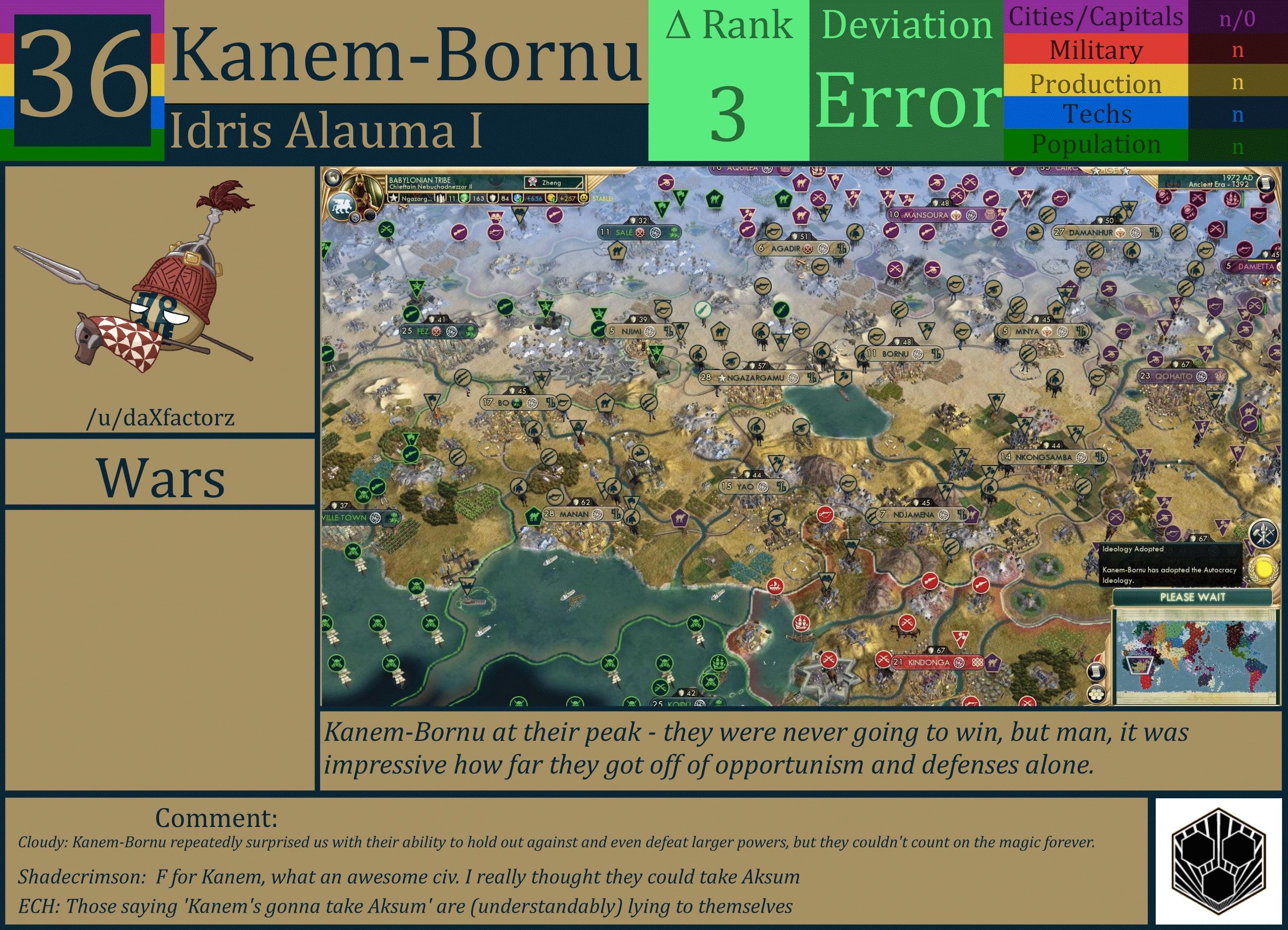
CBR In-Game Screenshot of Kanem-Bornu

26: Kanem-Bornu

NopeCopter:

Falling just a single slide after the fan-favorite England, Kanem-Bornu, another fan-favorite nation, joins them in the sub this week after finally breaking down the episode prior. While not as dynamic as England, Kanem-Bornu instead earned their fame through their sheer grit, unmatched anywhere else on the cylinder. They may not have ever been in a position to win the continent, but they were perhaps the most prolific kingmaker in CBR history, and their mere existence has shaped the direction of the CBR to a degree few mid-tiers are able to accomplish.

Initially ranked in 41st, in “the bottom of the middle of the pack”, with fairly low hopes given their awkward terrain and strong neighbors. Their start didn’t do much to change people’s opinion of them, either, with a fairly slow start that saw them plummet all the way to 54th in the rankings for their sheer lack of action compared to the exciting and expansive Sierra Leone and Alaouites. But these two, while they did settle right up to Kanem-Bornu, forgot to build a military to go along with their settles. Right when Sierra Leone was at their mightiest (and silliest), Kanem-Bornu took the opportunity to strike at their eastern border, taking the city of Bo for themselves before Sierra Leone’s forces could coalesce. They also settled Nkongsamba at this time, finally claiming some proper space for themselves to expand into rather than clumping all their cities together. This led to a 10-rank rise in Kanem-Bornu’s standing and a TWENTY-THREE rank drop for Sierra Leone. After five straight episodes of being completely ignored, Kanem-Bornu was finally starting to turn some heads.

Unfortunately, this victory also gave attention to Kanem-Bornu’s greatest problem throughout their entire run: their awful stats. Desert cities rarely make a good empire, but Kanem-Bornu was on another level, being absolutely abysmal in tech and production, for instance. Even if they did manage a clutch war, they were slow to rebuild and simply could not keep up with the pace of growth of the rest of the cylinder. And that inability to rebuild very quickly proved to be their undoing, as after an ill-advised war declaration against the Mamluks, both the Alaouites and Saba-D’mt (both top-of-the-line military powers with massive armies) invaded, tearing their admittedly decently-sized empire to shreds and proving their defeat of Sierra Leone was a mere fluke.

…Or, that’s what should have happened. Instead, the Alaouites absolutely fumbled a free war by trying to invade Sierra Leone at the same time, while Saba-D’mt, after taking Nkongsamba with no issue, suddenly proved completely unable to make any further progress despite their massive army and favorable terrain. Saba-D’mt was so incompetent, in fact, that Kanem-Bornu was able to take Agadir from the Alaouites with no issues! Sierra Leone sniped Sale and Fez, and Saba-D’mt did eventually take the city of Bornu as well, but on the whole it was a pretty impressive showing - and Kanem-Bornu actually retook Bornu off-screen a couple episodes later. Saba-D’mt split their forces and failed to commit properly, and it led to perhaps their second most humiliating war in the game. Kanem-Bornu celebrated their victory (Not counting the loss of Nkongsamba) by finally getting on with that invasion of the Mamluks, turning their near defeat of the Romans into a joint takedown that netted Kanem-Bornu both Minya and Damanhur. The terrain around Damietta proved to be too much for Kanem-Bornu to navigate, so the elimination of the Mamluks eluded them, but it was still an impressive showing by Kanem-Bornu given their stats were still pretty much in the gutter.

This series of wars was followed by a period of relative peace for Kanem-Bornu, but unfortunately it was less of a building-up period and more of a let-your-neighbors-build-up period. Sierra Leone and Saba-D’mt only became scarier, while Kanem-Bornu’s stats continued to hold them down. By this point, Sierra Leone had taken down the Alaouites and Saba-D’mt was at their peak, not to mention Ndongo looking solid to the south, so people had mostly written off Kanem-Bornu as an actual player. It was just a matter of who got around to dealing the killing blow first - the kingmaker of Africa, unable to win but able to grant victory to any of the three major powers. It turned out that Saba-D’mt would be the one to make the first grasp at the throne, with the advantage of not only gunpowder but the Production to actually sustain a prolonged war. A (mostly irrelevant outside of Rome) coalition war followed, and it seemed as though Kanem-Bornu’s time had finally come. As it turned out, their time HAD indeed come - not to die, but to show off their true power.

Kanem-Bornu’s UA, “None to Fear But God”, deals damage to all enemy units in all cities connected to their capital based on the city’s Faith output - and it just so happened that Kanem-Bornu had not only founded a religion so many turns ago, but also had one of the highest Faith outputs on the cylinder. Paired with the movement bonuses of both their UA and UU, this turned out to be a devastating defensive boon for an otherwise-outclassed civilization. Rome’s siege of Damanhur, seemingly guaranteed to take the city, completely floundered, and Saba-D’mt quickly found themselves on the back foot as Kanem-Bornu turned the tables and even recaptured Nkongsamba before peace was very quickly made. For a second time, Kanem-Bornu had utterly humiliated a top-15 power, and while they were still in no position to actually conquer any of their neighbors, their status as kingmaker had gone from “a free quarter of the continent for whoever invades first” to “an unbreakable wall only to be conquered by a truly worthy civ”. Their grit was unmistakable, and they began to truly be recognized as the legend they had become.

Kanem-Bornu once again had a brief period of quiet after this victory, pulling off a very funny (albeit very temporary) snipe of Marrakech from under the noses of Sierra Leone but otherwise getting an episode to relax and rebuild before suddenly being thrust back into war with Saba-D’mt due to Holy War mechanics, now packing an even more notable tech advantage with Cannons and Line Infantry. This, of course, also went nowhere, because of course it didn’t. Kanem-Bornu took the initiative despite Saba-D’mt (nominally) declaring the war, and then peace was signed by the end of the episode. It did tank Saba-D’mt’s reputation even more, though, which was funny. Kanem-Bornu celebrated by failing to eliminate the Mamluks (also part of the Holy War coalition), before taking a bit of a break with a small, irrelevant war against Rome.

However, as Kanem-Bornu recovered from their consecutive wars in the north and east, Sierra Leone began to grow more and more powerful - their tech level surged ahead, their Happiness problems were solved, and they even attained a foothold in Iberia. Kanem-Bornu, meanwhile, continued to struggle along with their lack of production and science, barely able to put together a semi-decent carpet before Sierra Leone finally came knocking for a rematch. Despite the overwhelming advantage on both land and sea, not to mention several well-placed Citadels, Kanem-Bornu fought hard and made Sierra Leone bleed for every inch of soil and every point of damage on their cities. Unfortunately, this time the difference in firepower and production was just too much, and Kanem-Bornu was slowly but surely pushed back. The straw that broke the camel’s back came in the form of aircraft, which Sierra Leone started to build in the middle of the war, effectively negating the effects of Kanem-Bornu’s now-infamous UA. Kanem-Bornu managed a couple more flips, but with their military already exhausted, they were relentlessly pushed further and further back until finally being reduced to two disconnected cities on the eastern edge of their once-great empire. At the very least, they didn’t need to wait long for their demise after being rumped and humiliated - in the midst of their conquest, they had joined Sierra Leone in a coalition war against Saba-D’mt that every other member had subsequently peaced out of, leaving them to fend for themselves with almost no resources to speak of against a further humiliated but ultimately still functional Saba-D’mt. They fought hard in this final war, down to the last man, but ultimately the difference in power was too much and Kanem-Bornu was finally slain by their age-old rivals.

And so the beast of the Sahara had finally been slain, and the kingmaker of Africa had placed their crown upon the head of Thomas Peters. But alas, it was a hollow victory, as the conquest had come too late to truly matter - a subsequent war against Rome went horribly awry, and Sierra Leone lost a good chunk of their gains against Kanem-Bornu, turning them from a shoe-in to win Africa to just another mid-tier power unlikely to break out of the continent. Saba-D;mt, meanwhile, continues to get bullied by Mogadishu. Kanem-Bornu’s final trick was to hand over no crown at all, only to grant a bit of hope before the crushing reality of the future of X4’s African powers was revealed. Sierra Leone, Saba-D’mt, and Ndongo will all likely rot on their split continent until some truly top-tier power invades and cleans things up, doomed to a mediocre end unless something massive changes. Kanem-Bornu, meanwhile, has escaped the cylinder with a legacy of daring and iconic moments intact, a prime example of a turtle that managed to give a good show despite their more defensive nature. It may not have been a good performance on an objective level, but it’s the nature of the CBR that not everyone can be a winner. Becoming a legend is certainly a fine alternative for such an underrated little empire, one once considered so boring that they weren’t even worth talking about. F.

CBR In-Game Screenshot of Vijayanagara

27: Vijayanagara

Cloudy:

Vijayanagara was a civ that tried surprisingly hard and walked away with nothing to show for it.

Boxed in at the beginning by aggressive settling from the Khoshuts and Harappa, Vijayanagara dropped to 50th place in episode 1, but while they never really got their momentum back, that did end up as the lowest rank they ever achieved. For quite a while they hung around South India with a few cities doing nothing in particular, even letting Harappa settle Sri Lanka, and their ranking bounced around in the 40s. In episode 10, however, they made waves—or at least heavy ripples—by capturing Sri Lanka from Harappa and settling an island city of the coast of Africa. Vijayanagara rose to 36th, their best ranking since episode zero, but they quickly fell back into the low 40s again when reality set back in. The fact remained that Vijayanagara was trapped: they didn’t have the land forces or the geography to take down the Khoshuts or Harappa, who had the great wall, and they didn’t have a strong enough navy to contest nearby civs like Siam at sea. Although they managed to construct a few more colonies in the Indian Ocean and Antarctica, they continued to stagnate overall, remaining below the mid-tier in most respects. When Harappa invaded them with a large army, they struggled to defend, and it looked like they would be ruined—but they made peace just in time, reinforced, and restarted the war. Eventually they managed to capture Harappa’s remaining coastal city of Mehrgarh, which propelled them to an all time high of 30th place, but by episode 18, 30th place wasn’t worth what it used to be.

This bump was short lived, and a rollercoaster followed. In episode 22, Vijayanagara found themselves simultaneously at war with the Afsharids, Harappa, and Singapore, prompting a fall to 37th. And yet, in that same episode, Vijayanagara completely unexpectedly fought back against the technologically superior Singapore and repeatedly flipped a city that started the war in Lee Kwan Yew’s hands. The following week, they ended the war with all the cities they started with, somehow. After that, Vijayanagara entered a second period of stagnation, which actually helped their ranking a fair bit, as other civs plunged past them, picked off one by one by larger powers. In episode 27, they even boosted themselves by capturing and keeping a city from Singapore. This rise finally culminated in episode 30, when Vijayanagara launched an ambitious and daring naval assault on the Noongar, sailing a large fleet all the way to Australia with little resistance. That week, their ranking reached its all time high of 26. But it was all downhill from there. In episode 31, Singapore attacked again, and by episode 32, Vijayanagara had been torn to shreds, reduced to a shell of its former self. The war finally ended in episode 34 with only the capital still in Krishnadevaraya’s hands. Two episodes later, they were dead, eliminated by a Wahgi paratrooper invasion.

In summary, Vijayanagara played the game and fought hard, but their position was untenable from the start. No one had any real illusions that they would become a major player after episode 1. But they were sometimes fun to watch and they notched some victories before they left. As for our predictions, they were almost spot on—we had them 33rd in part zero, and they finished 35th* (temporarily 36th until we shove Shang back into the grave where they belong). So, no surprises there. F.

CBR In-Game Screenshot of Mongolia

28: Mongolia

Leman:

Here lies Mongolia, a civ with a lot of promise and not a lot of follow-through. They started solid enough, we ranked them highly, as we normally rank Mongolian civs - 16th. They have good settling tendencies, lots of room, and a strong, aggressive AI. They sort of made good on that promise, settling decently well, but our hopes were quickly dashed as almost all of their neighbors, Selkups, Dzungars, Shang, and Goguryeo had far better openings. Mongolia at first found themselves a medium fish in a huge ocean, and then found themselves at war.

First with Shang, where they quickly dropped Old Sarai to the breakout star. Luckily Sorghaghtani had time to consolidate, and gather her empire’s meager strength, and managed to seize the city back, along with Xiaotun, while Shang was distracted by Goguryeo. Several episodes later, found themselves at war again, this time with Goguryeo, where Mongolia put together a truly heroic defense, going against the top-tier superpower without dropping a single city. Unfortunately, Mongolia’s other neighbors smelled weakness too and jumped on the opportunity. Selkups seized their western exclaves without much protest and Shang came cruising back in, hoping to redeem themselves. Luckily for them, again, Goguryeo took pity on Mongolia, perhaps respecting their incredible defense. They switched sides, eliminated Shang, and saved Mongolia.

Mongolia then slumbered for six or seven episodes, squeezed between Selkups, Dzungars, and Goguryeo. There was nothing else they could really do. They weren’t dead, they had eight cities, but nothing they could muster could scratch either titan they bordered (or Dzungars).

When Goguryeo finally decided that Mongolia’s time had come, the end was swift. The war took four turns from start to finish. Sorghaghtani left seven cities to Goguryeo, and one to a resurrected Daji, ensuring that if she were no longer participating in this game, her legacy would live on. Until Goguryeo decides to end that too.

CBR In-Game Screenshot of Finns

29: Finns

Msurdej:

Here lie the Finns.

They never got any real wins.

They got one forward settle,

then did nothing of mettle.

Until Latvia kicked in their shins.

CBR In-Game Screenshot of Qarmatians

30: Qarmatians

Orange:

As one of the great philosophers of our era said: “Wowie Meowie”. At the start of the part they were at eight cities and looked like they could take a shot at the battered Saba soon to mount another Qarmback. But now here they lie, dead in the desert, still bleeding from the bullet wounds of every single one of their neighbors. This wasn’t just a death, this was an orchestrated slaughter, an extermination of a people so swift it’ll make historians question if they even existed. Another Qarmback will not happen again, this is the end. I think we all wished they could’ve done better, they really are such a cool civ. Such a shame they couldn’t break out.

CBR In-Game Screenshot of Mexico

31: Mexico

ECH:

Today I have the morbid honor of pressing F for a real one, perhaps one of the realest to ever be one. I hate to pull a hipster card, but I must emphasise my personal sadness as I was one of a bunch rooting for Mexico from the outset, putting poor Max first in the X4 vote, rather than simply joining the growing chorus of fans as Mexico pulled their weight through the season. Maximilian offered us one of the most engaging civ stories this season, and in a way it’s quite ironic that they end only 2 ranks above their Part 0 prediction of 34th (3 if you don’t count Shang as alive).

Indeed, hopes were generally a bit mixed coming into this season, and why wouldn’t they? The Mexican region has never been a breeding ground for strong civs in the past, and with such lofty expectations for Seneca and other North American civs the feeling was that Mexico would simply end up squeezed. However, from the very beginning there were some suggestions that they could be a dark horse, as their Part 0 PR even says directly. Their UA giving them free units was a notable asset, and in testing they consistently held up alright. From the outset of the actual season, they began proving the optimists mostly right with a sturdy, even impressive, settlement program and statistical advantages: 10 cities by episode 7 and quickly becoming a military top 5 regular, boasting one of the more impressive carpets of the early-mid games. Notably, Mexico spent all but one episode of the first 20 in the 10th-20th range; and from Episode 21 to Episode 35 entirely within the top 10.

Now, in reviewing their total history after their death, the case could be made that they ultimately were never the most relevant civ, a perennial up-and-comer who never translated their momentum into game-changing action. They sparred with Pueblo and helped weaken their image just before their fall, perhaps. They enacted the great citadelling of the Mississippi, which has devastated Osage, true. They helped distract Ecurador when that civ could have been focusing attention on more profitable endeavours. Their most lasting image may in fact be their end; squeezed (as the PR’s of Part 0 somewhat got right) between Yellowknives and New Holland, fighting a grand struggle only to be betrayed by Wahgi, who had been peacekeeping all that time.

All true, and all perhaps paint a picture of a civ that could, and should, have achieved more. But perhaps, in the end, that was not the way of Maximilian. The Austrian Duke helmed a fine, prosperous empire for his people (let’s not check if they wanted him or not) and was cut down without clemency. Fitting, nein?

CBR In-Game Screenshot of Bora-Bora

32: Bora-Bora

Orange:

I am not the poet that Nope is, I sadly can not write a 2500 word eulogy for the greatest civ of the royale. But Bora deserves that, more than England does in my opinion, so however long this ends up being will have to do, and we can go get Coiot to shorten every other eulogy to be shorter than this one. It’s only fair.

Anyways, I started loving Bora-Bora from before the game began, I saw them in the voting and I think I had seen them in an AI game before, and I thought “Wow these guys seem great”. Like, nice colors, fun civ, looks like they could be an actual contender, and of course, their name is just one word repeated twice, which makes me want to say BORABORABORABORABORAORABORABORABORABORABORABORABORABORABORABORABORABORABORABORABORABORABORABORABORABORABORABORABORABORABORABORA.

That of course led me to ardently support them in the voting and to make a civball for them which I’m quite proud of tbh. I wasn’t sure between Pueblo and Bora-Bora which was my favorite, but I did have that clear top two. So, to start the game, of course, Bora-Bora was a little slow, Wahgi had gotten off to a settling spree start while Bora was more content to sit around, but in a number of tests they had done a real funny thing, the same thing that Mohave had done last time: Settle in a random place, notably in Argentina. And they went and did that. And just like that, boom, instant top tier unstoppable holders of the power of love.

They still were slow on settling though, both in the home islands and in South America, Wahgi was encroaching on their turf in the west while they didn’t put out enough to stop Tehuelche’s expansion in the east. But they persisted, and started to actually expand and grow for a bit.

Now at this point they hadn’t really done any warring. Around turn 70 they fought with Big River but that didn’t go anywhere, and then around turn 100 they fought with Tehuelche to a similar end. But it wasn’t until their second war with Big River, where in part 12 they had the opportunity to elevate themselves. Big River was being coalitioned, and Bora was in the midst of settling more islands, but they took their South American colonies and pumped out troops to go fight, it seemed easy, one city for each of them, Tiwanaku, and New Holland. But then NH took two. But Big River had two comp bows and a horseman, and they used those to take back their capital, and then Bora, like the bad bitch they are, waltzed in and stole the capital from under Maurits’ nose. Beautiful. Perfection. Solidified themselves as the best civ right then and there.

After that was a reprieve for a bit until they took on Tiwanaku where Bora had huge gains, especially grabbing all the islands Tiwanaku had settled and even a city on the Peruvian coast. Though while the Tiwanaku war was a big gain, they did also run into a Wahgi war at the same time, where they lost one island city against someone who was quite a larger foe even at the time. Then it was a much longer wait, around 100 turns, before Bora-Bora turned their focus once more to Tiwanaku. This was a long, drawn out war, but it resulted in Bora taking nearly everything Tiwanaku had (besides the bits that Ecuador took in the coalition of course). It put Bora almost on top of the whole continent. Riding off the coattails of that, Bora went further and took out Tehuelche, securing the entire southern half of the continent. It was also their peak.

Less than 20 turns after Tehuelche was taken out, Wahgi declared war on Bora-Bora, in this war Bora slowly, oh so slowly, lost nearly everything. But let’s pause for a second because there’s some more interesting things here. I want to point out Bora’s war record before this. In the 400 turns before the Wahgi declaration, Bora-Bora was involved in 12 wars, 11 of which were started by Bora, the only one started by someone else was the first Wahgi-Bora war, a war which saw Bora take a city, and then Wahgi take it back and take one of Bora’s cities. Within the 11 wars started by Bora-Bora, 4 of them were non-relevant wars (against Mag, Osage, England, and Nivkh, though you could argue that the Mag one is relevant). Of the relevant wars, only the first two resulted in no gains. Which is all to say, it’s a startling good war record. Like, Bora has consistently shown themselves to be good at war, and strategic about war. They have gotten involved in very few careless wars, and have won (or drawn) every war they started, with the only war they lost up until this point being one against a much stronger foe where they still took a city and kept it mostly even. Then Wahgi vs Bora-Bora II hit.

The second Wahgi-Bora war was the tipping point, the point where young icarus flew too close to the sun and got smited for it. But let it be known that Bora did not go down without a fight. I’ve gone into detail about this war in various places already but I just need to assert, Wahgi fucking sucks. For such a strong civ they sure are shit, at least on the water. They were struggling to take Bora’s cities for multiple parts, cities that had little defense and were staffed with much much weaker troops. It was Wahgi’s war to lose and the first part of it could hardly be counted as a win. But, as it was, the incredible tech lead slowly knocked down the legs of Bora-Bora, and after many many turns, their islands started to crumble and they fell back to the eastern continent. There we saw yet another stand, despite Wahgi being able to start paradropping. They fought and they fought and they fought but there is little one can do when fighting the strongest military force on the cylinder that outclasses you by 10 to 1.

The sorrow didn’t quite end there though, after finally, finally getting peace, and giving up many of the remaining cities, New Holland, the reaper of the Americas, decided it was time to do what they do best, and take out the rumpified state. And that is where it stands, a sad end to by far the most interesting empire of the game, taken out by utter villains because they dared to dream.

This goes out to Puni, may he ride high forever in our dreams.

BORABORABORABORABORABORABORABORABORABORABORABORABORABORABORABORABORABORABORABORABORABORABORABORABORABORABORABORABORABORABORABORABORABORABORABORABORABORABORABORABORABORABORABORABORABORABORABORABORABORABORABORABORABORABORABORABORABORABORABORABORABORABORABORABORABORABORABORABORABORABORABORABORABORABORABORABORABORABORABORABORABORABORABORABORABORABORABORABORABORABORABORABORABORABORABORABORABORABORABORABORABORABORABORABORABORABORABORABORABORABORABORABORABORABORABORABORABORABORABORABORABORABORABORABORABORABORABORABORABORA

CBR In-Game Screenshot of Seneca

33: Seneca

Msurdej:  

Every Civ Battle Royale, there is a civ that grossly underperforms, having a mediocre performance when it should have been a top tier civ. Mk2 had Poland and China, X1 Had Qing, X2 had Sweden, X3 had Rio De La Plata. When we were doing the rankings for part 0, I had a feeling that we'd have another Civ like that in this Civ BR.  I don't remember why I called out Seneca: maybe it was vibes, maybe it was non-conformity, but I ended up putting the Seneca remarkably low, into the 30s.  

AND I WAS RIGHT.  

Cornplanter did somewhere between diddly-dang and squiddly-squat. They sat by and let the Osage box them in, and failed to ever get higher than a handful of cities. Sure, they managed to curb the Faroe Islands cross continental expansion for a time, and managed to hold out against a large coalition, but these were way easier to do in the early game when they happened. Their inability to win was all but confirmed in this manner, it was just a matter of when. Greater civs like Bora-Bora, Visigoths, and Mexico died before them. Honestly, the most exciting thing about Seneca's death is that New New Holland keeps expanding. Rest in peace Cornplanter, you will barely be remembered.

CBR In-Game Screenshot of Taíno

34: Taíno

Leman:

Oh Taino, gone in a flash of nuclear hellfire. It goes to show that even being ranked in the relative middle of the pack won’t save you if one of the biggest civs decides to point its military your way.

Taino was never a civ with a lot of lofty expectations laid upon it. Its inclusion was somewhat worrisome, even, starting in the Caribbean instead of on the South American continent meant that there was a lot of free land for New Holland to gobble up. Plus, Caribbean civs have never been able to recreate the power of the Buccaneers from Mk2. Taino was entirely expected to be a weak civ that floated around until someone actually strong took them out.

Taino quickly bucked that expectation. They settled decently well, filling out the Caribbean quickly. They used their solid uniques and island buffs to power out a decent enough economy keeping pace, technologically at least, with the pack. Then, they let lose their singular flash of brilliance. A series of wars to rump and then subsequently eliminate Florida. Granted Florida had been one of the weakest civilizations throughout the entire game, but picking up any eliminations was a vast overperformance for Taino.

And after moving to Florida, Taino retired. Taino didn’t need to do anything else, because, compared to where they started the royale, they already had kind of won. They already achieved all they needed to achieve, more than anyone ever thought they would achieve. There were a few token skirmishes with Osage, and a robust mid-tier economy, sure but clearly Taino wasn’t really trying anymore.

New Holland wiped Taino off the map without much of a second thought. It took a total of 12 turns for Taino to be completely conquered, obliterated by the first completely unprovoked nuclear assault of the game. It was a little much, but honestly, I’m happy that New Holland decided to go with merciful, ruthless efficiency. We can remember Taino for the plucky underdog they were and not whatever rump they may have become. RIP

CBR In-Game Screenshot of Thule

35: Thule

Lasqueto:

Good night sweet prince. I know basically everyone wrote you off due to your dead-end position, but I always believed.

The expression “stuck between a rock and a hard place” comes to mind. For the entire game Thule had to contend with the might of Goguryeo on one side and the bulk of the Yellowknives on the other. This meant that despite having commendable stats they were almost completely unable to do anything with them. Past a couple grindy wars with Nivkh, there was nothing to do but bide their time and hope for a coalition that never came. Their only remaining option was Ikko and that spectacularly backfired. No matter how you slice it, Thule would have died to one of their neighbours. At least it was a memorable death and not just a footnote in total war. That's just round the corner by the way. Stay tuned…

Anyways,

RIP Thule, you could've been cool. Maybe if you'd spawned anywhere else on the cylinder.

CBR In-Game Screenshot of Kazan

36: Kazan

ECH:

I’m going to apologise here and now for not giving Kazan a better eulogy: I’m a tad sick and also, to be frank, I was never inspired by Kazan. That’s odd, because I can readily see the appeal of their story; they certainly made moves and did exciting things in their life. However, I’d make the case they never quite fully escaped the expectations ‘the west of Urals’ civ has every season.

An overview of their ranks over this season highlight them as having one of the most ‘rollercoaster’ journeys of any civ, from 15th in Episode 1 to 51st in Episode 5, as their early aggression to neuter the Kalmyks was met in kind by Bukhara taking Elista and a growing sense that they were being outplayed by every neighbour, from Latvia to Kazakhstan. After another 5 episodes they were back up to the top half at 25th, developing a reputation for choosing the military path in attacking Kazakhstan and flipping cities off the Kalmyks once more. The cycle repeated as they stagnated after this, dropping back to the mid-30’s by Episode 13; only to begin a gradual rise through the ranks, continually improving without any drops between Episode 14 to 24, the Golden Age of Kazan during which they critically contributed to the demise of Kazakhstan, eventually being the one to eliminate them. A shot of Kazan during this period shows a sturdy rectangular Uralic empire full of their UU, boasting stats in the top quarter of the cast.

The silver Kazan faced was always their position next to another steppe power; one they were never able to outshine in the end. If their rank journey is a rollercoaster, then we can pretty easily identify the 11-rank drop in Episode 33 as the headline big dip, as their Selkup rivals wielded the power of an early air force to surpass the rough terrain and reduce Möxämmädämin’s empire to a mere 3 city rump. I don’t think I have to go in depth on their final centuries, except to perhaps highlight the fun of their final wars, getting declared on by Latvia only to achieve one final conquest (oh, and to lose to Bukhara one last time). Finally, the Selkups came to finish the job amidst a regional clear-up. Ultimately, Kazan made a good attempt to break the cycle of their voting region, a locale characterised by vast expanses to use but also surrounded by enemies and lacking the open freedom of the Steppe civs to the east, boxed in by the Urals. I struggle to think of a better effort here off the top of my head, truthfully. Let’s see what the next season offers here, eh?

CBR In-Game Screenshot of Saba-D’mt

37: Saba-D’mt

Nathanmasse:

Saba-Dm’t started this season with everyone expecting relatively little from them, and boy they almost didn’t even meet those lofty expectations, dropping to rank 60 after episode 1.  But then things sorta started looking up.  They settled their second city, then a third, and a fourth.  Some other African civs rumped each other, making Saba look better by comparison. They even fought a few relevant wars which showed they may yet have that fighting spirit needed to win.  Finally, their golden-age UA looked extremely powerful and pushed them into the ranks of the top 10, topping out at top 6 in episode 16 and 18.

So where did it all go wrong?  Well, despite their incredible stats during their golden ages, it proved very difficult for Saba to capitalize on that excess food and production for meaningful and lasting benefits.  Their production was so great that it was literally beyond what they could build in any given turn.  They were finishing units and buildings in single turns and still production was going unused and being wasted.  Their massive food bonus would quickly grow their cities to rival those of Faroe and Wahgi at the time, but they would then starve back down to their pre-golden-age levels without being able to convert into long-term city or production growth.  

That’s not to say they were completely out of the running, but they were never again as impressive as they were during those first golden ages.  For the next 400 turns they remained largely unchanged.  They fought a few wars between Kanem and Ndongo in the west, with Eswatini, Mogadishu, and even Singapore in the east, and either came out ahead or at least no worse for wear.

The doom came shortly after Saba completed the Manhattan Project.  This was evidently too much of a threat for Sierra Leone to ignore it. A full-scale invasion was launched, pushing across the Sahel, into the foothills of Ethiopia, and ultimately leading to Saba suing for peace.  With just two cities left, they made a desperate attempt to restart the war with Mogadishu, but it was too little too late.  By the time Sierra Leone returned, there was little left for Saba to do.  They fought fiercely but were no longer up to the task of defending their empire.  

In the end, they finished in 25th place, well above their Part 0 expectations, and still it feels like a disappointment because they looked so close to being so much more.

CBR In-Game Screenshot of Bukhara

38: Bukhara

NopeCopter:

Well, it finally happened - Bukhara’s scariest neighbors finally turned their attention toward Central Asia, and this little orange rump state was wiped off the map. In a vacuum, watching another minor power get conquered isn’t really anything of note. But this wasn’t just “another minor power” - it was Bukhara, perhaps the pluckiest, scrappiest, and all-around most fun to watch little rump state in the game. Civs in Central Asia rarely do well - outside of Uzbekistan, we’ve seen the Timurids, Parthia, and especially the Massagetae dramatically underperform. But they also tend to be quite tough despite their small sizes, with Parthia making it to the top 10 and the Massagetae decidedly putting up a fight as well. Bukhara has honored that tradition and then some, and if it wasn’t for the likes of Bora-Bora and England sharing the spotlight I think they might have genuinely become the stars of the show.

Bukhara was not at all expected to do well, unlike their predecessors in the region - in fact, they were ranked in the bottom 10. This was not for no reason, as unlike previous seasons’ Central Asian civs, Bukhara was solidly boxed in from all sides by the likes of Kazakhstan, the Afsharids, and the Dzungars. Granted, many believed this ranking to be unfairly low, but it did hold. And this low ranking seemed justified at first - the Afsharids and Kazakhstan both expanded rapidly while Bukhara sat around outside of the spotlight with few cities to their name, and even Kazan seemed like a threat with their early conquests. But things picked up for Bukhara as they started to get their bearings, building a nice five-city core and eventually wielding one of the cylinder’s largest militaries by Episode 4, coinciding with a nearly 10-place jump in the rankings to 35th. A well-timed and well-executed war against Kazan also helped, securing the former Kalmyk city of Elista, and a war with Harappa didn’t stop them from settling the Hindu Kush mountains, so faith in Bukhara was starting to rise.

However, the fact of the matter was still that Bukhara was solidly trapped between two of the cylinder’s largest empires, and readers were quickly reminded of this fact as Kazakhstan turned their spears southward in a war that seemed sure to rend Bukhara asunder. The land was too flat, and Kazakhstan’s empire too mighty. But then… Bukhara revealed just what kind of civ they were. (Or maybe it was just that Kazakhstan revealed what kind of civ they were.) The assault on Herat was soundly repulsed, and as other neighbors of Kazakhstan took the opportunity to knock the giant down a peg, Bukhara mobilized an assault on the Kazakh city of Taraz! It didn’t work, but it was hype as hell, and it really got people rooting for Bukhara.

…And then Kazakhstan regrouped, took Herat anyways, and peaced out, leaving Bukhara looking like a long, thin mess of a civ only fit as a buffer state. Maybe it’s unfair to paint it like that - Bukhara really should have died in this war, after all, so only losing one city was kind of incredible - but it was still a loss that they almost avoided. Losing Herat was a pretty rough blow, especially as Kazakhstan’s other neighbors continued to wear them down, leaving people to wonder if maybe Bukhara could have turned things around. Bukhara did not have time to sit and ponder this, however, because not long afterwards their OTHER superpower neighbor invaded. Again, Bukhara started off looking good, destroying the Afsharid Caspian fleet and momentarily capturing Tehran, but then their carpet ran out and the Afsharids started to REALLY get their shit together. Samarkand fell, and the Bukharan capital was all but surrounded, the Afsharids ready to condemn Bukhara to an early grave or at least total rump status… but apparently, Muhammad Shaybani was an expert negotiator, because at the last minute he secured peace and saved his capital from falling into enemy hands. I’m still not sure how he did it, Bukhara didn’t even give up anything in the peace deal.

Still, Bukhara had been split in half, and by now they were considered bottom-10 material by the PRs. Sure they were alive and still held their capital, but they were out of units, while the Afsharids had plenty of units ready to finish the job at any time - and now Kazakhstan was launching another invasion, too! Elista quickly fell to the blue horde (pissing off the Kalmyks, who were also trying for the city), and it all seemed to be going oh so wrong… until everything started going even more wrong for Kazakhstan. Facing invasions from all sides once more, Kazakhstan was weak enough that Bukhara ended up being able to retake Herat. It wasn’t much, but they had grown, and for a now five-city rump state that’s really all they could ask for.

And then Kazakhstan handed Pavlodar to Bukhara in the peace deal, and people REALLY started to take notice.

Yes, by this point Bukhara had narrowly avoided death by both of their once-great rivals and even scored a peace deal city in a war somebody else had declared, and they’d begun to pick up a bit of a following. “Bukhara can still win”, they’d say. Of course, Bukhara was solidly a bottom-half civ in the PRs - realistically, they were out of the running - but the thing about not being a contender for the crown is that any victories you DO score end up being that much sweeter, no matter how small.

At this point, it became harder for a minor civ like Bukhara to really make an impact, though, so they had a few quiet episodes mostly spent on a couple of ineffectual wars with Harappa. At one point a coalition formed against the rump state, but all this resulted in was the capture of Pavlodar (a city Bukhara couldn’t defend in the first place) by the Selkups. (It wasn’t a huge deal, though, because the Kalmyks gave them a new goofy wacky exclave to make up for it.) An attempted invasion of the Khoshuts alongside the Afsharids went nowhere, and a second attempt also failed to see Bukhara make any gains as the Afsharids took all the spoils. It seemed the glory days of Bukhara were over. And then, in episode 33, a new coalition formed against Bukhara, with Kazan on the front lines. The former Kalmyk city-gift of Elista fell, and that was presumed to be it - just one more chunk broken off the one-kinda-sorta-mighty Bukhara - until, in the midst of the much larger Kazan-Selkup conflict, Bukhara captured Taraz. And they KEPT it. It was a beautiful little swan song for the stubborn and plucky Bukhara, but it was also the last cool thing they really COULD do - the Selkups and Afsharids now mostly surrounded them, with only the mountainous border to the east with the still-stronger Dzungars and a one-tile border to the west with the Kazan rump state left. They would need a miracle to make any more gains. Fortunately, the CBR is a game of miracles, as long as those miracles are funny enough. Bukhara declared another war on Kazan, and although they couldn’t quite fit any units through their tiny border, they launched enough bombing runs that Kazan just handed over the city of Bolgar anyways.

Unfortunately, after this it was finally time for Bukhara to go. The Selkups, fresh off their destruction of Kazan, decided Bukhara would be their next meal, and between a massive tech disparity and millennia of Afsharid Citadels, Bukhara stood no chance. That didn’t mean they wouldn’t try, though - they made the Selkups pay for every tile they took in blood, and with the help of some Dzungar and Wahgi peacekeepers they even seemed to have reached a stalemate at one point… until the Afsharids finally returned to finish what they’d started all those episodes ago. The Selkups made peace, but it hardly mattered - within a few turns, the Afshairds had cleaned up the last remains of Bukhara, finally putting an end to their fun.

Bukhara was not a civ that was expected to do well, and, well, they didn’t. Not in a traditional sense, at least. But holding the line remarkably well against Kazakhstan not once but twice, somehow surviving an all-out Afsharid invasion, and scoring not one but TWO cities off Kazan in the most unlikely of circumstances made them a treat to watch regardless, and I think that’s what really matters. While they spent most of the game hovering around the mid-40s in the PRs, Bukhara ended up placing 25th, and unlike with most high-ranking minor civs I don’t think I can really dispute this placement. Bukhara had grit, they fought to survive and they never really stopped acting even after they were by all accounts irrelevant. And really, I think that’s all we can really ask for out of a rump state. I know I was entertained, at least. F.

CBR In-Game Screenshot of Visigoths

39: Visigoths

Orange:

The Visigoths didn’t deserve to live this long, they sucked, bad, easily one of the worst civs of the mk, yet somehow they end up in 24th. Yeah nah, fuck that, send ‘em to the bottom, give this spot to someone who actually deserves it.

CBR In-Game Screenshot of Ikko Ikki

40: Ikko Ikki

ECH:

A supreme melancholy always belies the last civ to get eliminated before Total War; it’s entirely symbolic but still feels like the first person to get told the bus is full and watching them fade away in the horizon as you roll off. Then again, when you started with a prediction you’d be the 9th worst civ this season, can one complain about hitting 24th place?

As esteemed PR Leman put it simply in the Part 0 rankings to explain their placement at 52nd: “ Japanese civilizations historically do not do well.”. I envision that all future discussion of Kennyo’s run is going to debate how true that statement is in this case also, because a strong case could be made either way (although I personally lean towards the negative case). Fittingly, after some early episodes spent in the gutter of low expectations, Ikko Ikki would fittingly become one of the most consistently mid civs of the Cylinder. In fact, here’s an exceptionally niche stat for you: Over the 41 episodes they survived through, they sat in the 21st-31st range for 32 of them by my count, essentially moving from upper-mid to lower-mid throughout the season without drastically moving much outside of a range of 10.

So what did this season’s Japan actually accomplish? Well, that’s a probing question, and sadly their legacy is far more intangible than their fans would hope. For starters, they got the 5th religion in the game going on turn 40, their iconic Jodo Shinshu sect, which pairs some solid bonuses including health regen, science and growth modifiers which presumably helped Ikko surpass their deficiencies, while also allowing their uniques to matter. This has grown to become the 2nd biggest religion in both city count and followers, aided by becoming eagerly adopted by a certain major neighbour. In fact, it’s through the shared bond of Jodo Shinshu that we likely got the narrative Ikko Ikki will probably be best remembered for; their nearly-gamelong alliance with Goguryeo, even as they settled on Japan and gradually surrounded the weaker civ. It’s through this dynamic that judging Ikko Ikki’s performance gets difficult for me; they were always pretty much deadmeat from the early-midgame onwards if only Gwanggaeto desired, but he didn’t, and so Ikko Ikki was allowed to sit and tech up, remaining a civ with decent theoretical potential.

‘Potential’ is the operative word there however, as in practice despite their scientific advantage they never really made good moves, restricted by their awkward political geography and middling production. They lost to Nivkh, and barely managed a draw with Zheng. There is one exception of note, of course, one I shouldn’t need to highlight. In the greatest swan song a CBR alliance has ever seen, first Goguryeo jumped to the defence of their weaker friend in the face of a Thule invasion that looked set to devastated them; followed up by the pair jointly taking the fight to Thule lands, with Ikko Ikki expertly deploying paratroopers and advanced units to take the lead on the invasion, even snagging the eventual elimination. It’s a war that should go down in the books, and will certainly add some favorable colour to their mixed legacy. Shame about Goguryeo backstabbing them just an episode later, if they’d waited until Total War the lore would have been substantially more tragic. Sayonara, Kennyo. F.

CBR In-Game Screenshot of Rome

41: Rome

Leman:

If I’m being honest I wasn’t too excited about Rome coming into this season. They seemed, to me, to just be another Italian civ. Maybe they’d build a nice little empire on the Mediterranean but fail to project power out from that. They ended up being a much scrappier underdog than I expected.

Rome kicked the game off with some decent settling, forming the bones of an empire that looked a lot like what the Normans built last time. Rome fought with some of its neighbors but they really didn’t get going until their wars with Mamluks, wars that left the latter all but completely eliminated and the former holding massive Egyptian cities. With that decisive victory, Rome continued the game by throwing hands with anyone within striking distance. They took cities from Royal Hungary, Burgundy and even Sierra Leone, rising all the way up to 15th on the PRs.

However, despite Rome’s scrappy, underdog war declarations, they were never quite able to put together an economy that rivaled the top players. As their neighbors fell, one by one, Rome found themselves sandwiched between rival superpowers: Sierra Leone in Africa and Faroes in Europe. However, that didn’t stop them. In fact, at Rome’s peak, Rome handily and surprisingly defeated Sierra Leone, pushing deep into the Sahara.


However, all of that was cut short by the Faroes who declared war right as Rome was winning in Africa. While Rome was able to make it out of their war with Sierra Leone with their gains intact, they were no match for Faroes.

Or so we thought. Rome put everything they had into stopping Faroes at the Alps. And it worked! Faroes was able to capture a few colonies in Spain, France and Corsica, but never was able to break into Rome’s Italian core. It took everything they had but Rome was able to hold off the strongest civ in the game at the time.

Unfortunately, they had nothing left when Sierra Leone came back. In subsequent wars Sierra Leone forced Rome out of Africa, out of the Mediterranean, and out of Italy, leaving Rome with Antioch in Greece (and just enough troops to eliminate Kazan of all civs, like what on earth?). Most of what Rome was left with had to be gifted to Faroes for a final peace.

Rome was left with just that single Greek city during total war. And it only took two turns for that city to fall to Pontus. But Rome wasn’t quite done yet. As heroically as they had held off Faroes, Rome managed to limp into Rome one final time, before finally being eliminated by Sierra Leone in their eponymous capital city.

CBR In-Game Screenshot of Bavaria

42: Bavaria

ECH:

The story of Bavaria is… wait a second, let me fix the slide image here, it’s meant to show their ranking peak across the season, not their first episo- Oh hang on, it’s not a mistake…

In a way, I think it’s a fitting twist of fate that I was randomly selected to write this eulogy. Lady Luck herself has appointed me, as one of the rare rankers to actually like Bavaria from start to finish, with a hardy task: justify why CBR Ludwig deserves to be mourned. I can see why it might be a challenge at first glance, to say the least.

Bavaria are a civ who frankly came into this game as a bit of a joke, spurred by their reputation as an AI and the eccentric nature of their historical leader. They are unrepentantly a culture civ, with cultural biases, uniques and even a UU that can’t attack; plopped down not only in a region known to be make-or-break at the best of times, but even further around 7 tiles away from 2 rivals capitals, both of whom were judged far more capable. Getting 59th in the part 0 rankings was a testament to the low hopes put on Singapore and Zheng, I’d argue, and by all accounts there easily could have been a timeline where a two-city Bavaria is smushed to death between Burgundy and Hungarian settles and one of the first eliminated civs. Instead, both those civs have been dead for a decent while, and Bavaria marks the start of the top 20 (22nd here includes Eswatini and Kalmyks, who don’t count).

So much of this twist of fate can be put on the very first episode of this season, which truly does represent the high point of Bavaria’s perception by the PR team, awarded a hearty 11th place off of their admirable and uncharacteristic settling spree! Not only did they break from their reputation and settle, but they settled aggressively and pretty well, Ingolstadt in particular ensuring their passage into Northern Italy all through the season and even ending up their final stronghold. However, everyone remembers what came next, surely? As quickly as they were raised up, they fell down to 42nd as Regensburg was pounced on by the vampiric menace of Royal Hungary. I think this was especially damaging as it lined up with an image we all had of them: that even if they were a bit more expansive than usual, they’d be a weakling in war.

Thus began the long saga of revenge that lasted all through the capture of Regensburg to turn 233, my personal favourite period of Bavarian history, as Bavaria quietly bulked up and fought to reclaim this small glory. Throughout the early to mid game, Bavaria would fill a niche as a small, but productive, cornerstone of European geopolitics. For a long while, they continually appeared in the top 5 most productive civs per city owned, and they managed to more or less match their more militaristic neighbours in tech also. Bavaria would surprise many by jumping into the war against Burgundy and walking out with Beaune, alongside holding back the stronger forces of Latvia when they came knocking. However, their most glorious moment was undoubtedly when they finally came against Royal Hungary with a worthy force and took back their ancestral lands, ultimately leaving the vampiress as a rump in the process. Not content there, it would later be Bavaria that slayed the monster entirely, giving the unlikely culture civ an elimination notch few expected.

Honestly, I have to imagine that in the end, that was enough for Ludwig. He wasn’t a warmonger, and he’d already ruled outside his usual wheelhouse for so long and got the trophy no-one expected. Why fight any more? Why not instead just sit back, and enjoy a good many centuries of basking instead? Certainly this is the more charitable take you can give on what happened next, because to be frank, the objective truth is that Bavaria never again lifted much of a finger. To give some credit, the alpine state kept up in tech, but I think everyone knew Total War would be the end of the road for them. Hitting 20th and starting the list of our top third of civs is more of an achievement than Ludwig expected, but hopefully some will agree that doesn’t make it undeserved. F to the Swan King.

CBR In-Game Screenshot of Osage

43: Osage

Leman:

Osage has got to be one of the most memorable civs in the whole BR. They kicked off the whole thing by kicking around, and eventually killing Shawnee. They beat back the much, much more powerful Pueblo, even after Pueblo had citadelled right up to the Osage capital. And then they even killed Crow and warred with Yellowknives during their rise to power. And despite all these achievements Osage never amounted to much in the first 600 turns of the game. Their early warmongering left their stats in the dust, their diplomacy in tatters, and their reputation among the PRs underground. They spent the vast majority of the midgame skirmishing with the Taino and being cut in half by various more powerful North American civs.

The turning point came when Wahgi decided that it would build millions and millions of troops, sending their military all across the world, carpeting far away lands with peacekeepers. And Osage looked at that and thought - “I should do that.” And do that they did. While Wahgi’s carpets were oppressive and suffocating, Osages were quirky and charming. The underdog snapped up cities from the strangest civs, taking cities from Rome, Dzungars, and Ikko-Ikki thousands of miles from their North American core in a scattershot attempt to recreate fan favorites from years past like Finland. Everyone loved them.

Then, in a cruel twist of fate, Osage was taken down during its prime - a recurring theme in this season. Right after grabbing a few Ikko-Ikki colonies from under their noses, Yellowknives decided to put an end to Osage’s shenanigans, and cut their North American neighbor down in the blink of an eye. They were left with a single city and 100,000 troops scattered around central Asia and western Australia.

Unsurprisingly, in Total War, it didn’t take long for New Holland to take out Osage’s final city during total war. But Osage wasn’t quite done yet. Pawhuska’s soldiers were still out there. Popping up in random places. Like Merv. Or Irtysh. Each city capture only lasted a mere turn, the Osage were never able to hold any territory for long.The wily sniper was last spotted in Pataway, only for his insurrection to be put down by the Palawa. That seemed to be the end of the Osage in the civilization battle royale.

Or is it?

Pawhuska still has a fighting force of 11,866 soldiers spread throughout the world. Who knows what they’ll do in the next episode.

CBR In-Game Screenshot of Noongar

44: Noongar

CelestialDalek:

And thus, Noongar is at long last dead. A long eulogy does not befit them, since they were one of the most completely repetitive and inactive civs on the cylinder. For part upon part upon part, the process was simple. Remain at peace with Palawa for some time, then attack Nipaluna. Deal damage to it and surround it, but inevitably get beaten back by Palawan troops that were ever-so-slightly more technologically advanced. Early on in the game (before composite bowmen had reached much of the cylinder), they captured Maytim and Kriwa from Palawa, but for hundreds of turns the objective turned to Nipaluna. Of course, there was also the war with Singapore. For a brief period of time around episode 24, they controlled all of Java, having taken it from the pink menace. But then their navy gave way, and they lost Java again. They lost Kriwa again in another war with Palawa, but regained it. Constant flux was the norm in Noongar lands. But not the fun kind of flux. The kind of flux that’s suffocating, like the Doctor Who episodes written by Chris Chibnall. They bounced from fugue state to briefly winning to losing again and again, until their energy ran out and they bounced no more, settling in at 20th. Top third isn’t bad.

CBR In-Game Screenshot of Dzungars

45: Dzungars

Cloudy:

The Dzungars have finally kicked the bucket after a long and troubled existence. They weren’t the dullest as far as Central Asian civs go, in fact we’ve seen much worse, but they could have accomplished more than they did. In fact, they started off strong, settling well and building up a large army, catapulting them into the top 10 for episodes 8 and 9. But after they failed to do anything besides capture an isolated Khoshut city and gain another in the peace treaty, the power rankers began to sour on the value of their large army. For quite a while they had the largest army on the cylinder but still didn’t make the top 10, and in fact their rank kept steadily decreasing, losing 10 places in 11 episodes. They did show some signs of life, such as taking a Kazakh city, but it wasn’t enough. One last break for them did come late in the game, however, when they finally turned against an exhausted but much stronger Selkups, hoping to use their numerical advantage to seize as much land as possible. But despite capturing four major cities in a shocking blitz, they fumbled the ball almost right away, waiting too long to make peace and allowing the Selkups to recapture three of the cities. Although they kept one, they gave away another in the peace treaty, making the war a wash. In fact, due to our skepticism, they never even saw a significant rank gain from this turn of events, and it was all downhill from there. At one point they joined the Khoshuts coalition, which resulted in the elimination of the Khoshuts, but they still lost a city. After that, they sat there until shortly before total war, their unit carpet long since outdated, their science in the dumps, until finally the selkups and Goguryeo carved them up like butter with paratroopers and Nexuses. It would have been over even faster if not for a lack of melee units that allowed them to persist well into total war, but eventually their last city crumbled, and they were left to the dust of history.

CBR In-Game Screenshot of Zheng

46: Zheng

Msurdej:  

Zheng was the final civ to die in this episode, not counting revives, which we don't. Koxinga had a good run, especially when you consider they were ranked 60th in Part 0.  But by part 2, they'd carved out a good start for them. This kept them out of the bottom of the bin, and held them in the middle of the pack for the first third of the game. By part 14, they had garnered their way into the Top 20, taking the cities of Maguindanao. By part 17, they were taking cities from Dai Viet as well. Two parts later, they'd gotten into the top 5, and were even winning against the Wahgi. But they never broke out from there, unable to crack Goguryeo, Wahgi, or even the Ikko-Ikki. Managing to get to Total War was an impressive feat, but it ended the way we knew it would. With Zheng getting worn down by the Goguryeo until there was nothing left. A solid performance for Koxinga, one worthy for her to get a pizza party upon arrival to the sub.

CBR In-Game Screenshot of Mogadishu

47: Mogadishu

Leman:

Mogadishu is dead now, and I am sad about it.  

Mogadishu came into the royale as my pick to win it all. I believed in them. Mogadishu has absolutely busted uniques. They spawn livestock like Faroes do, their UU generates food by existing and they have a UA that gets even more food from trade routes than a normal civ does. It's huge, and I expected, or hoped, it would power a massive, tall, Indian-Ocean spanning empire the likes of which CBR had never seen before.

But Abu Bakr ibn Umar had other plans. He decided it would be cool to not do that. I don’t really know why. It might be because Saba D’mt popped off instead and made the AI too defensive, or Mogadishu rolled poor AI bonuses, or sheer bad luck. Regardless of what it was, instead of being the hero I hoped for, Mogadishu spent the early game being a lazy, boring, weak little mid-tier that honestly looked like it was just waiting for death.

But then, somewhere around turn 375, Abu Bakr ibn Umar woke up. He didn’t wake up like other civs woke up, but he woke up. Mogadishu cleaned up and eliminated Eswatini. They pushed Palawa out of the Indian Ocean. They seized Zheng colonies, participated in the Qarmatian Partition, and fought several, scrappy, and ultimately victorious wars with Saba D’mt. It wasn’t a lengthy list of accomplishments – Goguryeo probably accomplished more in single parts – but for a civ that most, if not all of us had completely written off as a nothing-civ, it was incredible.

Mogadishu’s final feat was persisting. Before the declaration of Total War, Ndongo and Singapore were doing serious damage to Mogadishu’s humble East African Empire, but they were holding on. They held on against Sierra Leone’s onslaught, they pushed away Ndongo, and they defended against Singapore for 15 full turns until they finally succumbed in 15th place. (It’s fifteenth, ignore the number up in the corner there)

15th is a far cry from the first place I had hoped, but it’s even further from the 40th-ish place I had assumed Mogadishu was going to receive back in episode 20, when they were languishing in the middle of the pack, doing nothing of sorts. I’m proud of the way Mogadishu handled the back half of the game. F

CBR In-Game Screenshot of Ume-Sámi

48: Ume-Sámi

Lasqueto:

Welp. That’s it for Ume Sami. I think I’m one of approximately 3 people that even gave a shit about these guys, and that was mainly cuz I did the art for them. I can’t blame the rest of y’all though. What a flop. Even their death was uninspiring. I loved the Sami in X1 and was so ready for another performance in line with that. Despite that Ume decided to show me up by doing sweet fuckall all game. It’s actually kinda impressive considering how decent they were even up until the end. Their stats never really fell off. I guess you could argue they didn’t have many expansion options due to strong neighbours, but come on, they could’ve at least tried. What a disappointment.

It’s been so long since we last had a good Scandinavian civ. Sweden flopped, Anglo-Norse flopped, and now Ume too. Hopefully X5 will be less of a snoozefest for the peninsula.

CBR In-Game Screenshot of Latvia

49: Latvia

Cloudy:

I don’t know how I could write a better eulogy for Latvia than TopHatPaladin did in the discord screenshot used for last week’s Latvia slide. That eulogy was imbued with a passion and closeness that could only be achieved by the man who made the mod, but I won’t lie when I say that that same enthusiasm rubbed off on me from an early stage, as soon as it became clear that Latvia wasn’t going to roll over and die. Most rankers placed them very close to the bottom and we were proven wrong almost right away. Latvia was expansive, scrappy, and aggressive, constantly winning wars with what seemed like hardly any troops, always flirting with the specter of devastation, but always eking out a win in the end. They landed a deathblow against Makhnovia; outmaneuvered Royal Hungary, Bavaria; crushed the hapless Finns; and even seized a city from the mighty Faroes in a war that the islanders started. Even when they faced doom at the hands of the Selkups, they fought the enemy to a standstill, clawed back as much of their lost land as they could, and escaped mostly intact. And when total war came, they had one of the densest carpets on the cylinder, even if it was outdated, and despite being targeted with dozens of nuclear strikes, their haggard forces stretched thin between the shattered husks of cities, they continued to fight, and they never gave up. They will be missed. So long, Karlis Ulmanis.

CBR In-Game Screenshot of Pontus

50: Pontus

Reformer:

It’s eulogy time. Dearest Pontus. You were one of my favorites at the beginning of the season. A long-awaited inclusion, with plenty of hype behind you.

…hype that proved to be excessive, undeniably.

Pontus’ history is filled with skirmishing against various neighbors fruitlessly, with some rare exceptions. Let’s go through the big hits.

Pontus’ first war was against Kalmyks on turn 34 - an early war against a neighbor protected by rough terrain. Over 50 turns of war, and for nothing. While still involved against Kalmyks, they declared war on Afsharids, just to really hammer in the fact their early aggression would be wasted.

These early declarations, alongside a few others, seemed to garner unwanted attention, as on around turn 112 Pontus became victim to a small coalition. Qarmatians and Royal Hungary, still respectable at this early point in history, were too much for the ill-prepared Pontic army. Still, losses to this coalition were only peripheral, being weak cities in Arabia and Europe. These losses were far from crippling, but this was still quite a setback.

Pontus would then enter a period of mostly-peace for over 200 turns, a period which would be ended by their third attempt against Makhnovia being successful. One of those big Makhnovian cities on the Black sea would end up in Pontic hands, showing that Pontus could defeat a significantly weaker opponent.

Another massive period of peace would follow. On occasion, Pontus would beef with a neighbor, but these would always be low-stakes: Mamluks, Saba, Kanem.

Until finally, four-hundred turns later, on turn 524, it would be time for retribution. Technologically and numerically superior Pontic troops would descend upon Qarmatian Arabia, taking back those cities lost so long ago. Spurred on by success, Pontus took this war all the way to the finish line, eliminating Qarmatians in 32nd place. This, unfortunately, would be the last excitement Pontus participated in before Total War. Which, yes, leaves another nearly 300-turn period of peace in-between.

We know how Pontus fared in Total War. The multitude of fronts eventually got to them - and though they more or less held against Latvia and the African civs, they would meet their fate between Afsharids and Faroes, squeezed to death in 12th, on turn 834. An ignoble end for a mostly peaceful civ. But that is not the whole story, is it? Pontus’ greatest contribution to Total War, and arguably the entire game, was their UA coming to play. For anyone unaware, the Pontic UA causes cities controlled but not founded by the enemy to enter resistance when Pontus defeats their units. The greatest victims of this ability (as I recall) were Wahgi and Sierra Leone. In both cases, Pontus likely played a significant part in these civs’ downfalls, though it is difficult to say for sure how significant the impact truly was. For this single contribution, I salute Pontus. Any contribution against the monstrous Wahgi is welcome, and through this feat, they have made their involvement worthwhile.

…One more thing. In a certain prominent doomed timeline, Pontus’ UA proved far stronger than expected or intended. All enemy cities end up with hundreds of turns of resistance, and the only movement on the cylinder would eventually be Pontic troops marching from city to city, conquering the cylinder unchallenged. For the proper timeline that we got to observe, the UA was indeed fixed, weakened, nerfed, however you want to put it. The truth is all the same: Pontus was holding back for the entire game, and transcended the prime timeline just to punish Wahgi. That’s a good story in my books.

CBR In-Game Screenshot of Sierra Leone

51: Sierra Leone

Orange:

And down they go, Sierra Leone finally bites the dust. On the eve of total war they seemed promising, the strongest power in Africa and ready to push into the Med, but alas it was not meant to be. Sierra Leone started off strong but then struggled to keep up, and I don’t really know why. They just, stopped producing units, and with that, they had a slow tumble down to the hands of the top power of the Faroes and the scrappy underdog in Ndongo. They really should’ve done better with what they had, but they just couldn’t keep up. It feels like a weak end for a civ that could’ve been much greater.

Sierra Leone throughout the game had an interesting path to the end. They had a nice amount of expansion with some quite out there settles that they weren’t punished for. They then struggled in war against the Alaouites for a while, but eventually persevered. And then as the game went on they fought with Kanem-Bornu and Rome, securing West Africa and much of northeast Africa as well. Sierra Leone even took Rome itself. But despite all that, they just couldn’t hold up in the war, they failed to use their core to push out Ndongo, and were unable to defend against the much stronger Faroese. I’d lay a fair amount of this blame towards their lacking tech, they had weak units and cities with little strength at all. Ultimately, they couldn’t stand shoulder to shoulder with the others, and now they lie to rest here in 11th (15th for now because of revives, but really 11th).

CBR In-Game Screenshot of Afsharids

52: Afsharids

Reformer:

Afsharids? Yeah, they died. Sure, they currently hold a city, but that’s a REVIVAL, so it doesn’t count. We will slap them in the face with an eulogy to make sure they know they’re dead. So let’s go! It’s time for an adventure!

Afsharids’ performance is best characterized as a rollercoaster, going up and down and up and down, in perpetuity. Until they died, that is.

Much of the strength of the Afsharid Empire was built upon good early settling. Much of that strength was undercut by early failures in war. Perhaps the most famous example of course is the loss against the Qarmatians. This certainly did not radically change the overall trends, but it no doubt slowed down that oh-so-crucial early growth. And when Afsharids next headed to war, the result was…successful, albeit lukewarm. This was their first war against Bukhara, of course.

More important than the actual outcome of the Bukharan war was the apparent regaining of confidence, as afterward, Afsharids would partake in smarter, smaller wars, which always ended up in Afsharids’ favor. Kazakhstan, Harappa, Vijayanagara, all were defeated, though never decisively. This would be followed by a period of peace…

…until the 270s, when Afsharids took the battle to Harappa again, only to be beaten to the punch by Khoshuts. With the help of a coalition, Afsharids would soon enough attempt to break Khoshuts, but to no avail. Indeed, Khoshuts came out of the coalition war with a net gain of one city! Embarrassing. Afsharids would return home and lick their wounds. And after a short 30 turns later, Afsharids would return to waging war against Khoshuts. What difference could 30 turns make? All the difference, apparently, as Afsharids would straight up MURDER Khoshuts during this war. Nothing beside remained. This would end up being one of the bloodiest non-TotalWar conflicts in the history of the cylinder.

Afsharids would afterwards return to smaller wars, slowly growing between periods of peace. Kalmyks, Bukhara, and Selkups would all be defeated- Kalmyks eliminated and Bukhara crippled, of course. These less impactful wars would be the last of Afsharid expansion before Total War.

As mentioned, throughout this history, Afsharids experienced a never-ending rollercoaster, though that may not be apparent from the above brief history. The rollercoaster becomes more apparent when looking at their history of stats, which continuously oscillated in an absurd manner. Every episode, you couldn’t predict how strong they were under the surface, even as they stayed at peace and simply rested. What strange incidents were happening in this empire? We’ll never know, but Afsharids’ failure to maintain good domestic policy is easily the single most important contributing factor in the failure to win the game. They played a fairly smart game in all other regards. But let’s get onto Total War, now.

Afsharids would end up taking on a big brunt of Wahgi’s Intercontinental Drone Fleet. Against our expectations, this monumental challenge was handled pretty well, and Afsharids would go on to retake the South Asian territories they lost to Wahgi, all the while stalemating Selkups and Pontus. Eventually, fortunes ran dry in the east, but instead Afsharids pushed through the former stalemates. Most importantly, Afsharids pushed through Pontus like a wet piece of cardboard, reaching the Mediterranean. A grand success of course, but if we know anything about Afsharids, it is that fortune heralds misfortune. Goguryeo, having conquered their way through Selkups, had reached Afsharid borders, and progressed unchallenged into Afsharid lands. In the west, Faroes took the other half of Pontus, and in them, Afsharids gained another undefeatable opponent. And just like that, the Afsharids were crushed to death in 10th on turn 842, with the rollercoaster hitting a brick wall. Two brick walls, really. The trend that defined their game would end it as well. How poetic!

CBR In-Game Screenshot of Wahgi

53: Wahgi

Leman:

A titan fell today, and what a thunderous crash as Bol'im hit the ground. Wahgi was truly an unprecedented civilization, in so many ways. Their start was a rollercoaster, settling very well at the outset of the game, then being punished for that aggressive settling Maguindanao, only to completely turn that around and help tear Maguindanao to shreds. From then on, the early game was full of instances that us Power Rankers thought would be the end of Wahgi, but Wahgi always managed to pull ahead. Their war against Zheng, their first war against Bora-Bora, their first war against Noongar, all were solid victories pulled from difficult situations. Wahgi showed their competence and resourcefulness.

Wahgi’s central story, however, had not yet begun. While Wahgi was scrapping with its neighbors, they were growing and teching up, mostly on the back of their very powerful UB, and building wonders. The most important of which was Gate of the Sun. Together, the UB, Gate of the Sun, and a few other synergistic wonders, transformed Wahgi from a scrappy, solid civ into a technological nightmare. Unprecedented growth catapulted Wahgi far, far ahead of their neighbors, unmatched even by the other top tiers. At their peak around turn 380, Wahgi had built up a lead of eight to ten technologies over civilizations like Faroe Islands and Gogouryeo, and a lead of fifteen to eighteen technologies over neighbors like Palawa and Bora-Bora.

Wahgi did not put this tech lead to waste either. They built advanced, state of the art, units. And more units. And more units. And more units. Siam didn’t stand a chance when hordes of paratroopers invaded their enlightenment-era cities. Bora-Bora didn’t stand a chance when waves upon waves of Wahgi units crashed into their shores. Bora-Bora fought well but when your foe has triple the production, eighteen more technologies and nine-times the military manpower (and growing), Bora-Bora didn’t stand a chance. Wahgi, over the course of a hundred turns, threw units at Bora-Bora until their massive empire was reduced to three sad little cities in South America, and Wahgi ascended to number one on the power rankings.

At this point, the game should have been in the bag. Who was going to stop Wahgi? Nobody was going to catch them technologically. Nobody was going to catch them militarily. The entire South Pacific was covered in Wahgi drones! The entire South Pacific was covered in Wahgi drones… Who was going to pay for that? Bol'im’s war machine had been out of money for dozens of turns by now. He had been financing the whole thing off of Bora-Bora spoils, and as that war finally concluded in overwhelming, fantastic victory, that revenue source dried up. The money for all these drones had to come from somewhere. Bol'im stopped producing science at a once impressive 100 technologies, letting old rivals pass him by. They tried to go to war to get a little bit of money – Wahgi picked off Mexico and Vijayanagara, but those were small fry. Wahgi never bothered to go after someone substantial again. Wahgi never managed to restart their dominating science again.

But Bol'im never stopped building units. At the dawn of Total War Wahgi had over four million troops, over quadruple the next most powerful military, and the largest military the CBR has seen since Brazil probably. They spread across the South Pacific, South America, India, Persia, Quebec, and South-East Asia. These troops, once state of the art, were old, out of date, and out matched by most of the powers in the cylinder. But there were more of them. That had been Bol'im’s strategy against Bora-Bora, that would be Bol'im’s strategy against the world. Throw units at his problems until they were dead.

At the dawn of total war, this seemed to work. Noongar was obliterated in a matter of turns. The Afsharids were hollowed out and neutered. New Holland was blasted to bits, former Ecuadorian land turned into radioactive rubble. Singaporean India was razed to the ground. Zheng was partitioned. Palawa was bloodied. Faroese Quebec was ransacked. Singapore’s core was scratched. Random cities in the Middle East, Europe, and Africa were sniped by unending legions of Wahgi military. Wahgi ballooned up to 97 cities at their peak after the first episode of Total War.

But slowly, Wahgi’s military score began to slip, then fall, then collapse into nothingness. One by one, each one of Wahgi’s 4,607,083 troops perished. Civs that had completed the tech tree held on in the face of Wahgi aggression. The Faroes managed to clean up their Wahgi problem quickly. New Holland managed to keep their core intact before forcing Wahgi out of South America. Singapore stood tall, unbroken. Goguryeo seemed to hardly notice. Wahgi lost 50 cities in the second episode of Total War, dropping down to 47. They lost 41 more in the third, dropping down to only six.

In general, when we get to Total War, there are three camps of civs. Civs that are already dead (Noongar, Bavaria), civs that have completed the tech tree but have a small military (Goguryeo, Faroe Islands, New Holland, Yellowknives, and Singapore), and civs that have not, but have a huge military. In every case, civs that have completed the tech tree always win. Their cities are more resilient, their units are more resilient, they have more production to rebuild units, they have more resources to rebuild cities. The big military civ always makes dents in the beginning but always falters.

I thought Wahgi was going to be different, for two reasons. First, nobody had as big of a military as Wahgi had. Tuva and Han from last season looked like they weren’t even trying next to Wahgi. Sure, those militaries hadn’t been able to cause enough damage in the early turns of Total War, but would 4 million troops be able to? Second, Wahgi had a fantastic production base. They had the second most production, in fact, less than only the Faroe Islands. Surely if they ran out of their 4 million troops Wahgi could replace them quickly? I think this is where an unlikely foe enters the fray, in the form of Pontus. Whenever a Pontic unit killed a Wahgi unit, every city that Wahgi captured, but did not found, went into resistance. Wahgi had a lot of units that died and a lot of cities they conquered. All that production was worthless.  

Pontus died in 12th place, three places before Wahgi. But by that point, it was already over. Wahgi was clinging onto dear life. Bol'im was killed in Mount Hagen by Lee Kuan Yew on turn 858, eliminated in 9th place. Then revived, and then killed again by Johan Maurits on turn 932, still in 9th place.

I’m sure it was cathartic for Singapore and New Holland to land those killing blows. I’m sure it was cathartic for the fans of Maguindanao, Siam, Vijayanagara, Afsharids, Zheng, Noongar, Palawa, Singapore, New Holland, and especially Bora-Bora, to see Mount Hagen flying flags of Singaporean Pink instead of Wahgi Purple.  

But I am sad. We lost a titan today, one of the strongest, most defining, most game breaking civilizations CBR has ever known. We will be telling tales of your exploits for years to come. F

CBR In-Game Screenshot of Selkups

54: Selkups

JDT:

Every single season, it is mandatory for one massive civ to come out of Central Siberia. In fact, it's more uncommon for such a civ to not show up. This time around, we’ve got arguably the best one since Sibir in the Selkups.

The Selkups are like the Phoenix Suns. Perennial contenders, never reaching the apex. But they sure as hell tried. After a solid, but shaky start that saw scuffles with the Dzungars, Kazakhs, Mongolians and Bukharans, the Selkups pounced on the complete collapse of the Kazakhs to turbocharge their empire. From there, it's the story of practically every Central Siberian civ. Gradual conquests over their neighbours paired with increasing stat buffs rendered them a formidable foe, doubled by the shield of their geography. They bullied the Mongolians, crushed the Bukharans, entered Europe through their conquest of Kazan and halted northwards expansion of the Dzungars and Afsharids. Though there were many points midgame where it looked like they were being too outscaled in tech to truly contend, they were able to eventually clutch up in the endgame and even finish the tech tree by total war.

Speaking of total war, that's where they really baked their bread.

Ready to let all hell break loose, the Selkups, well carpeted and stockpiled, initially took an immense initiative. They bloodied the mouths of Goguryeo a bit, sniping several vulnerable settlements in Siberia, whilst wiping much of Eastern Europe off the map. They snaked their way down the Afsharids, simultaneously entering a showdown for the ages with Latvia for the fate of Europe, slowly killing millions for miles. And yes, there is the thing with Bukhara, where inexplicably Bukhara failed to die from repeated assaults.

Unfortunately, all things must pass, and with the Selkups, their reaper came in the hands of Goguryeo. A sweeping conquest of Latvia proved to be a pyrrhic victory. With most of their arsenal demolished or stuck in Europe, Goguryeo found itself with free reign over their core.And in a handful of parts, the mighty Selkup empire, that almost spread the geographical extent of the irl Russian Empire, was gone. All that was left was blood and ashes.

To wrap this whole thing up, the Selkups were neither the flashiest or the most domineering. But they were consistent. Silent killers, top tiers from the jump who eternally contended for the throne, and even took the opportunity when presented. And hey, in a royale filled with indomitable underdogs, bombastic busts and unstoppable juggernauts, being a silent, consistent Tim Duncan like figure is not a bad way to go. He won MVPs and rings after all. F.

CBR In-Game Screenshot of Palawa

55: Palawa

Reformer:

Palawa’s final death knell in Ep46 is an ignoble affair, symbolic of the way they played this game: completely devoid of respectability. Palawa’s history here can be summed up in three incidents: their unending and impotent bloodfeud with Noongar; their habit of licking Wahgi boots; and the dishonorable way in which they betrayed their Wahgi overlords as soon as it were beneficial to do so.

When the game began, I was excited to see how they’d do, and when they were one of the most prolific early expanders, it seemed that my excitement was well-placed. But Palawa’s issued were 𝘴𝘶𝘣𝘵𝘭𝘺 𝘧𝘰𝘳𝘦𝘴𝘩𝘢𝘥𝘰𝘸𝘦𝘥 very early on, before we even broke turn 100, during the first Palawa/Noongar war. Noongar took initiative, but the war was inconclusive. Though in the future Palawa would take SOME initiative, really, that’s a pretty good explanation for the whole of the bloodfeud.

Aside from the feud and their betrayal of Wahgi at the very end, Palawa only fought inconsequential, distant wars against targets such as Tiwanaku, Tehuelche, Eswatini, and Mogadishu. Well, that’s not entirely true. Being the world’s best toady, Palawa was also complicit in Bora-Bora’s collapse, declaring TWO SEPARATE WARS against Bora-Bora while Wahgi were systematically dismantling them. And hey! Palawa got some scraps out of it, like a good toady.

And then…well, then it was time for Total War. Sounds abridged, but that pretty much was it. In Total War, Palawa continued unofficially working under Wahgi’s thumb. And I mean it, these two only sent a nominal force against one another, to keep up the façade of Total War. Now, I called ‘em dishonorable before, but I want to be clear, I respect ‘em for it. And it’s not JUST because the betrayal was targeted at Wahgi, the ever-hungry demon, the ancient dragon that terrorized the cylinder- ahem. Anyway, you gotta respect it. You have to play dishonorably sometimes to win these games. Now, obviously, Palawa didn’t win, though compared to the vast majority of contenders, they did come pretty close! That’s snazzy! But no one will think, wow, Palawa played such a good game. Nah. They got hard-countered by the one other civ on Australia, then became a bootlicker, and then a dirty backstabber. That’s their arc, and everyone will remember them for one or multiple of those things. Adieu, you dog.

CBR In-Game Screenshot of Singapore

56: Singapore

Orange:

And they die in the freezing waters of the Antarctic, just outside of the top 5. Singapore this game played quite well, and for a bit it looked like they were on a run comparable to that of Timor-Leste, but it was not meant to be. They couldn’t break into Africa like TL, and they failed to unite Australia, getting stuck on the last couple cities and ultimately falling to the Yellowknife invasion. Singapore played a very chill game overall, they didn’t get into too many conflicts, and they picked at weaker neighbors when they had the chance, but it was never enough to put them quite on top. So when total war came they started it off pretty strong, breaking through India, Madagascar, and Australia, and really ripping Wahgi to shreds. But they ultimately did not have the means to push back the Gogurt masses. So despite the work they did, and despite the progress they made at the end, they just couldn’t quite make it. Now they rest here in 6th, forever enshrined as discount Timor-Leste.

CBR In-Game Screenshot of Ndongo

57: Ndongo

Msurdej:

Well Ana, this has been your best showing yet. Both in terms of the actual game, and in the overall Civ Battle Royale universe. Ana was always one of the more powerful civs on Africa, though more often than not was overshadowed by Sierra Leone. While Sierra Leone was busy making waves, Ndongo mostly stuck to kicking around weaker civs like Eswatini and Rozvi, before turtling up and getting ready for the coming war. In the end, they managed to hold fast in Total War, being lucky enough to have fewer points of attack than Sierra Leone. Leading to Nzinga living longer than her northern neighbor. But in the end, it wasn't enough to stop the onslaught of Goguryeo, and Nzinga ended up dying on an island in the Indian Ocean.While it may not be a winning move, this fifth place is the best Ndongo has ever done in a Civ Battle Royale. Back in the Mk 2, Nzinga had a poor showing, dying to the Boers on Turn 301 at 56th place. Then in the first season of CBRX, they fared little better, dying to Zimbabwe in 53rd place. But it seems this time around, Nzinga has improved her lot far more. So good on you, Ana. F

CBR In-Game Screenshot of Faroe Islands

58: Faroe Islands

Leman:

Faroes finished fourth. Which is an excellent rank, for any civilization. Objectively fantastic. Congratulations Trondur, you monster, you did a fantastic job.

Then, why do I feel disappointed?

The Faroe Islands were never, for even a moment, an underdog. The Faroes were first in the PR from episode four to 14, eleven episodes in a row. They were the only civilization to be in the top 10 for their entire run. Their lowest rank ever was Episode 0, with a rank of 7. They dropped out of the top 4 only twice and ended the game with an average rank of 2.35. In terms of the PRs, the Faroe Islands were the absolute most dominant civ in not only this version of the CBR but across all five iterations of the CBR to date. In terms of cumulative PR stats, Faroe Islands stand head and shoulders above Australia, Uruguay, and even Goguryeo.

For a monster like that, fourth place feels like a drastic underperformance.

Trondur i Gotu came out of the gate swinging, grabbing free techs from ruins and getting out to a settling blitz thanks to their excellent abilities and unrivaled stats. They ended up being the civilization that founded the most cities out of any other civ, before total war, and in the CBR that is a feat that earns you an easy top tier status. However, going wide was never Faroe Islands' only strength. Somehow, simultaneously, Faroes went tall. They were always top or second to the top in population, fighting it out with Wahgi. In fact, unsurprisingly, Faroes enjoyed top tier stats across the board in all parts of the game. Food, production, science, culture, military manpower, Faroe Islands never wavered from any of them. They founded an empire that stretched from Denmark to Quebec and fueled it, not through conquest, but economic dominance.

But this is CBR, and advanced peaceful nations are never as popular as the warmongers that surround them. Faroes earned a reputation, not as a utopia filled with technologies and building wonders, but as a boring, lazy, lethargic civilization that wasn’t serious about winning the game. They fought in a few wars in the early game. They beat back Ume Sami and landed a beach head on the Norwegian coast. They snagged Ohio from the Seneca. Why was this? Faroes had flown too close to the sun. Their growth was too explosive, their settling too expansive. The civilization broke past all limits of the happiness system and found itself completely unable to grow, with a massive combat penalty, and an AI that had no desire to fight wars when it was facing such a crucial happiness problem.

Crippling unhappiness kept the Faroes quiet, boring and unpopular. When they finally, finally fixed these issues, it came time to fight their neighbor to the south, England. England had made itself somewhat of a hero, a scrappy nation that slowly and steadfastly pushed into Europe. And Faroes had cast itself as the villain, by callously, efficiently, and unflinchingly destroying England in two quick wars. Suddenly, the big, boring, peaceful Faroe Islands became a monster, slaughtering fan-favorites without a second thought.

Faroes didn’t really stop there. After overrunning England, France and Iberia, Trondur moved on to Italy, going after a second, European fan-favorite in Rome. Rome, unlike England, was able to resist the invasion forces, thanks to Faroe’s navy being locked behind Gibraltar, but nonetheless the Faroes were able to snag their colonies, and demand cities in a peace treaty. Two strikes. Not even killing off Visigoths could redeem them. In fact, Faroes’ most popular moment might have been when they lost Denmark to Latvia.

And what had happened to Faroe’s stats while this was all going on? Well, Faroe’s stats slowed. Faroe’s population hadn’t grown for dozens of turns. A comfortable 14-episode lead turned into Faroe’s flip flopping around in the top three. Wahgi rocketed ahead with whatever witchcraft contained within the Gate of the Sun. Yellowknives and New Holland seemed to be within striking distance. And, most troublingly, Goguryeo caught up through turns and turns of steady conquest. However, what might be most impressive, is that, that was it. Despite centuries of dissent, dissatisfaction, and stagnation, Faroe Islands never dropped below fourth place. Their lead was that large, and while they faltered, they stayed strong throughout the entire game. Any other civ would have collapsed into oblivion. Many did, but Faroe Islands built themselves back almost as strong.

Total War was a bit of a godsend for Faroe Islands, I’d like to think. Faroe Islands had, unto this point, been loud in the stats sheet, and quiet on the map. When they had decided to flex their muscles, they were devastating, and now they were forced to. Faroes got off to a somewhat slow start, allowing Yellowknives to nuke Quebec to irradiated rubble, and Latvia to sweep through Europe, but when the Faroes got going, they were nigh unstoppable. Ume Sami buckled under the combined weight of Faroe Islands and Latvia. When Ume Sami was defeated, Latvia was obliterated in a dozen turns. Sierra Leone fought bravely, and collapsed like a house of cards, squeezed from every coastline until they crumpled in on themselves. Afsharids were swept up by the rising tide, despite starting so far from the cold, damp rock that Torshavn was founded on. The conquest only stopped, when Faroes ran out of civilizations to kill in Eurasia between it and Goguryeo, and peace was tentatively declared before Faroe’s could rampage through Africa.

Faroe Islands found themselves the strongest they’d ever been. An empire stretching from the Middle East to Quebec, holding dozens of capitals and over a hundred cities. The largest production in the world, a massive army, and a complete tech tree.

Second place.

It was a relatively close second place, but a clear second place. Gogorueyo had outgrown them. Goguryeo had outconquered them. Goguryeo had outplayed them. While Faroe Islands had come out of the gate, building its empire so fast they tripped over themselves. Goguryeo had been building itself up slowly, steadily, solidly. While Faroe Islands was tentatively making attacks against Ume Sami and Seneca, Goguryeo was flipping the tables against Shang. While Faroe Islands was drowning in unhappiness, Goguryeo was throwing Peublo out of the Pacific. While the Faroe Islands was reestablishing themselves in Europe, trying to recapture what it had let go, Goguryeo keeping ahead, killing Shang and Mongolia and Nivkh and Thule and Ikko-Ikki.

While Faroe Islands had ballooned up to 127 cities, Goguryeo had managed to get to 196.

Faroe Islands hadn’t worn the city count crown for some time now, but it wasn’t until Total War where regaining the top spot seemed out of reach. But like I said. Faroe Islands were stronger than they’d ever been. Goguryeo might be favored to win, at best, Faroe Island had a chance. And at worst, Faroes would be a fearsome final boss.

I don’t know where it all went wrong honestly. Faroes collapsed. Goguryeo charged through the Faroese hinterlands without a second thought. Faroes was reduced to its tiny core around Greenland, Iceland and the British Isles in a few dozen turns. Faroes only outlived Ndongo through a stroke of luck, that Goguryeo decided to move south when the opportunity arose, instead of finishing the job they started. I think it’s sort of a don’t start a land war in Asia situation. Whatever the reason, Goguryeo was overwhelming.

Fourth place seems like underperformance. For a civ so dominant, throughout the whole game. For a civ that despite crippling itself never sank lower than the place it finished in. For a civ that, for so long, looked poised to win it all.

I don’t think that will be their legacy. I don’t think people will fixate on the fourth-place finish. I think we’ll remember the settling sprees, the technology counts, the stats. The fear, the dread, the anticipation, felt waiting for Faroe Islands to finally choose a victim. Faroe Islands was, statistically, the most dominant civ throughout the course of the game that we have so far seen in CBR. That will be their legacy. A game well played and a battle well fought. A lofty, blistery peak that won’t be summited any time soon.

CBR In-Game Screenshot of Yellowknives

59: Yellowknives

NopeCopter:

Ahh, the Yellowknives. The unproblematic fave of X5. The dark horse winner of North America. Perhaps now the most successful North American civ… ever. The Yellowknives are a difficult civ to eulogize, because for one thing, they never actually died (even if they would have). But also, the Yellowknives got up to so much that, if I were to recap everything, we’d be here all day. So, let’s take a trip down memory lane and look at some of the highlights, instead.

The Yellowknives were ranked decently highly in the Episode 0 Power Rankings, but make no mistake: their dominance over their continent was FAR from expected. Three other North American civs (Pueblo, Crow, and Seneca) were ranked higher than them, and unlike the Yellowknives, those three all had actually solid terrain to work with. The Yellowknives were expected to stick around for a while, sure, but their odds of actually uniting the continent seemed pretty dismal.

At first, this assessment seemed pretty fair. Sure, the Crow were getting off to an awkward start, but they were still expanding just as quickly as the Yellowknives (not to mention the Thule), and of course the Pueblo were an absolute powerhouse. The Yellowknives did eventually pick up the slack and start to pump out cities, but then a new problem emerged: a comical lack of units, which wasn’t helped by their disastrous first war against the Crow. At one point, around Episode 5, the Yellowknives had the single lowest military score in the game. The Crow, the nominally weaker civ, had turned the tables on the Yellowknives and began harassing the cities of the nominal invader, and this dipped the Yellowknives to their second-lowest PR score of 25 (the lowest being in the Episode 2 PRs). Luckily they managed to peace out before they could lose any cities, and the Crow effectively neutered themselves not long after by giving away a city to the Thule, which gave the Yellowknives some time to recover. Unfortunately, the Crow were far from the biggest problem the Yellowknives had. They were looking fairly impressive at this point, don’t get me wrong, and by Episode 10 they’d broken into the top 10 of the PRs, but this almost didn’t matter, because of who the OTHER civs in the top 10 were. The Yellowknives had two major neighbors, aside of course from the Crow: the Thule, and the Pueblo. Both of these civs were ranked EVEN HIGHER in the Top 10 than the Yellowknives and for good reason. Essentially, North America was a three-layer stack of top civs, and the Yellowknives were unfortunate enough to be stuck in the middle with the worst stats of the bunch. They really only had one expansion opportunity, and even then they’d already proven to be fairly incompetent at warfare. The Yellowknives really did look kind of stuck at this point, even if they did have a pretty nice empire on paper.

However, as the three great powers of North America sat locked in effective stalemate over the next 10 or so episodes, things slowly began to change. The Pueblo and Thule proved… less than competent over the coming episodes, or at least just as inactive as the Yellowknives, and the Yellowknives themselves saw their stats rise to effectively the same level as their neighbors if not even higher. In Episode 17, the Yellowknives finally overtook the Thule in the Power Rankings, as their northern neighbors started to look just as trapped and somehow even less competent. But the real game-defining moment came two episodes later, in Episode 19, when it finally happened. A coalition war. The Thule, Pueblo, and even the Crow all decided to gang up on the Yellowknives, partitioning their common enemy and turning the three-way standoff into a two-way struggle for the continent. That was the plan. Reality, however, was not so kind to the coalition - it turned out that the Yellowknives had learned a thing or two about war after their initial failures. They didn’t manage to make any gains on the Thule (not even taking the former Crow city-gift), but they did manage to scare them off and turn their 3v1 into a 2v1 in a matter of turns. The Crow were the next to bow out despite seemingly having the positional advantage, ending their part in the coalition with a net loss of one city (due to the Yellowknives taking a random outpost city), This left the Pueblo all alone, and despite their supposedly dominant position, they really couldn’t get much done with such a small and treacherous border. They lost a couple of outpost cities as well (including a city the Thule had given them), and eventually they too were forced to sue for peace as Goguryeo and Mexico launched their own joint invasion. The Yellowknives had won. They’d not only avoided losing a single city in a three-front war, against two other top-10 civs no less, but they’d even managed to make gains in the process. They were no longer the third wheel of North America - they were a certified equal. And by the end of Episode 21, owing to the Pueblo taking a MASSIVE hit in those wars with Goguryeo and Mexico, they had become the continent’s top dog.

With both of their formerly-terrifying neighbors now proven to be utter chumps (the Pueblo suffering massive stat reductions after their loss of Hawaii and the Thule completely fumbling a war against the Nivkh), the Yellowknives finally felt safe cementing their position as North America’s dominant force. After only about an episode of recovery, the Yellowknives rekindled their war with the Crow, taking the opportunity to redeem themselves by utterly curbstomping the scrappy buffer state. They didn’t get the kill (the Osage sniped the final Crow city), but they did take the lion’s share of the corpse. The Yellowknives were pretty solidly considered the third or fourth best civ in the game by now, and while they didn’t start any big wars in the episodes after their destruction of the Crow, they instead took the time to tech up and score an ideology. This was all in service of the next step in the Yellowknives’ plan for North American domination, and perhaps one of the boldest moves the game had seen: a simultaneous declaration of war on both the Osage and the Pueblo.

In any other circumstance, declaring a war on two neighbors at once - one of which was still a high-tier power - would probably have been an act of hubris at best and an act of self-sabotage at worst. But the Yellowknives had one key advantage, one tool that turned this fool’s errand into a genuine success (at least on one front: aircraft. A literally game-defining weapon, and something that neither of their opponents had access to. Surprisingly, the Osage turned out to be a genuine thorn in the Yellowknives’ side, and they even managed to take multiple cities off the Yellowknives - an embarrassing upset, which would have seriously put the competency of the Yellowknives into question if not for their OTHER front. The Pueblo, despite their nominal strength, folded like a house of cards to the Yellowknife invasion. They’d effectively lost the entirety of the west coast to the Yellowknives by the end of Episode 28, and even once the Yellowknives started running a touch low on ground troops, their uncontested air superiority let them continue cleaving through Pueblo cities with no issue. It wasn’t long before they’d recouped their losses against the Osage, either, and while they didn’t bother to push any further before making peace, it was clear that the next Yellowknife-Osage war would not go so well for the Osage. The Pueblo did not receive such mercy. By the end of Episode 30, they were dead, and the Yellowknives held practically all of western North America. The Pueblo were dead, the Thule had been completely eclipsed, and nobody to the east was remotely threatening outside of the plucky but ultimately irrelevant Osage. They didn’t own the entire continent yet, sure, but the Yellowknives had won North America.

So, what was next for the Yellowknives? Were they going to take their revenge on the third and final member of that coalition war against them? Or perhaps they were going to go in for a round 2 against the Osage? Well, for a few episodes after their conquest of the Pueblo, the Yellowknives were content to just sit around and tech up, striking up a fairly innocuous-seeming friendship with New Holland in the meantime. This friendship would turn out to be some grim foreshadowing, however, as the next Yellowknife expedition was not to be against the Thule or the Osage, but rather against the rising power of Mexico - a double-pronged invasion with New Holland as a partner. This war was another massive success. Mexico, for all their gains, still hadn’t developed their recent conquests enough to be truly on the level of the other American powers, and being split between two continents left them weaker than their neighbors on both fronts. By the end of the war, they’d conquered all the way down to Mexico City, although Wahgi peacekeepers made going any further effectively impossible. Those Wahgi peacekeepers also swiftly turned the remains of Mexico into a Central American foothold, which was definitely concerning, but this turned out to be far from the most concerning foothold the Yellowknives would need to worry about. The Yellowknives had taken too long to unite their home continent, and now the other great powers of the world had decided to take some of it for themselves. A joint Goguryeo-Ikko-Ikki invasion demolished the Thule, while New Holland secured themselves a solid foothold on the Eastern Seaboard by killing off the Seneca and Taino (with some help from the Osage, of course). Some quick action let the Yellowknives take a few cities off the overly-greedy Ikko-Ikki, but even then, the Osage ended up taking just as many cities with their suddenly-massive Paratrooper carpet. Thankfully for the Yellowknives, they also finally got around to taking down the Osage just before Total War - and, befitting the Osage, it was a shockingly difficult war due to the oversized Osage military. Still, the Yellowknives had managed to unite MOST of North America just in time for Total War… but “most” was not “all”, and that was a problem. Goguryeo still held a few cities in Alaska, New Holland controlled a sizable chunk of the Eastern Seaboard, the Wahgi controlled Central America, and the Faroes held all of Quebec - every other member of the top five had a colony on the Yellowknives’ doorstep. Victory would be an uphill battle from here.

Honestly, though, even if the Yellowknives had united North America, they’d still have struggled - North America has become known as a sort of fortress continent lately, for better or for worse. Conquering into North America is notably very difficult, but expanding out of it is just as painful. Despite its size, North America can almost feel like a death sentence for a civ in the endgame, a prison stifling any further conquests. The Arapaho failed to break out of North America, as did the Dene and Rio Grande, and the Iroquois, and even the Inuit. And the Yellowknives hadn’t even managed to unify the continent before Total War. Would the Yellowknives stand a chance?

Well, at first, the answer seemed to be a resounding “no”. As the Wahgi waves flooded the cylinder, the Yellowknives lost a couple of cities in the south, while Goguryeo besieged the western coast and New Holland expanded their hold in the east. Worst of all, the Faroes made major inroads across Hudson Bay, threatening to unite the North American Arctic and bust into the Yellowknives’ core. Slowly, though, these fronts began to stabilize, and the Yellowknives retook control of the situation, mostly through the power of incredible violence and copious amounts of nuclear warheads. Goguryeo’s fleets ran dry, the Wahgi proved to be a paper tiger, and Faroese Quebec was literally erased from the map as a resurgent Yellowknife military force retook the Hudson Bay area with ease. New Holland retained their hold on eastern North America, which was an issue, and Goguryeo couldn’t be dislodged from Alaska, but neither could push any further, either. It was a classic case of Fortress North America, just with the defensive lines drawn a bit further inland than what would be ideal. But at this rate, the Yellowknives were still going to end up just another North American power that couldn’t go any further, and they’d end up the least impressive of the bunch, at that. One more in a long line of continental-level empires that just couldn’t go any further.

However, the Yellowknives had one final trick up their sleeves. With Goguryeo’s naval power decimated, they were able to sneak a fleet of their own into the Pacific and begin an invasion of the defenseless Wahgi Pacific island cities. By the end of Total War I, the Yellowknives had amassed a cute little secondary core in the Pacific. But this was not the end of their plans. No, Akaitcho’s true magnum opus would come a few turns after the establishment of the great peace, when they made the incredibly bold decision to restart one of their wars, even while still fending off New Holland (who had pushed as far west as Texas by now): a war against none other than the Palawa. The Palawa, a civ that had proven remarkably stubborn both before and during Total War in land combat (against civs that weren’t the Noongar), turned out to be shockingly vulnerable by sea. In only a couple dozen turns, the advanced Yellowknife fleets tore through the Palawa holdings in the Pacific, and then their mainland Australian holdings, until every last Palawa city in Oceania was theirs. The Yellowknives had done it - they’d broken the curse and broken out of North America. As Total War II fired up, they found themselves with a mighty foothold on Australia, and two new targets in the mostly-dead Singapore and the war-weary Goguryeo. Suddenly, the Yellowknives, a civ everybody had written off, seemed like a genuine contender for the crown once more.

Unfortunately, this victory was not to be. While the Yellowknives made huge gains in Southeast Asia against Goguryeo at first, these victories slowly ended up getting reversed as Goguryeo reorganized and locked in. New Holland was finally pushed out of North America, and the Faroes were finally stamped out as well, but the Yellowknives were simply stretched too thin to push any further. Before long, the world was locked in stalemate as all parties were completely exhausted, and while the Yellowknives didn’t immediately crumble when XCOM Sudden Death was activated, this sudden reinvigoration of their military-industrial complex wasn’t enough to break the stalemate between them and New Holland, either. When the game finally crashed, Goguryeo had already flooded the Yellowknife lands with their XCOMS, and the long-awaited conquest of North America was well underway. The Yellowknives were technically saved by the bell, but it was clear that they had lost.

Still, it was an incredible performance. The Yellowknives, more than just being a powerhouse, had consistently managed to defy expectations throughout the game, lulling readers into a false sense of security in the beginning with their disastrous first war against the Crow only to pull the rug out from everybody with a series of incredibly well-executed wars. And just when it seemed like they’d peaked, just when it seemed like they were doomed to a fate of just being the least-successful North American superpower, they pulled off one last insane stunt to truly cement themselves as a CBR icon. The Yellowknives had stepped into X4 with big shoes to fill, being the cultural kin of the Dene who had previously put on an entertainingly defiant performance in X2, and despite everything they managed to exceed expectations on all fronts. Well done, Yellowknives - you’ve managed to earn yourself a spot in the hall of CBR legends alongside the likes of the Inuit themselves, managing to be not just mighty but also entertaining, and perhaps most impressively, you’ve cemented yourself as an almost universal favorite without even the slightest hate-base. Perhaps you were the protagonist of X4 all along. o7.

CBR In-Game Screenshot of New Holland

60: New Holland

ECH:

What a conundrum. Writing up a eulogy for a civ that never really got started on cracking, although we all know that they inevitably would have. Arguably the champion of their hemisphere, and in fact the second place civ of the entire season, yet also a civ remarkably lacking in what you could call pure flourishes, unadulterated highlight moments where New Holland had to tackle a difficult situation and overcome it. Like, surely they must have had some, but god knows it’s weirdly a struggle to name them. A civ that surely has to go down as one of the essential civs of this season, yet I’m pretty certain of the top 20, Maurits will be forgotten more than most.

This confounded me, and would probably have left me writing a quite dour writeup here, until I really pondered over New Hollands game, and came away with an alternative conclusion to just ‘they got lucky’ or ‘they were lame’. No, they weren’t. New Holland was in fact quite similar to our champions, Goguryeo, I’d argue. What they mastered was the art of the Cautious Approach: New Holland and Goguryeo both prioritised solid empire-building first, and spent the majority of their offensive energy throughout the thousands of turns on wars they were extremely weighted to win. The critical difference between them was environment and army-building; Goguryeo acted on this Cautious strategy with more neighbours to select from when they became weak; easier terrain to act on said weakness of said neighbours fast; and had such a well-built army that having neighbours be comparatively weak in comparison wasn’t difficult. New Holland… had to play things… slower… so slow that it took even though they never truly lost status in a significant way - seriously, their ranking line is fully green, the lowest they ever hit was 15th and they only spent 4 episodes outside the top 8 - they simply didn’t become a transcontinental competitor fast enough, barely being ready for that title when the endgame started, if even that.

To quickly summarise New Holland's glacial game, they came in with great expectations at 4th, and essentially lived up to those expectations quickly in the early game, hitting 2nd place in Episode 2 off the back of settling a fifth city that boxed in Rio Grande. They would hit 2nd again in Episode 10, where they not only had continued to expand and build up, and not only acted on Rio Grande by taking a city off them, but for a brief time had the world's largest army by a decent ways, plus the science to be repping Pikemen, Catapults and Composites. However, New Holland really began to face a grand rivalry by this point against the Andes power of Tiwanaku, equally solidly built and bearing down on Rio Grande. Of course, famously the scramble for Rio Grande between NH, Tiwanaku and the dark horse Bora Bora was stuff of legend. This scrambled resulted in war between the giants of South America, and New Hollands sinking first to 9th, then 11th, then their nadir of 15th in Episode 17 as Maurits wasted dozens of troops against his orange foe for naught, leaving his civ carpetless and stuck in the Brazil region.

However, New Holland were always good at bouncing back, and by Episode 20 they held the 4th highest production and top 10 mil strength AND science once more, earning them 4th. However, perhaps one of their greatest missteps would come in Episode 25, as after starting another stalemate war with Tiwanaku in earlier eps they peaced out just before Ecuador and Bora Bora went in, causing them to miss out on the immediate breakup of their rival. Indeed, they spent a loooot of time at peace around here, even as their army out-teched and outnumbered Ecuador. However, it’s during the 30’s New Holland finally seemed to wake up again, daringly prodding the East Coast of America to take the first of their Eastern Seaboard colony off Seneca, and famously becoming the Reaper of South America in Episode 34 when they slithered their way through open borders to eliminate both Tiwanaku and Ecuador. They really cemented this new moniker when they joined in with Yellowknives against Mexico and took the lion's share of the rewards; followed by bringing perhaps the first nuclear hellfire in the game to wipe out Taino in the same episode they eliminated the rump Seneca and Bora Bora civs. To reiterate, I wouldn’t call these risky wars, but smart, well-calculated ones.

However, by this point we’re 7 episodes away from the finale, and New Holland had little to show on a trans-cylinder level. In retrospect the entire 40’s was one of two fronts for NH: hardy fighting to unite South America before the game ended; and hardy fighting to keep their North American expansions against the Yellowknives. Putting aside a fun little excursion with settlers into post-nuclear West Africa, those two fronts represent all one needs to know about New Hollands finale performance, and are arguably telling as to why this second place feels so secure yet so… meh? But still, the rules of the game are that the official rankings go in elimination order and by all measures New Holland were most sheltered from the Goguryeo onslaught, so congrats Maurits! I appreciate your strategy, but hope next season second place goes to a more vibrant performer, please.

CBR In-Game Screenshot of Goguryeo

61: Goguryeo

Cloudy:

And last but first, the conqueror of all, emperor of emperors, hail to the victor—it’s Gwanggaeto, indomitable leader of Goguryeo, Korean kingdom extraordinaire. Goguryeo has now joined that elite group of immortal names, emblazoned into CBR history alongside Brazil, the Moors, Chukchi, and Timor-Leste. They did it; they won.

Goguryeo was never an underdog. Ranked 22nd in episode zero, we were confident that they would perform reasonably well, and by episode 2 they had risen to 8th after a strong settling pattern out of the gate. From then on, all the way until the finale at episode 46, Goguryeo never slipped out of the top 10—a level of dominance that has rarely if ever been seen from a battle royale winner. In fact, starting in episode 10, Goguryeo remained in the top 3 for 36 straight episodes, all the way up until they won.

So how did they do it? Well, there was a little bit of luck, but there was also a lot of excellent gameplay. Goguryeo secured itself a solid position early on by settling a large number of cities across northeast Asia, outcompeting Nivkh and matching the equally expansive Shang. Nivkh attempted to stop Goguryeo early, but failed to find a melee unit to finalize the capture of Pyongyang, and the city held. That was in episode 2, and it was the last chance Nivkh had to make any significant impact on Goguryeo’s trajectory. Over the subsequent millenia, Shang tried to invade Goguryeo numerous times, even capturing a minor outlying city, but they never managed to do real damage to Goguryeo’s production base or military. At the same time, Ikko Ikki was building up to the east, with a city on Korea and forays into mainland China, but instead of turning the Sea of Japan red with blood, Goguryeo befriended its eastern neighbor, who allowed them to settle scattered cities throughout Japan, intertwining their two empires into a collective juggernaut who declared frequent coalition wars against their neighbors.

Eventually, Shang self-destructed after the people rose up against Daji’s wholesale slaughter of her own citizens. With Shang’s production base shattered, they began to collapse. Goguryeo only captured a couple cities during the initial phase, but with their scariest neighbor effectively neutered, Gwanggaeto’s position was more secure than ever before. They moved into the top tier in technological progress, and when Shang tried to rise again with an invasion of Mongolia, Goguryeo intervened and sent a technologically advanced invasion force that captured the Shang capital in a matter of turns. The rest of Shang followed a couple years later, as Goguryeo became one of the first civilizations to use airplanes in battle, driving Shang into the Himalayas until at last, Daji was killed. Goguryeo was now in possession not only of top tier stats, but possibly the largest empire in the world by land area.

Gwanggaeto didn’t sleep on his victory for long. A few episodes later, he began a systematic campaign to eliminate his smaller neighbors, one by one. Nivkh was destroyed in episode 34; Mongolia fell in episode 36; Thule was sent to the shadow realm in episode 38. And finally, in episode 41, Gwanggaeto swallowed his heartbreak and turned against his erstwhile ally, the Ikko Ikki, ending thousands of years of partnership with the roar of bombs and the wail of air raid sirens. The Japanese archipelago fell under Korean control in only 5 turns.

When total war arrived, the power rankers considered Goguryeo the favorite to win. And amid the chaos consuming the world, they did nothing to prove us wrong. Goguryeo avoided having its core wrecked by nuclear hellfire, and in fact was one of the only civs to survive the nuclear holocaust relatively unscathed. After their opponents had exhausted their articles, Goguryeo moved in, advancing with careful, calculated movements, steadily rolling over Zheng, crushing the Selkups in an extraordinary maneuver warfare campaign, and battering the Yellowknives in North America. Soon, the Afsharids fell as well, uniting almost all of Asia under their control. By the end of the first round of total war, Goguryeo’s dominance was the most solid of any remaining civ, but as long as the Faroe Islands and Singapore continued to make gains, their victory was not yet assured. So Gwanggaeto did the smart thing and made peace with one foe to focus on the other. Leaving the front line with the Faroes at peace with a demarcation line slicing through eastern Europe, Goguryeo turned to the south and threw its unfathomable might against Singapore—one of the civs that had grown the fastest in total war. But Gwanggaeto put them in their place. In the face of the Korean onslaught, the island empire collapsed utterly, and Goguryeo swept unopposed into Indonesia, India, and even parts of Australia.

When total war was declared again, little doubt remained. Goguryeo lost some peripheral cities at first, but as soon as their industrial engine shifted into gear, the world was doomed. One by one, their remaining rivals fell, as Gwanggaeto dismantled what remained of Singapore, followed by the once mighty Faroe Islands, and finally the resurgent Ndongo. They would eventually have finished off the Yellowknives and New Holland to secure the New World too, but the game crashed before they could do so. Nevertheless, Goguryeo was the undisputed winner.

Throughout the game, Goguryeo made almost no tactical or strategic mistakes. They attacked neighbors when they were weak and made friends with them when they were strong. They moved quickly, efficiently, and ruthlessly. They built infrastructure and prioritized balance across all key statistical areas. It was obvious from the start that they were playing to win, and win they did. In the end, their victory might not have been a surprise; in fact, it was the opposite, and for that reason they won’t be remembered as fondly as Timor-Leste or Brazil. But there is absolutely no doubt that they earned their triumph, and that they deserved it.

Supporter Comments

Supporters can leave one comment within a week of release.

Sign in to leave a comment.

No comments yet.