
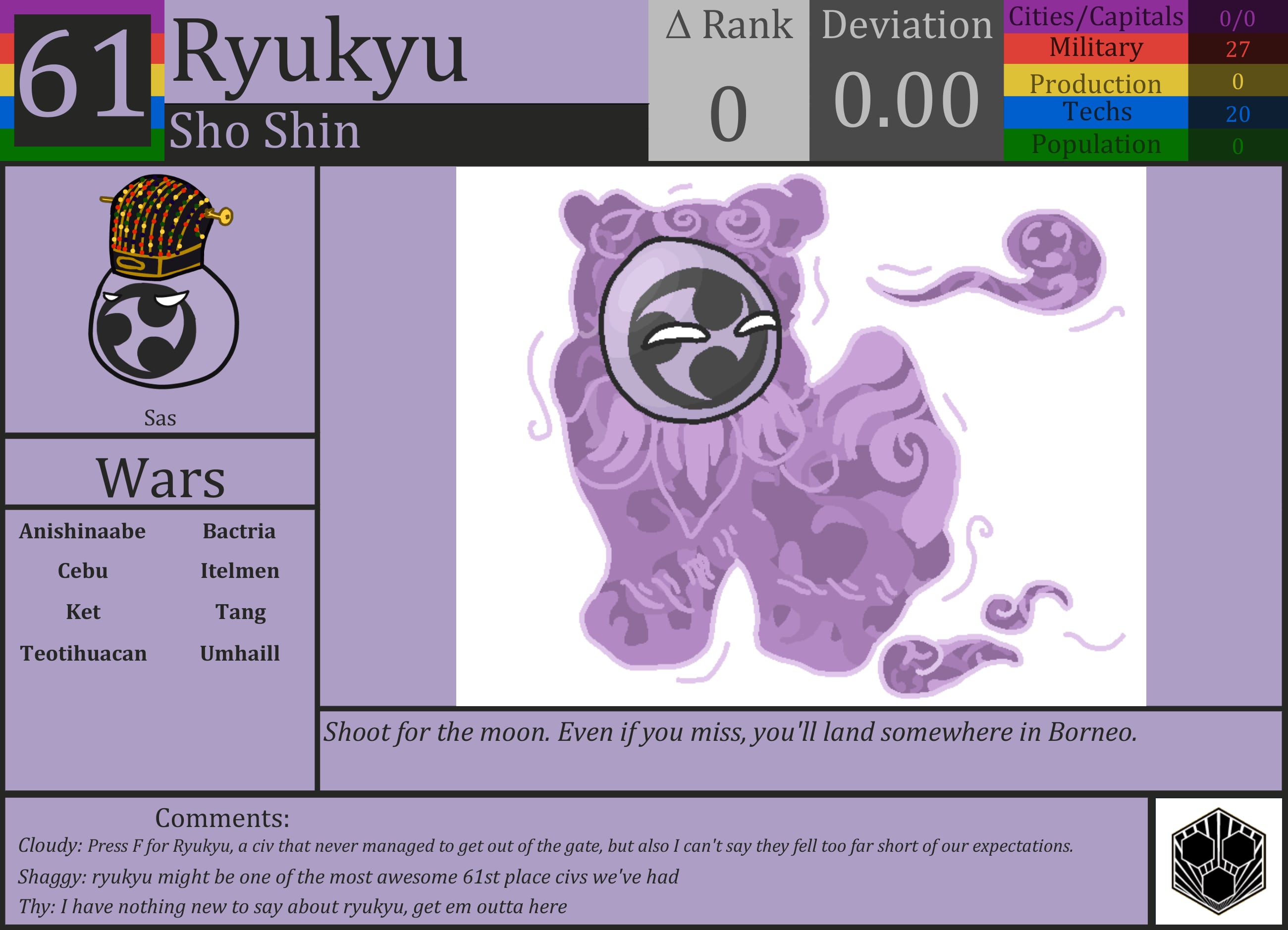
1: Ryukyu
NopeCopter:
There is something sacred about the first elimination of a season, the 61st placer. Their destruction signals, in a way, the start of the game, an often quiet and yet seismic shift in the state of the game from a complete roster to something no longer whole. The first piece torn out of a picture soon to be ripped to shreds. There are so many forms, too, that this first elimination can take, so many of which can feel… cruel, unfair. From the likes of Xia and Assyria, cut down before they ever even had a chance, to Rome, a perfectly decent civ which was simply beaten down relentlessly. The 61st placement is sacred, in a way, just as exclusive as the 1st place ranking and just as impactful. But they are rarely looked upon fondly. They are looked on with pity, with sadness. With “what could have been”. This is to be expected - they, by definition, did poorly. But the funny thing about the CBR is that even the worst of the worst can be looked upon fondly, because there is more to existence than success here.
The status of a “legendary” civ is a funny thing with regards to the CBR, because it’s so thoroughly divorced from what makes a civ successful, and yet it’s perhaps even more difficult to achieve that status than it is to win the entire game. It brings into question what a “good” civ even truly is - is it the civs that were strong? Or the civs you remember? Is the ultimate success of a civ to be powerful, or to be entertaining? To be both is the ideal, of course, but which takes precedence? The path to being a successful civ is obvious - there are many routes to take, but they all have similar ingredients and ultimately convene at the same result. Good stats, good initiative, good momentum, working around the geography and neighbors. The process of being a “strong civ” is built and maintained over eons. On the other hand, the process of becoming a “legendary civ” is often a matter of moments. It is spontaneous, it is divorced from and in some cases antithetical to success, and it is by its very nature unexpected. There are many legendary civs which were successful, of course, but just as many were the least interesting civs in the game until one moment, one decision, changed everything. So, then… what would it take for the 61st-placed civ to become a legend? To rise beyond even the stigma of last place and become something beloved, something iconic, despite having the worst record and the least time to make a miracle happen? Is it even possible to achieve such a thing without self-sabotage? Well, I suppose we have our answer to that question now, thanks to none other than Ryukyu.
Ryukyu’s entire existence was defined by chaotic ups and downs, of hope and despair, of denying supposed inevitability to create a new reality and then denying that too. From the very beginning, Ryukyu was not set up for success. Filling a slot most often given to a mainland civilization, Ryukyu was instead set to begin on a small island off the coast, disconnecting their core from their capital and potentially surrendering swaths of land to their other South Chinese rival, to say nothing of their naval vulnerability. Almost poetically, they found themselves stuck between China and Japan, just as they did historically. But the voters did not care. This was the point. This was a nation known for the impossible - for the infamously difficult EU4 achievement which required the player to lead them to world conquest. This was a civilization which had been waiting for an updated mod for a decade, and was finally getting a chance to prove themselves on the grandest stage of all. When they were voted in, some reacted with dread, lamenting the imbalance they represented. Others celebrated, seeing the potential for an underdog run. But none believed in Ryukyu.
Then, something changed. Among the Power Rankers, whispers began to circulate, spreading news nobody expected to hear: success for the Ryukyu. Two incredibly strong test runs in a row. Strong settles on the Chinese coast, and even Korea, translating into eventual conquest of Japan and dominance of the coast. It seemed impossible. It seemed to defy all logic. But the reality was undeniable. Ryukyu could not only succeed but even thrive. Immediately the PRs began to sing a new tune, one that saw Ryukyu as a dark horse, a secret powerhouse that defied all notions of what an island civ in a land-dominated region “should” be. It was exciting. And with further buffs to improve island civs’ settling AI, that excitement seemed ready to blossom further.
However, as the tests continued, a new reality began to set in. Failure after failure. Where had that scrappy, expansive Ryukyu gone? It was hard to say. They had perhaps one more run resembling a success, but that was it. To some PRs, this was enough to cull all those feelings of hope that once abounded. Still, some refused to see this reality, clinging to first impressions. Ryukyu was still a dark horse, a potential power. And with this split, Ryukyu was placed in a controversial 55th place in the initial Power Rankings. They were spoken as if they were trapped between major powers, unlikely to amount to anything, but also as though they had that spark, that glimmer of hope. Like the power which led to those early test runs still laid dormant inside them, ready to burst out if given the opportunity.
And, as bottom-tier civs often do, Ryukyu seemed to let that latent power, that underdog spice, flow instantly into their every action, as if compelled by a higher power to make the PRs look like fools. Ryukyu came out of the gate swinging, playing every card right, placing not one but two cities on the mainland in the first episode alone. Yunnan, meanwhile, was slow - they did not settle. Cebu was even slower. Japan settled southward, but their cities were all vulnerable by sea. Instantly, Ryukyu rocketed up the PRs, into the top half. For some other civ, perhaps this would have seemed premature. But the PRs had seen what Ryukyu could do. They knew the potential Ryukyu held, if they could just get off to a strong start. They were ranked low because their course was so uncertain, but once they had chosen their course, the trajectory could only lead to success.
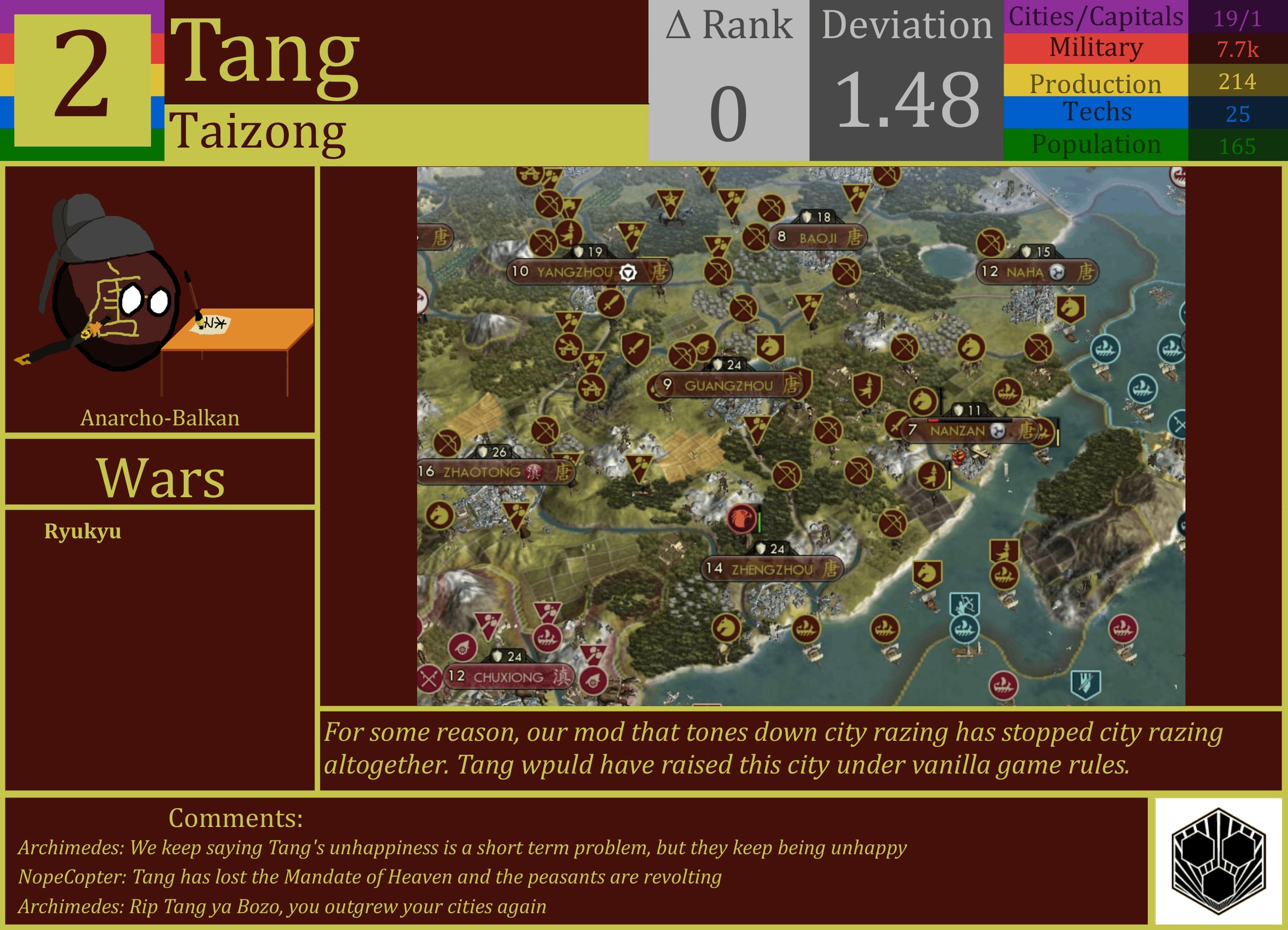
…Or, that’s what we believed. But there was one other factor that nobody considered: the potential that Ryukyu wasn’t the only civ overperforming. As Ryukyu stagnated and rested on their laurels, Tang sprung into action with a series of bold settles, crushing any dreams of Ryukyu expanding further inland while simultaneously strangling Yunnan in their bed. Ryukyu would not be a Chinese civ this time. But this was okay. Their destiny always laid on the sea. And fortunately for Ryukyu, opportunity abounded in the south. As Yunnan underperformed, Cebu and Pegu performed exactly as expected: which is to say, not at all. Even Lanfang seemed disinterested in the likes of eastern Borneo, leaving massive swaths of Southeast Asia open to the enterprising Ryukyu. It was silly, sure. It was much worse than just strengthening their hold on the mainland. But it provided a route into a full region of vulnerable targets.
Ryukyu’s opportunism wasn’t limited to their settlement, however. Above them, Japan has been expanding rapidly, cutting Ryukyu off from any northward settlements. But that meant that all of these cities - constructed instead of a navy - were island cities hopelessly exposed to a naval assault. And Ryukyu had a navy. So as Japan rushed to colonize Korea, they struck. Their Triremes surrounded and battered Momoyama. Taking even one city in this war would cripple their northern rival and put them on the first step to conquering Japan as they had in those first test runs, to put Ryukyu on the path toward dominance over the northwest Pacific. They had done it before, after all. They could do it again.
Unfortunately, by their very nature, risky plays are risky. Putting it all on the line is rarely a choice made with 100% safety. Sometimes bold, aggressive plays fail. And here, Ryukyu’s dice rolled snake eyes. Granted, this was largely their own fault for playing far more boldly than they needed to. Their fleet was beaten down by the waves of Momoyama, the siege broken by a Japanese navy that mobilized faster than expected, but the war was a desperate and unnecessary play anyways. Instead of a safe and useful mainland settlement in Vietnam, Ryukyu instead went immediately for the riskiest possible option and settled Borneo, angering Lanfang and making their critical fourth city needlessly difficult to reinforce. Ryukyu’s rank tumbled. Ten ranks after being blocked out of China, and another ten after wasting their navy and their Settler.
From here, the consequences of Ryukyu’s actions reared their ugly heads immediately. Yunnan and Cebu, despite their sleepiness, finally found the time to claim the eastern coast of Indochina, locking Ryukyu out of their next-best base of operations. Lanfang punished Ryukyu’s insolence by quickly and effortlessly capturing their forward-settle of Tomari. To Ryukyu’s credit, they refused to give up at this point. But whether it was a panicked attempt to salvage their position, thrill-seeking, or delusions of grandeur, they just could not resign themselves to a safe play. Instead, they built another Settler… and once again sent it to Borneo. The settlement of Nakijin was perhaps a belated attempt to reinforce their second core, or perhaps it was a signal that they had given up and had decided to just have fun with the rest of their existence. Whatever the case, it was also a clear sign to the PRs that Ryukyu was well and truly out of the game. They had given up. Their stats were in the gutter. Of course, in theory they weren’t COMPLETELY out of it - they still had two utterly pathetic neighbors in Yunnan and Cebu - but that didn’t matter, because they hadn’t actually made peace with Lanfang, either. In fact, Lanfang wasn’t even their most existentially threatening opponent. The almighty Tang, who had just brought both Rouran and Yunnan to heel, also tired of Ryukyu’s shenanigans. And thus, Ryukyu was to be crushed.
But the coalition war against Ryukyu was strange. In fact, it almost felt like a mockery of Ryukyu’s dreams and aspirations, what they wanted to be. Because Ryukyu actually did succeed at fending off Tang and Lanfang, at least at first. But then Ryukyu’s arrogance truly came back to bite them. First, Japan joined the war. Ryukyu, whose navy still had not recovered from their reckless attack against that very same civ, found themselves the victims of their own aggression. And yet somehow this was not the most impactful or even the most karmic moment of Ryukyu’s downfall. For in their hubris, Ryukyu had forward-settled Lanfang, yes - but more importantly, they had NOT forward-settled Cebu, the slow-going, despondent Filipino civ. Cebu had left their entire potential core open to grab, but rather than take the opportunity to cripple their neighbor for good and position themselves to conquer this bottom-feeder, Ryukyu bypassed them entirely, because they were the dark horse underdog, and they were too good for Cebu. After all, this was Cebu, the civ which had not built a single Settler in over a hundred turns. They could always come back to grab the rest of their unused land later. And it was this very ignorance, this desire to be the cool dark horse underdog, which provided the opportunity for a REAL dark horse underdog to rise. Because suddenly, in the midst of the coalition war that Ryukyu was barely holding out against, Cebu awoke. And they mobilized the navy that had been scattered across their oceans. And in the span of five turns, they not only took Nakijin, but also Ryukyu’s very own capital of Shuri. Ryukyu was cut down by the very image of what they could have been.
In an ordinary world, perhaps even a just world, this would be exactly where Ryukyu’s story would end - a civ which rolled the dice for no reason and lost, a civ which in their attempts to rocket above their station only handed that same opportunity to another. And as their final cities, those coastal Chinese cities which gave the PRs so much hope, were besieged by the Tang, that seemed to be their legacy. As their final city fell, Ryukyu was set to be a tragic tale, a classic example of a 61st-place civ - a dream cut short, a valiant effort ultimately reduced to nothing by the crushing arm of reality, to be remembered as nothing other than another coalition victim.
But the process by which a civ becomes legendary occurs in moments, not eons, and the hand of destiny strikes whoever and whenever it pleases. And so, by the efforts and dreams of the very last Ryukyu Spearman, Nanzan was flipped one last time, one last show of defiance and spirit before exiting the stage of the CBR. Not an uncommon gesture, but always a respectable one.
And then Tang made peace.
In one moment, Ryukyu has remade their destiny, their legacy. They had become the very first civ in CBR history to meaningfully un-eliminate themselves, clutching life from the jaws of death. In a way, it was meaningless - they were still a city-state trapped for eternity with nothing else to do. But legends are made in moments. And in that moment, nothing else Ryukyu had done or could do mattered. They had stopped being a civ and became a story, an icon. A legend.
Well, this legend was admittedly somewhat dampened by the fact that it ultimately did not truly matter. A few episodes later, Cebu once again declared war, and this invited Tang to return and finish the job. Ryukyu still placed 61st. Their miraculous revival did not change their fate or even improve their ranking. But Laos’s self-immolation did not prolong their life. The Afsharids ultimately fell all the same even when they clawed their way back from a single city’s liberation to control over India. Ryukyu’s rank would have been the same whether or not that one Spearman had made that one fateful move, and Nanzan would be Tang either way. But what WOULD have changed is the spirits of the cylinder, the words spoken between observers, the jokes, the emotions, the excitement. Ryukyu’s rising from the grave changed nothing, and yet it changed everything. It was something we had never seen before, and will likely never see again. It was a forgettable blip on the radar in terms of data, but it was an unforgettable MOMENT. It was not only the ultimate demonstration of the difference between a “strong” and a “good” civ, but also the ultimate demonstration of the value of the human in the CBR, of the observer, of the little moments that make people smile even as the cylinder marches toward homogeneity. It is the perfect encapsulation of what makes the CBR special, and it has made Ryukyu into something not only unforgettable but beloved. And they’re the LAST PLACER of this season. So thank you, Ryukyu. Your legacy may not be what you were promised, but it is positive all the same. You did not conquer the world, but you conquered our hearts and reminded us all of what truly matters. F.







No comments yet.