
1: 15 Turns of bloodshed
Hello lads, and welcome to Episode 9 of Season 1 of the world-famous Civ Battle Royale X! I am /u/ThyReformer, and I will be your host today, narrating you through what is turning out to be a very stormy episode indeed.
 Civ Battle Royale
 With most of the cylinder entering the Medieval era, more and more civs begin to run out of space. To-be conquerors would do well to remember, however, that as victories mount, so too will resistance.
Hello lads, and welcome to Episode 9 of Season 1 of the world-famous Civ Battle Royale X! I am /u/ThyReformer, and I will be your host today, narrating you through what is turning out to be a very stormy episode indeed.
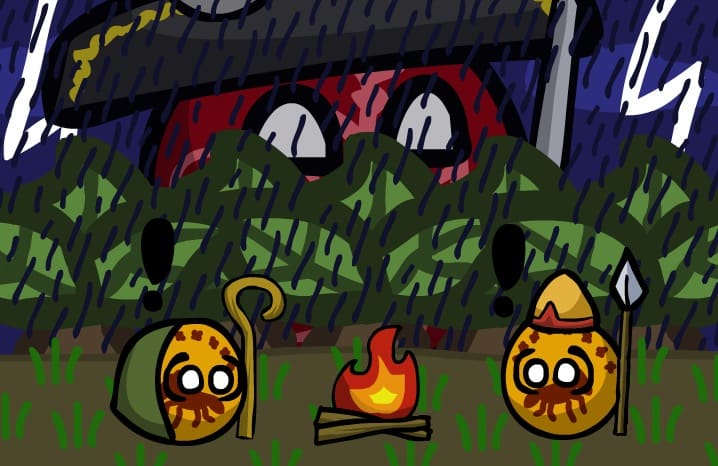
Last week, Haiti took Maturin without much trouble. Can they move onwards to bigger targets this week?
Credit to /u/Doccit for this piece of art.
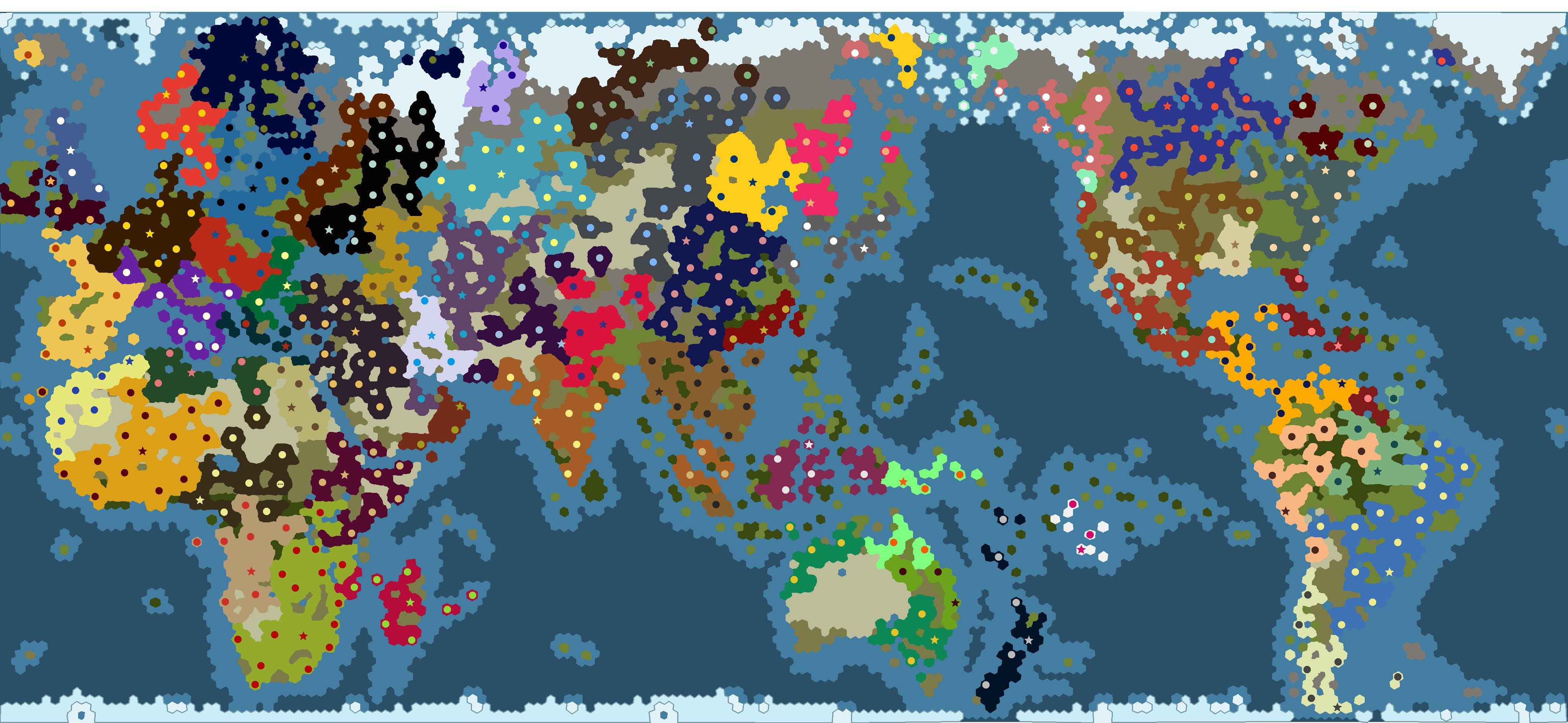
Here is the hand-drawn map by /u/Vihreaa. Hot-spots to watch this part are the HRE’s wars, the Nubian coalition, the Goth wars, what remains of Canton’s coalition, and of course the Venezuelan coalition.
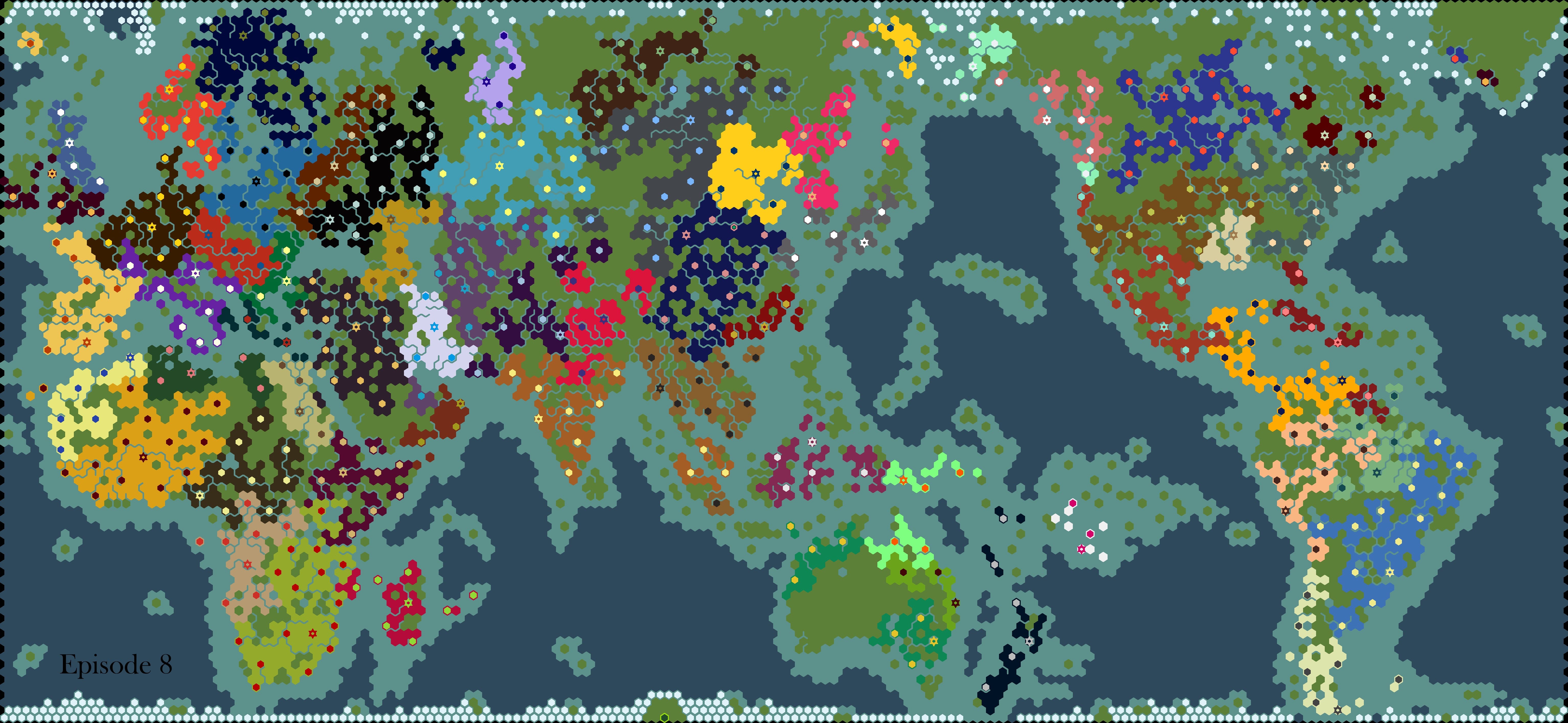
And here, for a bit of a change of pace, is a tile- and terrain-accurate map from /u/DerErlenkonig. Other hot-spots around the cylinder are the Manx-Scottish war, the Kazakh-Evenks war, and the Apache-Aztecs war.
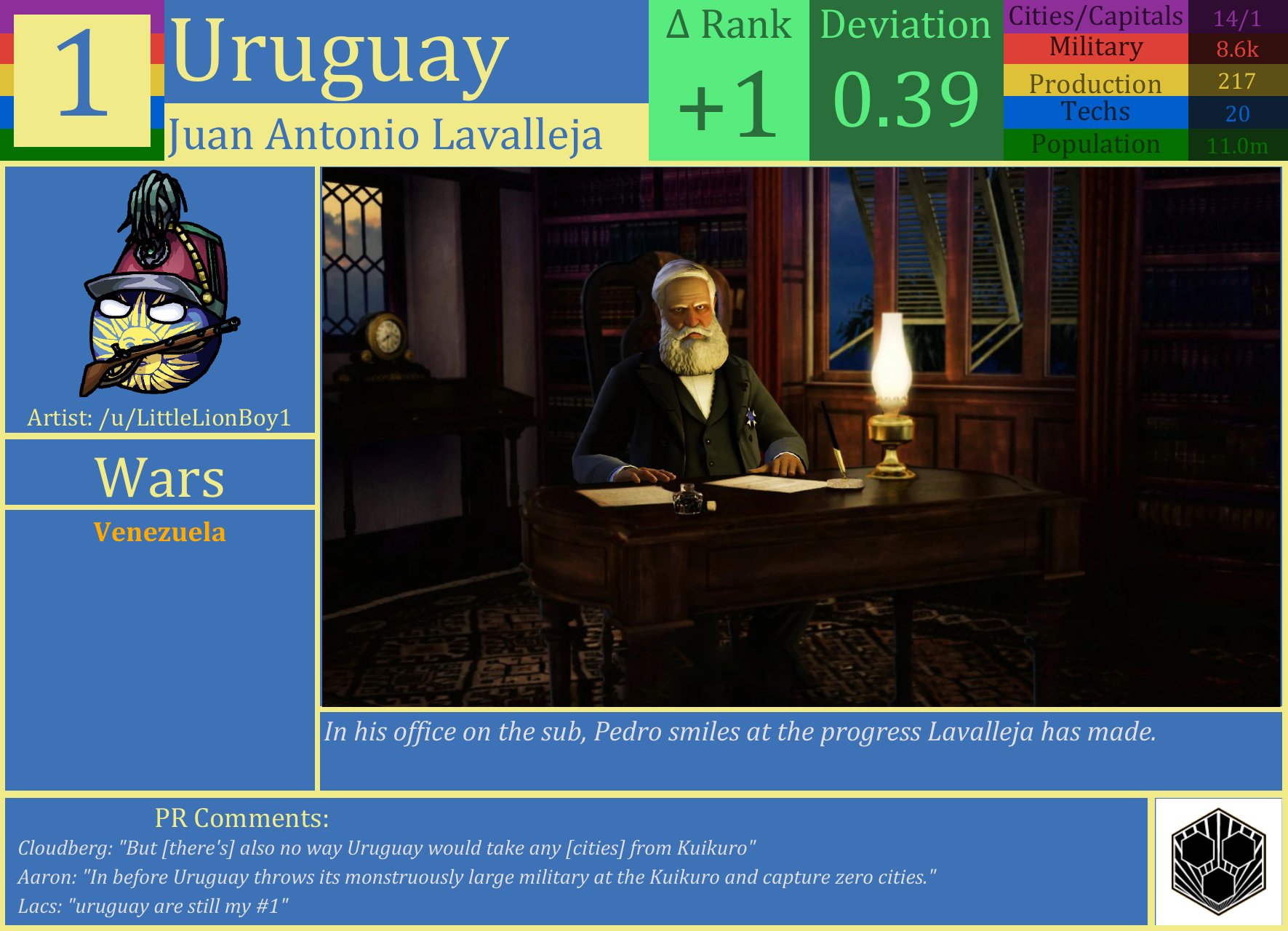
Breaking Zimbabwe’s streak, Lavalleja’s Uruguay re-enters the top spot. The two civs remain extremely close, but will they still be neck-and-neck after this part?
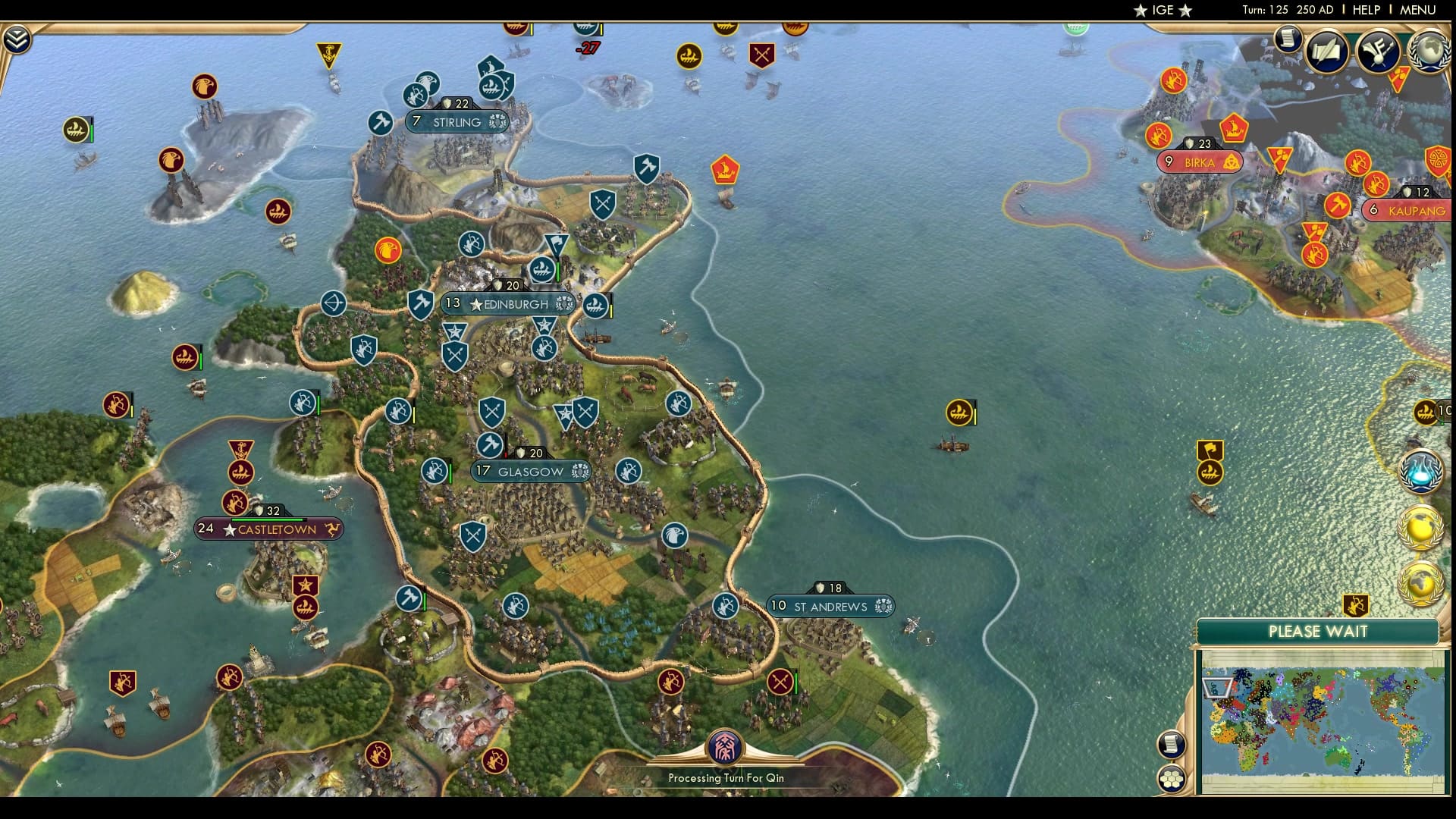
We start off the episode in the Isles, observing what is the first damaged city in one of the many ongoing European wars this part. From the safety of the Great Wall, the Scottish composite bowmen fire potshots at the Manx capital, while in the south the Manx land forces approach St. Andrews. With the Scottish city not even garrisoned at the moment, I somehow have more confidence in the Manx offensive - even if it’s the one hindered by the Great Wall.
For a war in the Isles, the seas are strangely calm, as the only naval battle appears to be in the north in the form of a small skirmish.
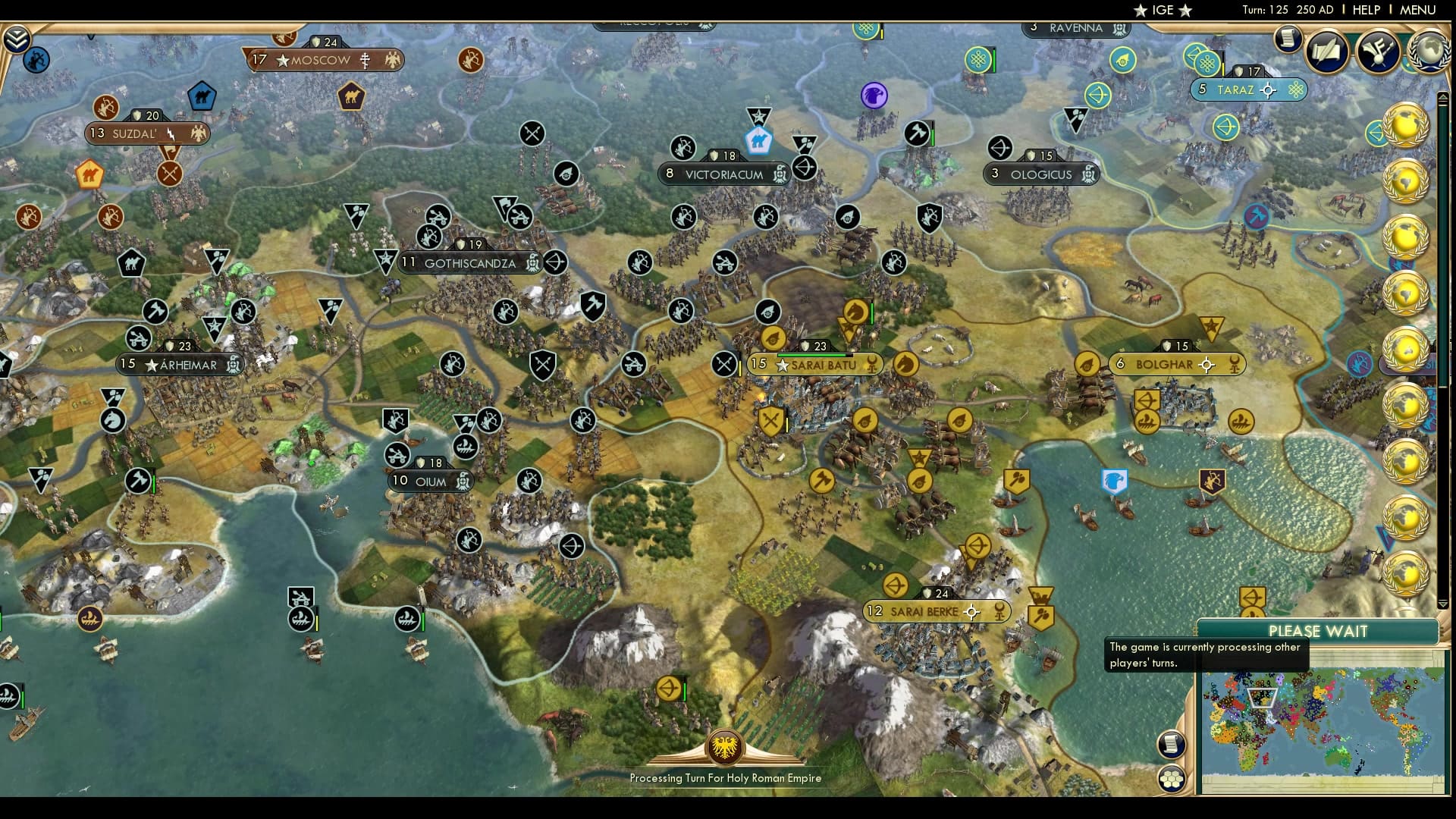
Eastward, on the edge of Europe, the Goth army marches onward, finally breaching the walls of the Golden Horde capital, Sarai Batu. Tokhtamysh has gathered a host of his best men for a glorious last stand, but will it be enough?
Meanwhile, in the upper-right corner, the Goths begin to slowly realize that they have another enemy to fight, as Ablai Khan’s men systematically surround Ravenna. As we remember from last part, Ravenna has already taken heavy damage, and is likely to fall soon.
Perhaps more interestingly, the Parthian settler you barely see on this slide has sat still for dozens of turns at this point. What goes through the heads of those people, I do not know. Maybe they’ve gotten lost in the dunes.
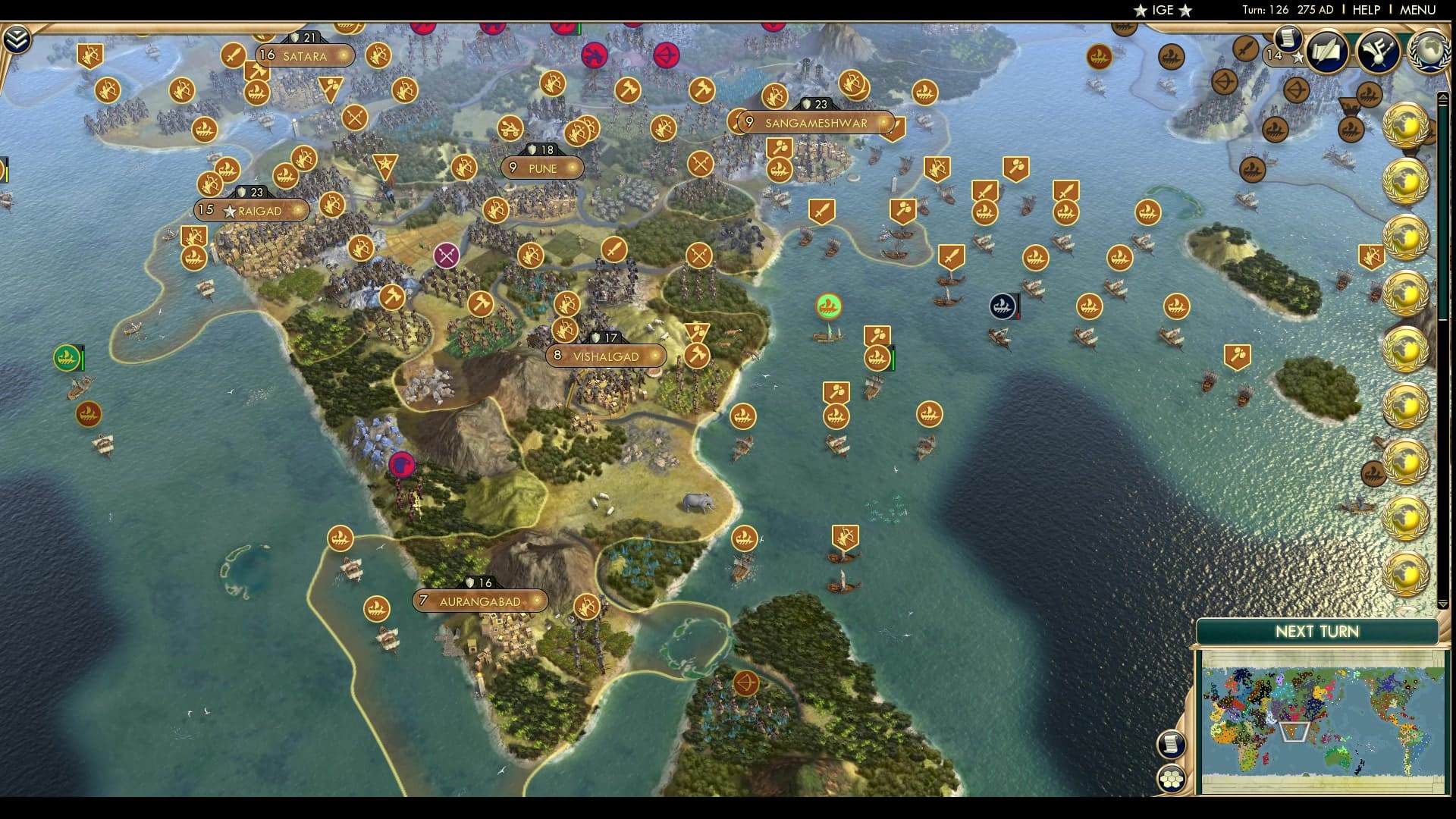
BC bestows upon us an excellent shot of Southern India, home of the Maratha. As the highest ranked Indian civ, Maratha is facing a lot of pressure - and as we know, pressure can mess with a man. Opting to forgo Sri Lanka in favor of more distant islands must be a stress-induced decision. Moving a good dozen units to protect your distant holdings is a more coherent action, but still questionable.
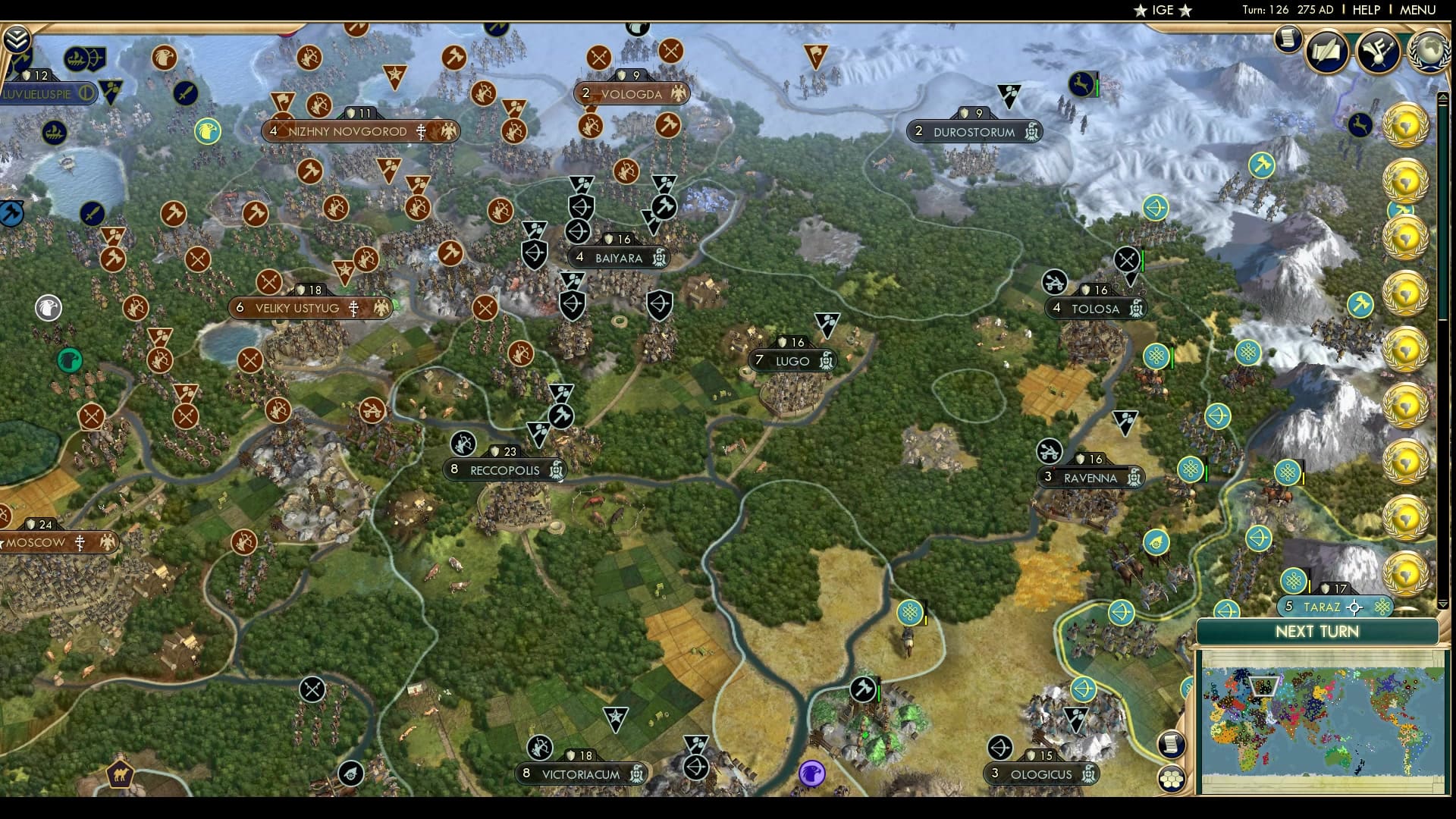
We return to the Goths with a proper view of their eastern holdings, and indeed it is proven that Ravenna is at 0 HP, with a Kazakh melee unit ready to go once next turn comes. With Ravenna’s fall a foregone conclusion, will the Kazakh hordes march further, or will the attack dissipate beyond Ravenna?
On the west side of the Goth realm stands a surprisingly good Muscovite army. Attacking now would be a shot at long-term relevancy for Ivan the Terrible, but does he have what it takes to disprove his moniker?

In Central Europe, Havel continues to desperately funnel troops towards Liberec, his former city, all the while forgetting that melee units are a useful thing to have on the front line. Somewhere in Prague, a general is yelling loudly.
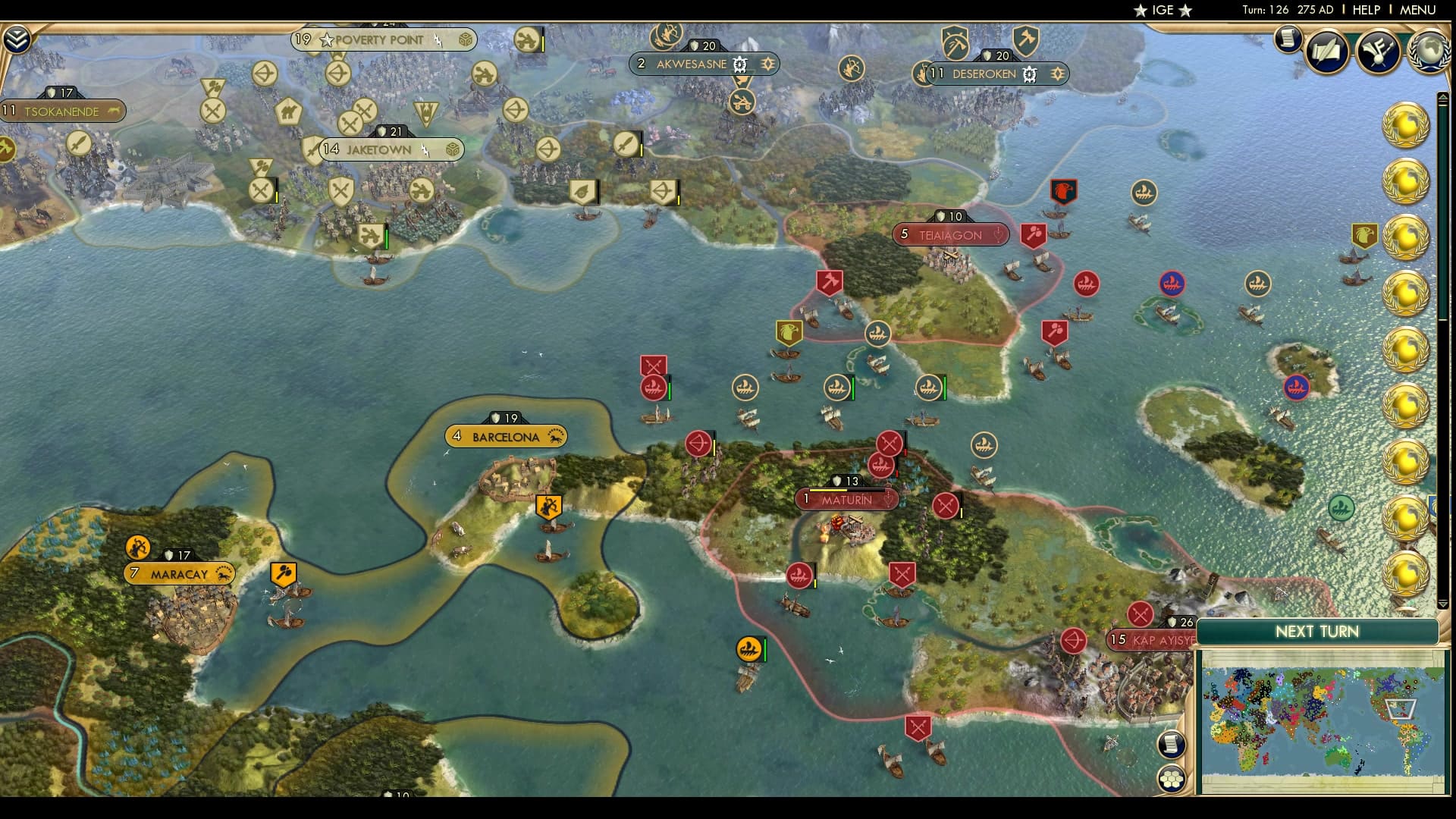
With Maturin well within his grasp, Toussaint considers sailing forward to Venezuela’s slightly misplaced city of Barcelona, but observant, uh, observers will notice that the Haitian forces have suffered noticeable losses in this war. Sure, Barcelona has only an embarked composite bowman defending it, but when the land approach to the city is one tile wide, and you have only three triremes nearby, even an undefended city poses somewhat a problem. Go away, go away, come back another day!
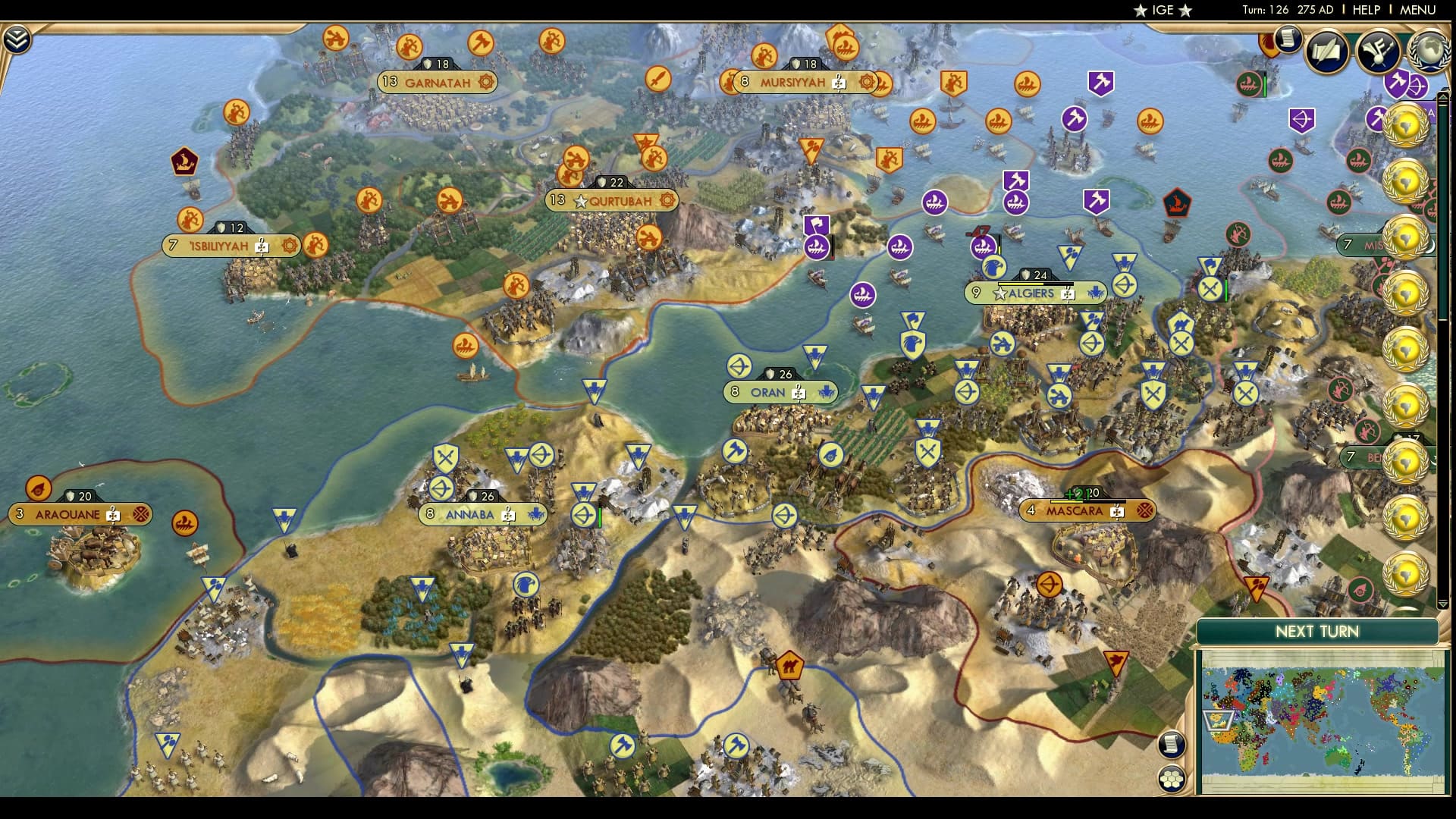
Enrico stubbornly continues his naval invasion of Algeria, with the capital of the white-and-blue civ still in the yellow.. As we remember from last part, this attack already dispersed once. At least you can’t blame the Venetians for giving up. Including the settler in the attack is a weird choice, though.
Just south of the Algerian capital, Mascara still heals from the wounds of war. Peace between Algeria and Songhai might’ve been an excellent decision for the Algerians, as it ensures that the Algerian army is not distracted by Mascara, and is instead able to sit on the Mediterranean coast, firing arrows and rocks weighing less than 90 kg at the invasion fleet.
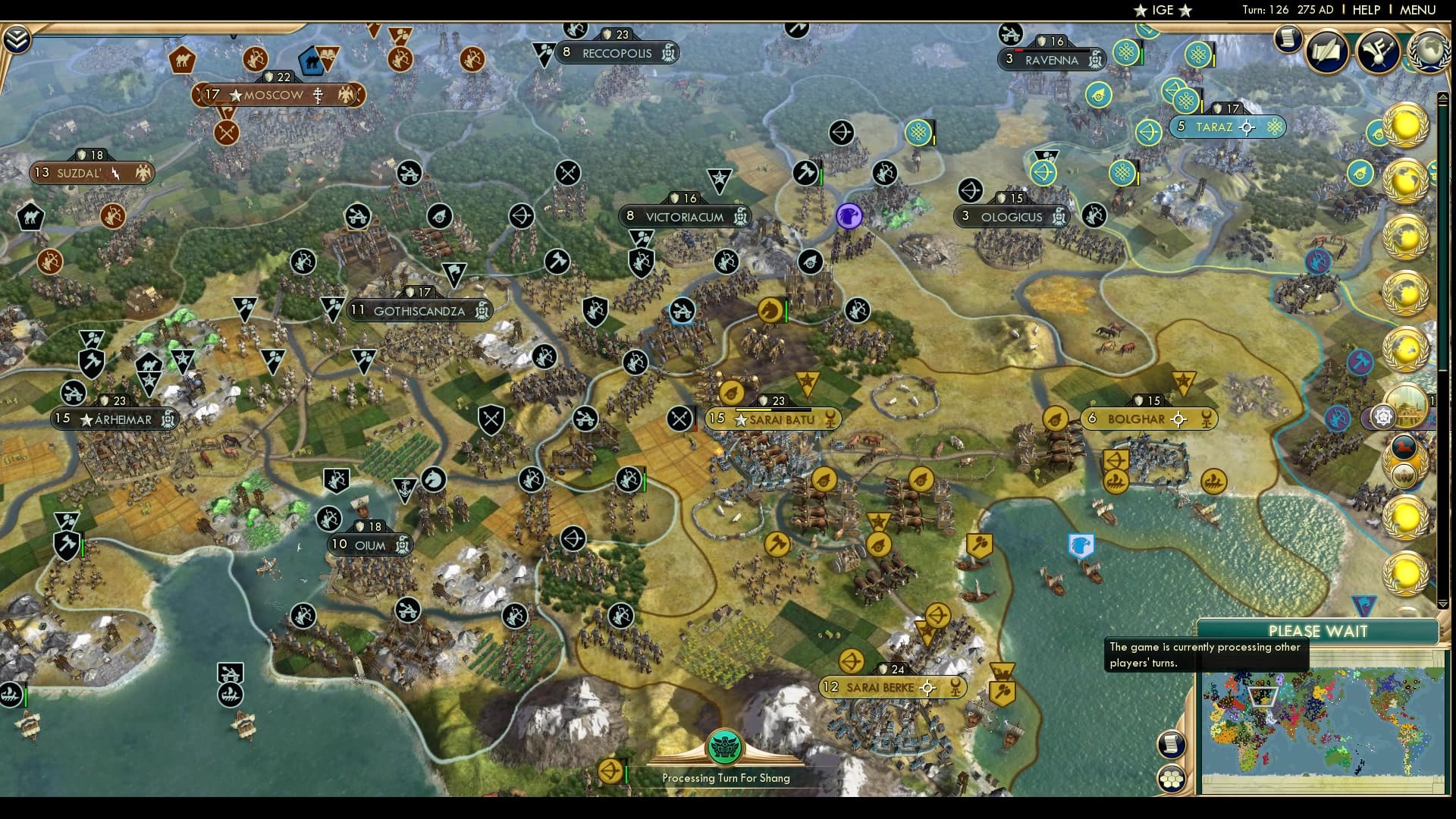
In a single turn, the Goth army brings Sarai Batu down to half health. With any luck, the city will fall next turn, but the melee unit next to the city looks a bit worse for wear. Alaric would do well to bring another one closer, if he’s actually interested in capturing the city.
You might notice that Ravenna has not fallen despite my ravings earlier to the contrary. But this simply due to the Kazakh turn not coming along yet, and as such, I maintain my promise that the city will fall.
Parthian settler status: Sitting on their hands.
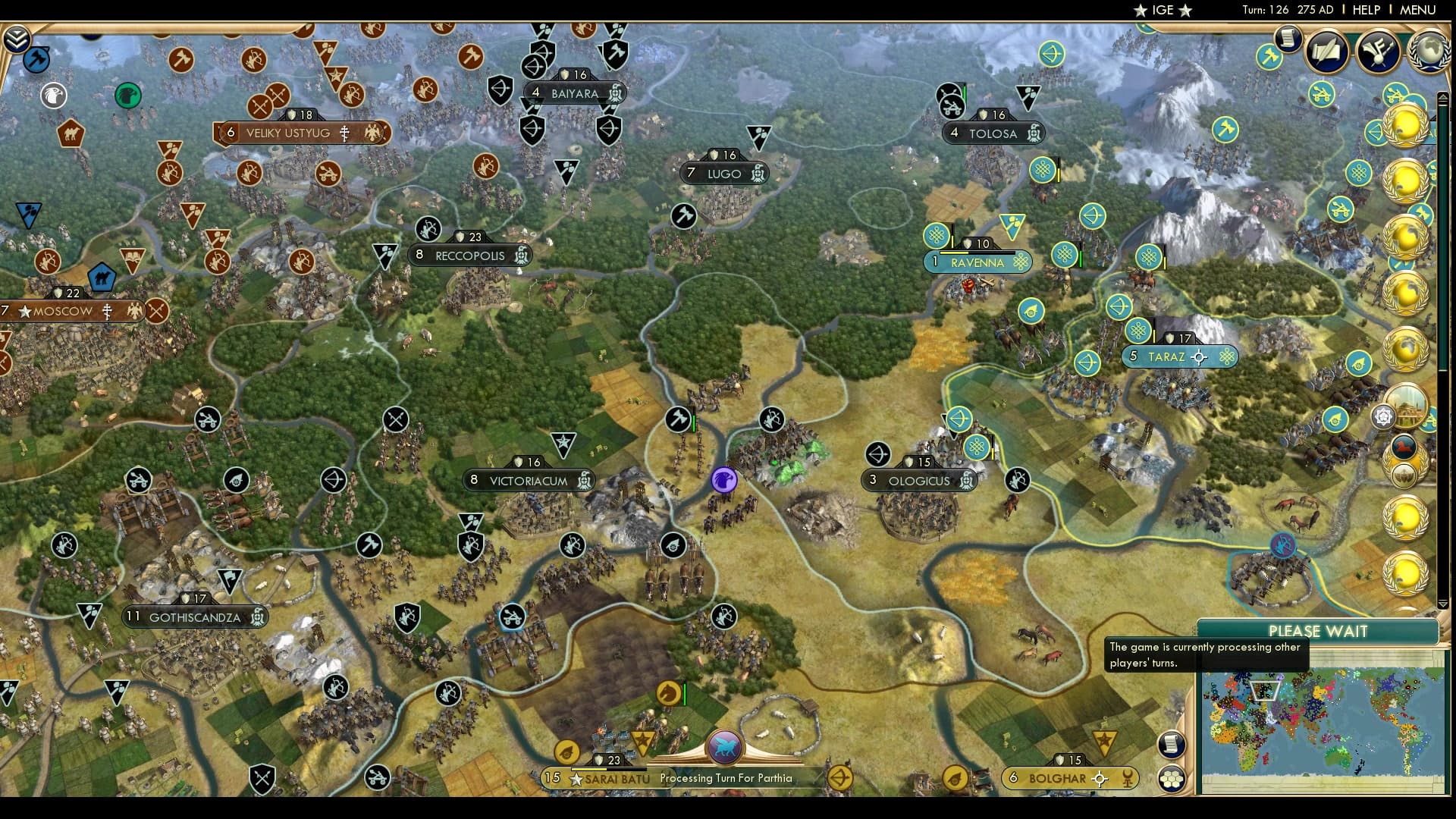
And mere moments later, Ravenna has fallen to the Kazakhs. Immediately thereafter, Ablai Khan orders his men to Divide and Conquer. As in, divide into two separate groups and attack two cities simultaneously. It worked before, right?
On the sidebar, we see Shikoku has built Hagia Sophia, giving them a Great Prophet when all the religions have already been founded. In slightly more important news, Nubia has managed to make peace with one of the civs in the coalition - but then again, it’s not like Minos was much of a threat to begin with.
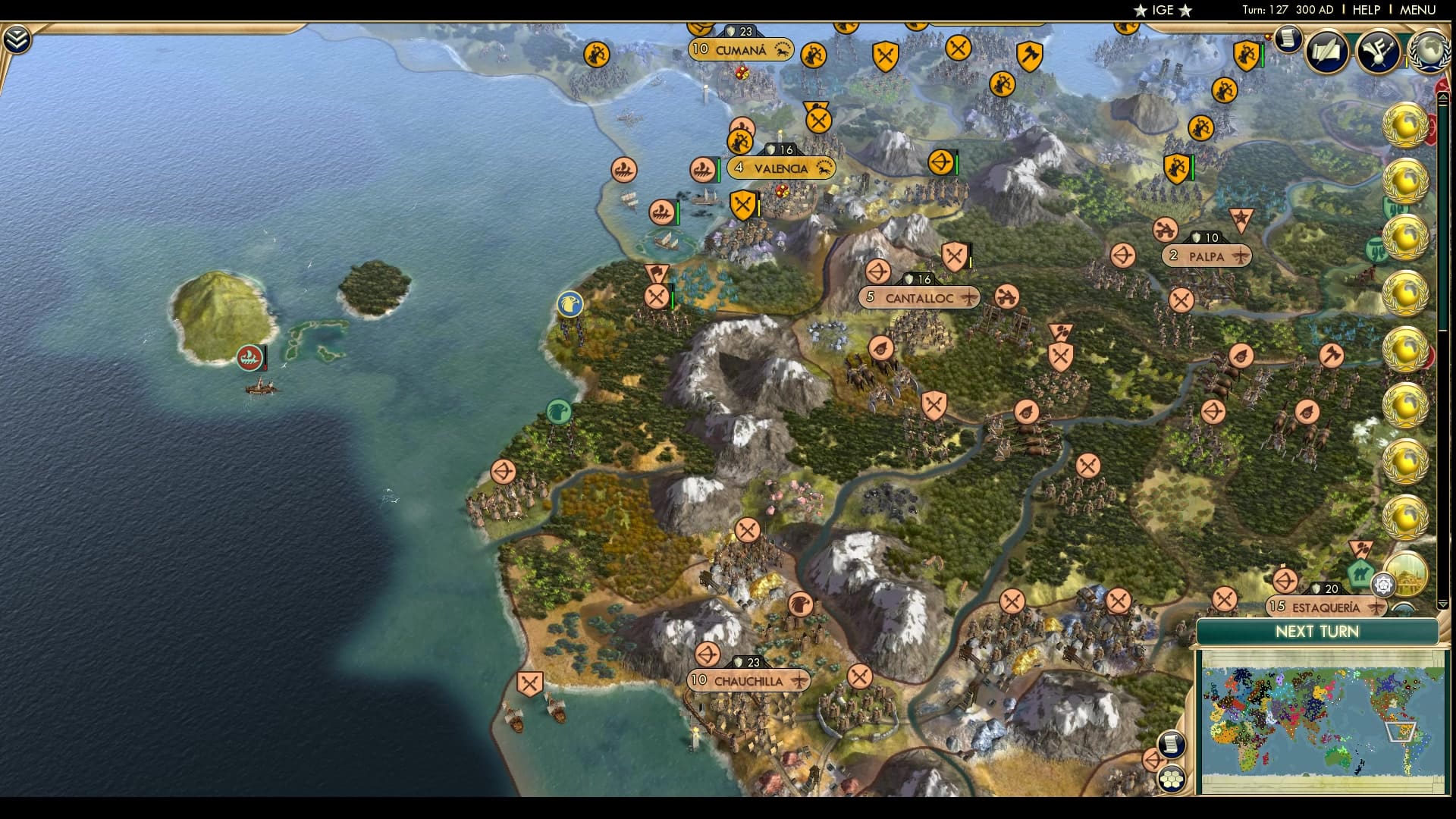
Coming in sight of another civ fighting the Venezuelans, we have the Nazca, doing its best battling through the small mountain passes of Valencia. A respectable navy of four triremes has come together outside of Valencia as well, but nevertheless, the city seems like it will hold for now.
Notable, however, is the settler walking through a mountain pass, seemingly towards Valencia. The spearmen, I hear, are accompanying the settler for self-defense. Self-defense that mostly consists of charging into a Venezuelan formation of spearmen, to be specific.
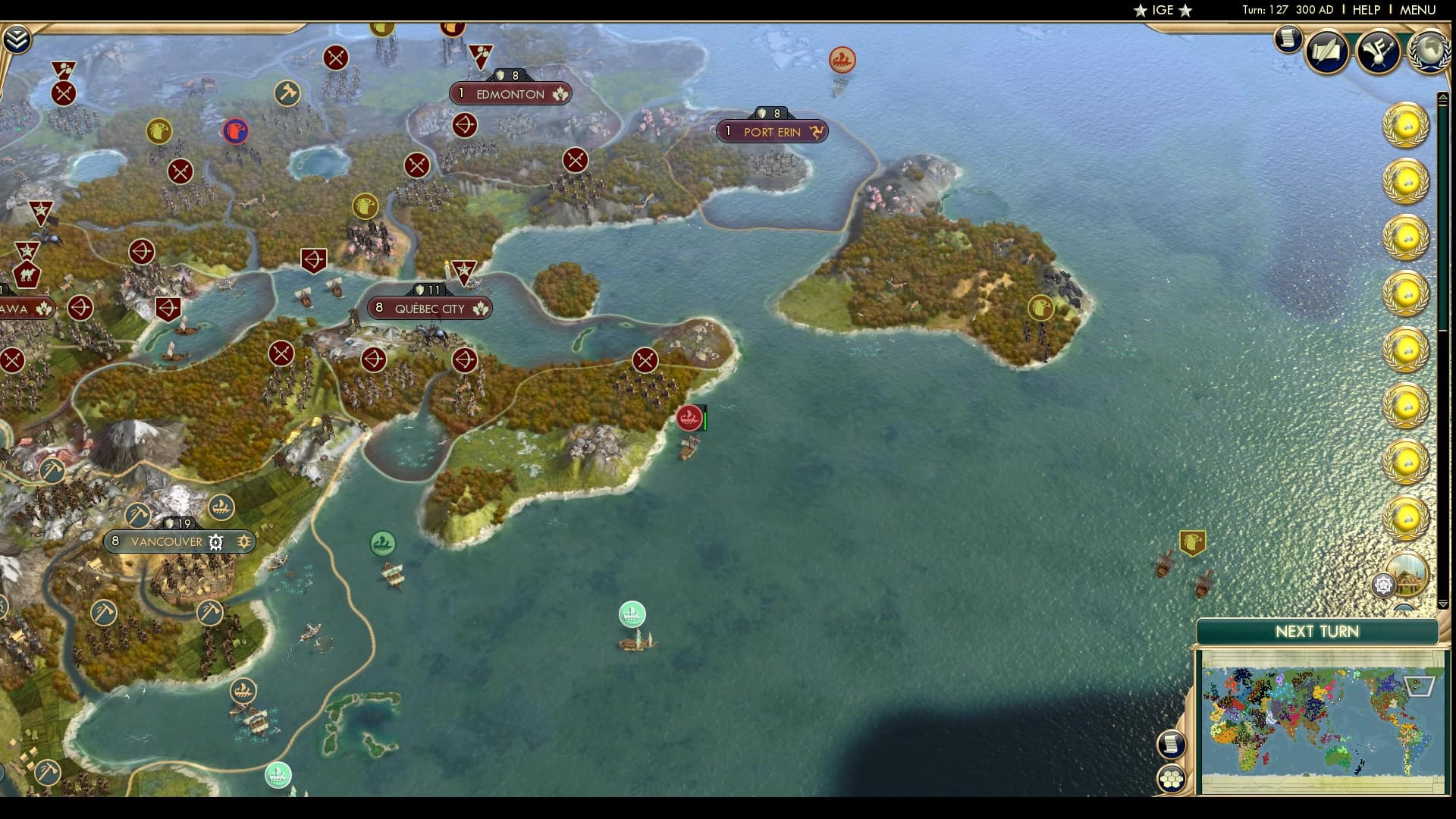
We are taken all the way north to Quebec, as a Manx city has been spotted by some Canadians walking by, near the also-recently-settled city of Edmonton. A settling choice rivalling that of the Yup’ik or the Qing in absurdity, Port Erin is a wildcard on the North American continent. Will the Manx go as the Icelandics once did in an alternate reality, or will Canada finally have a city to capture?
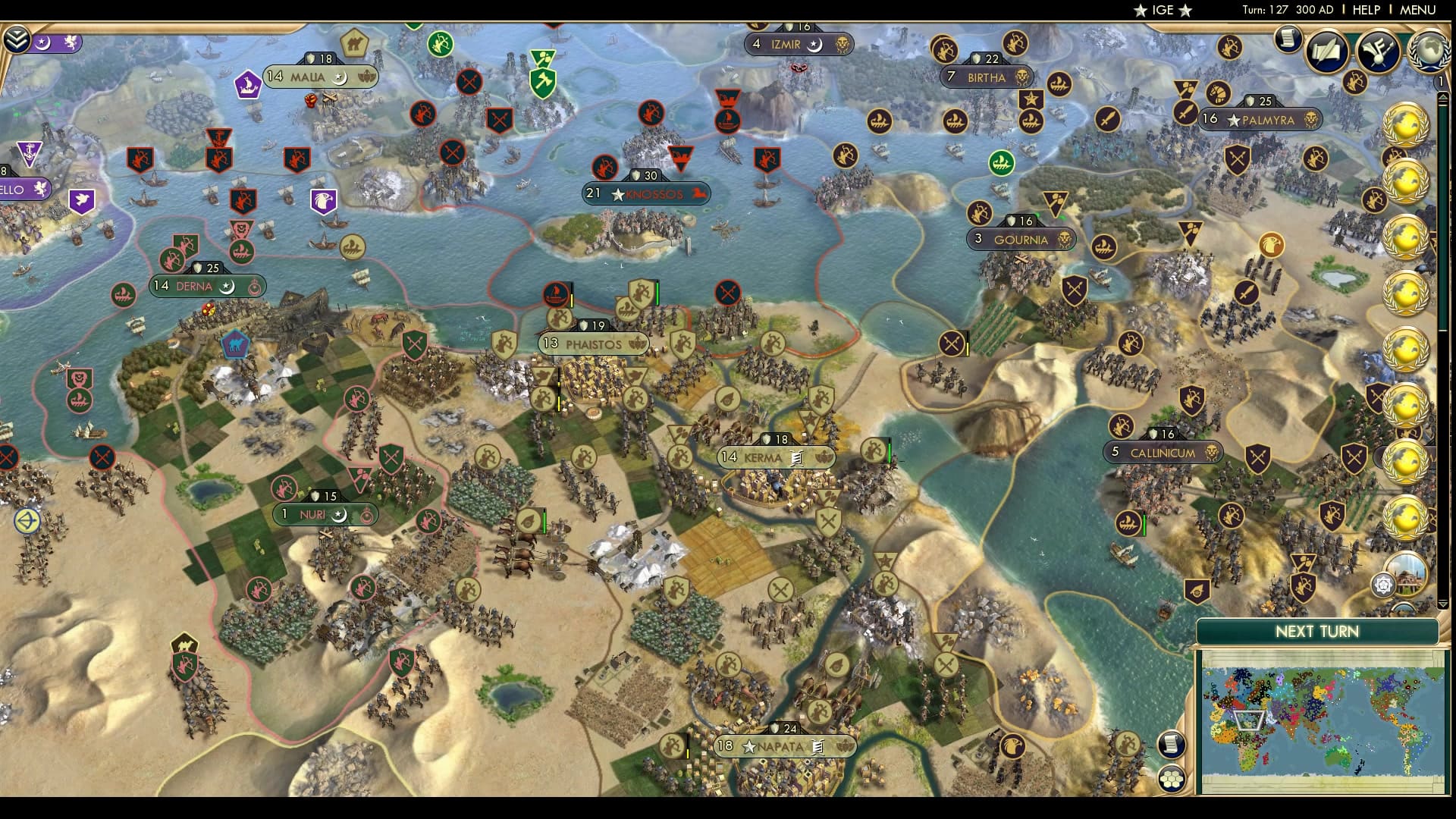
A single look at Eastern Mediterranean reveals the grave reality of the Nubian-Minoan peace. In order to appease the Nubians, Malia has been given away in the peace deal, leaving Minoa with one last city. What could’ve possibly driven the Minoans to accept this? Personally, I believe that Minos finally escaped his labyrinth, but not with his sanity intact.
Away from the painful disappointments of the Mediterranean, the Libyan-Nubian war presses on. With Palmyra rendered to a non-threat due to terrain, Piye is able to reinforce the western side of his dwindling kingdom. Perhaps he can come out of this war without losing any more cities.
Coiot: Nubia is the biggest bully!
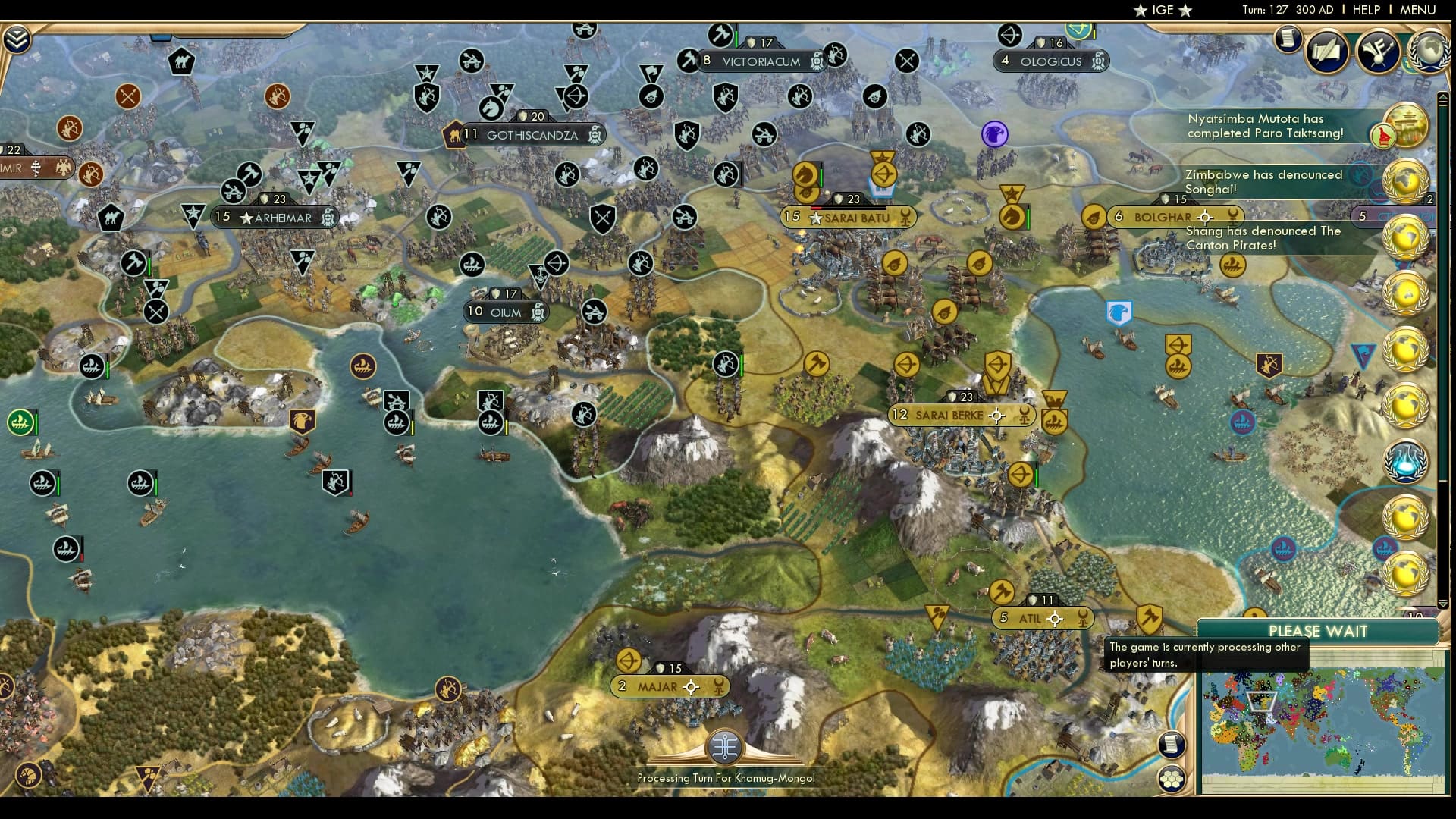
As expected, Sarai Batu has fallen to very low health. In equally expected news, the spearman sitting outside the city has also fallen. Please, Alaric, I believe in you! Move that spearman closer!
In less stressful news, Zimbabwe has built yet another wonder. This one is Paro Taktsang, and it gives +1 faith and culture from mountain tiles. Specifically, it gives those yields to all workable mountains in Zimbabwe lands.
Parthian settler status: assumed to have been eaten by a sandworm.
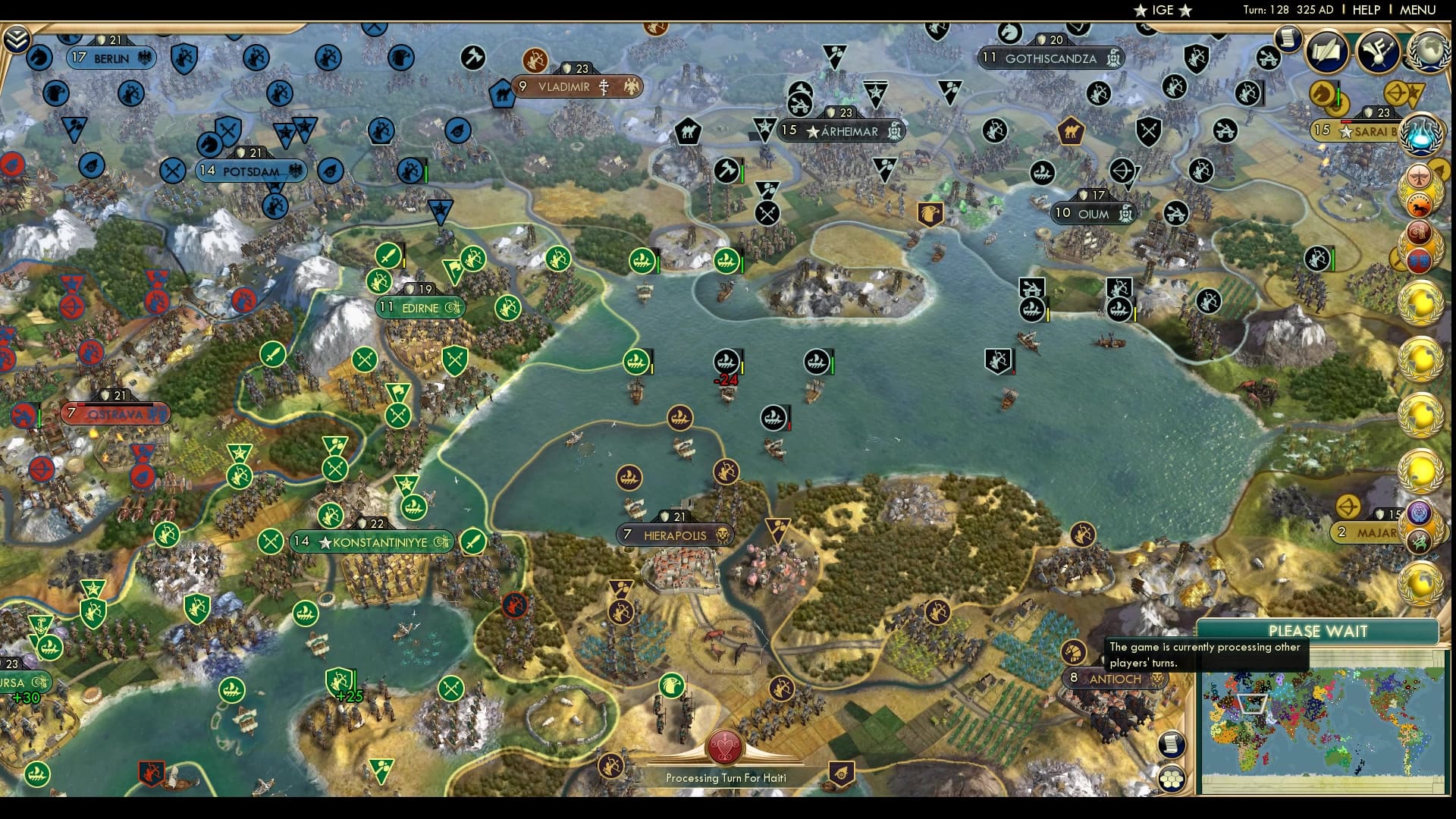
Don’t be distracted by the naval skirmishes occuring in the center of the shot here. Point your eyes at the city of Ostrava, in minimal health, with a Turkish swordsman a tile from the city- what do you mean they made peace? The Turks make peace with the Czechs once again without taking Ostrava. I do believe this is the closest they have gotten to capturing the city, so maybe next time they’ll have better luck. Maybe Mehmed will turn his eyes to Malia’s new owner instead?
The other relevant peace on this slide is the one between Nazca and Venezuela, meaning the Venezuelan coalition might be falling apart already.
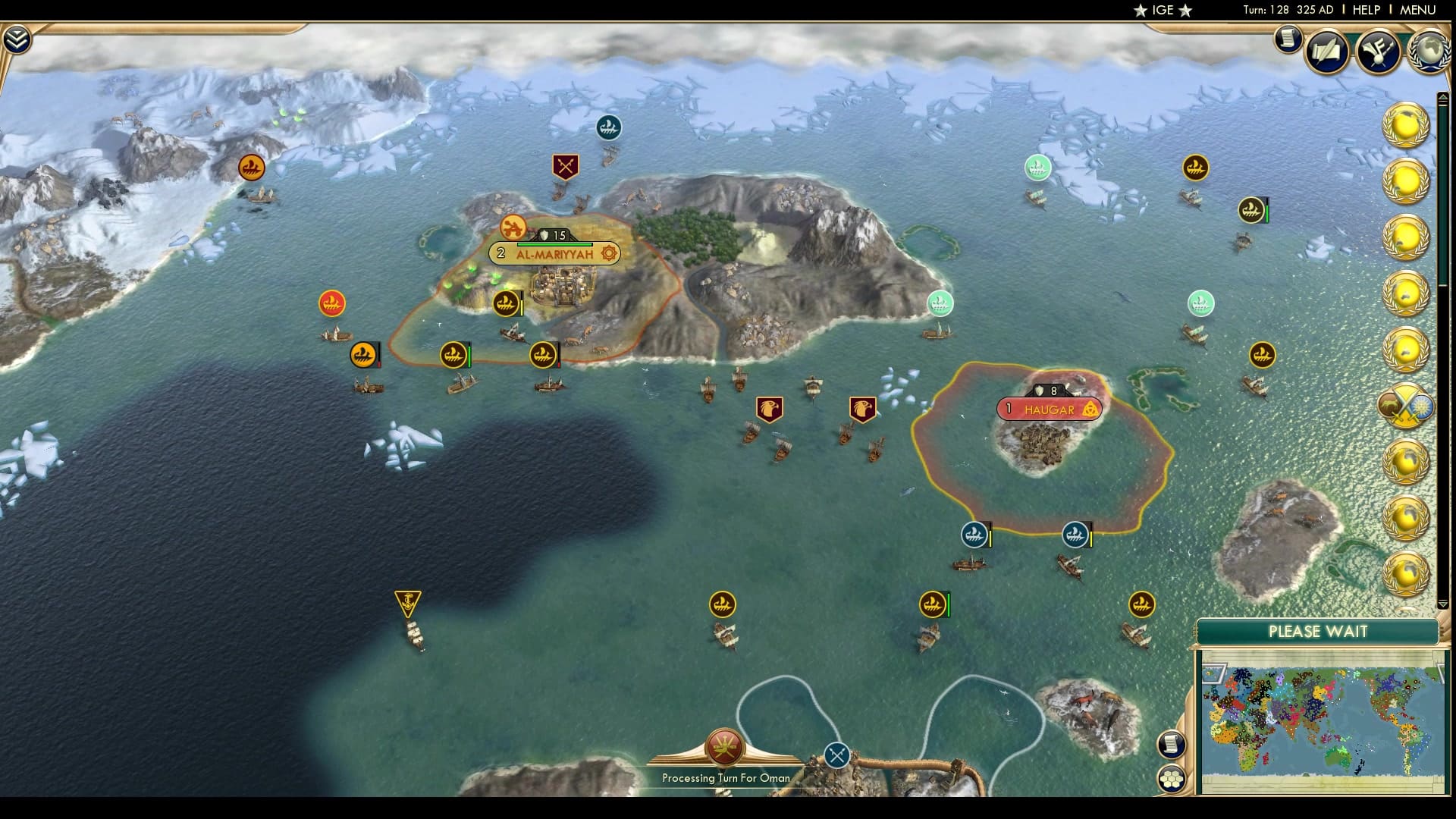
While the Moorish city on Iceland and its German invaders aren’t exactly news, the Viking city on Faroe is! While not as good as its Moorish counterpart, Haugar will hopefully serve as a stepping stone to more distant lands for the Vikings, who have yet to prove they deserve to be called such.
Sidebar tells us that Uruguay has declared war on Apache. While clearly too far to from each other do anything, it seems odd and out of place...
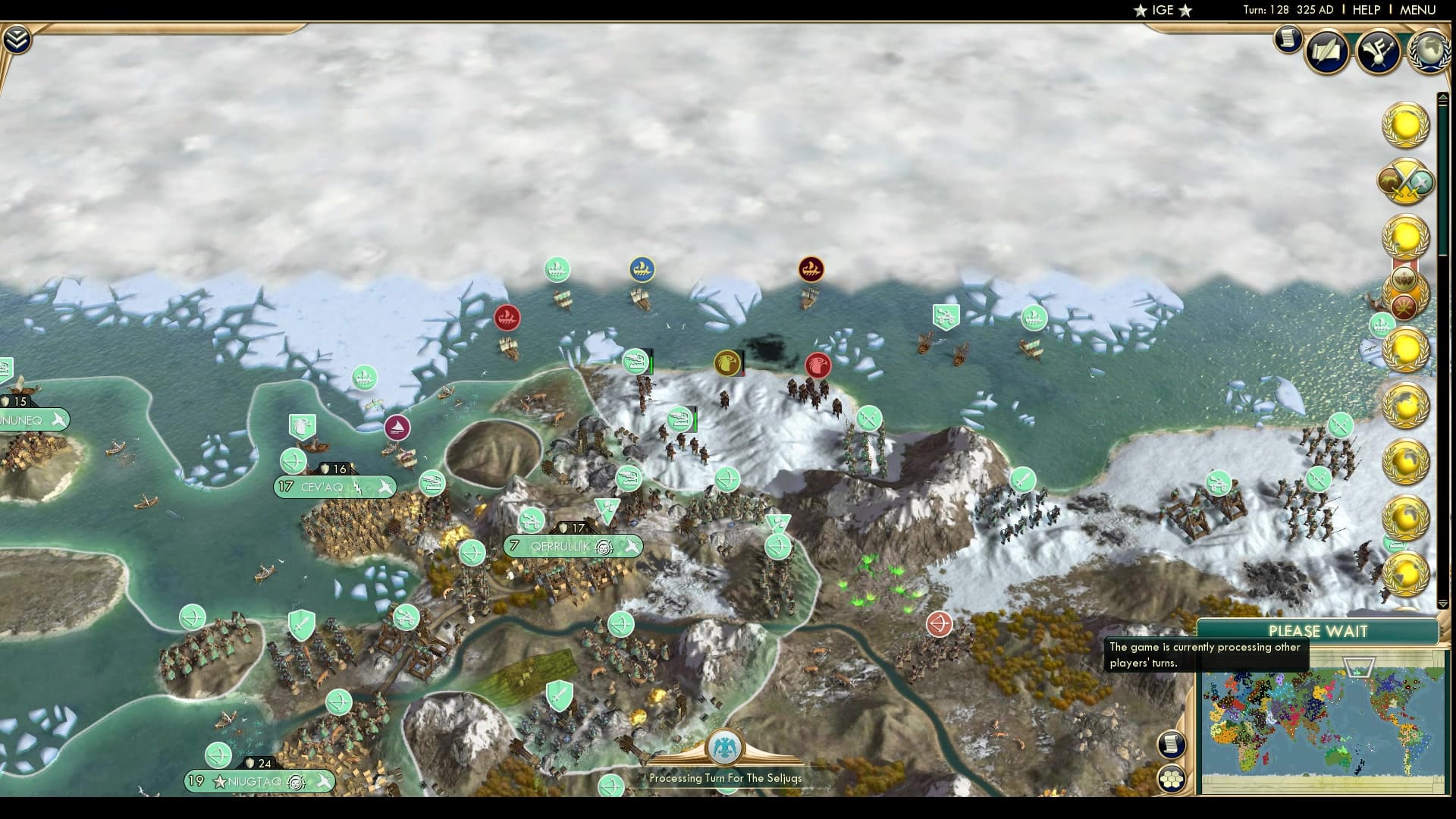
The next scene reveals the true nature of the declaration of war on Apache. Yup’ik has also declared war on the Apache, hinting at a coalition war. And while Yup’ik are just as unlikely to deal damage to the Apache, there is a very real chance that someone closer to them joins the coalition.
For now, the only victim of the ‘coalition’ war is an Apache scout, stuck in the arctic wastes, with the Yup’ik army on one side and the freezing sea on the other. But hey, at least he gets to view the Triremecon in his last moments.
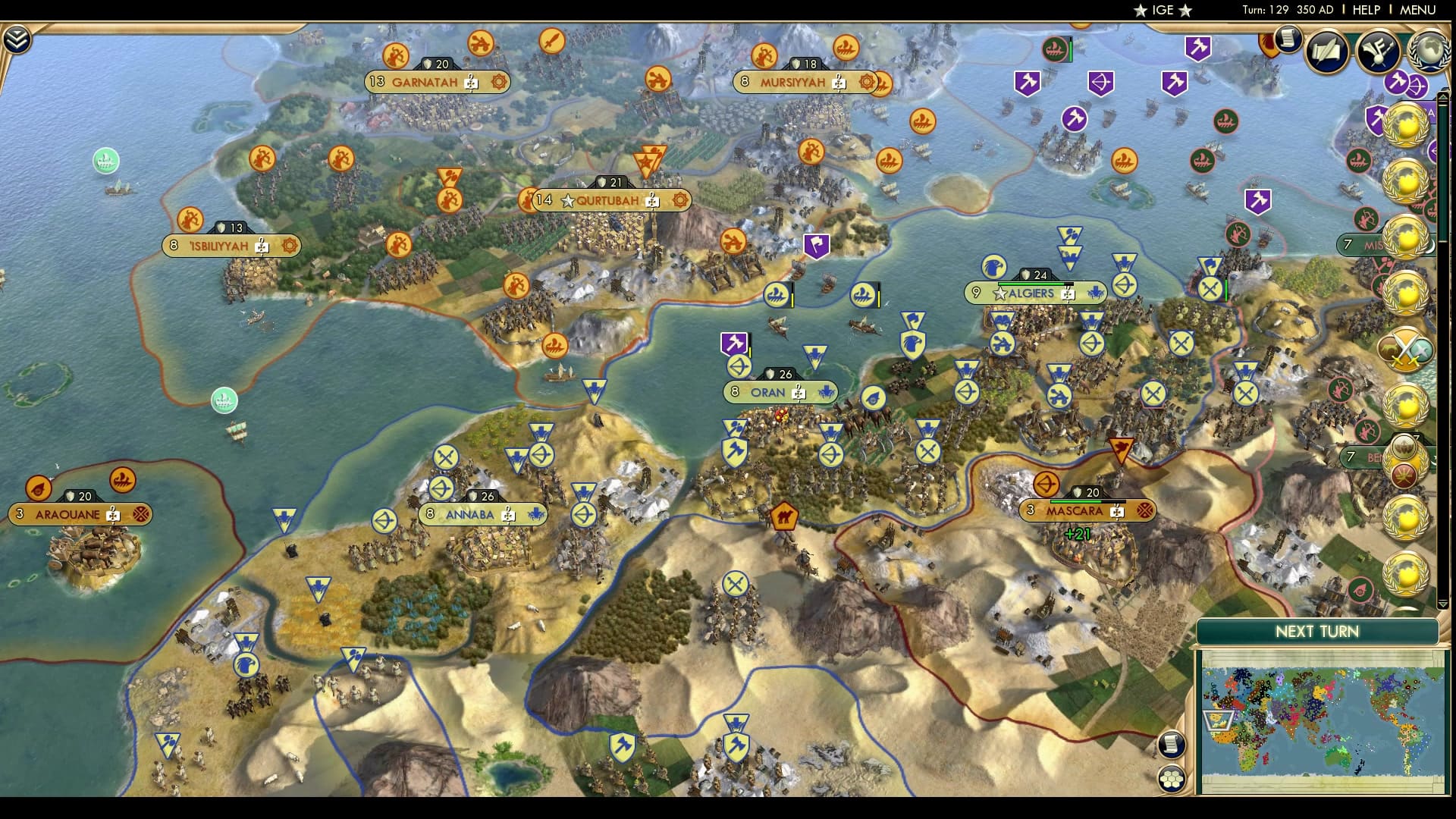
And just like that, the Venetian invasion has been deflected again. In fact, it was deflected so well that I can’t see a single Venetian trireme here. Only an embarked warrior remains. And the settler from earlier, for whatever reason. If I were you, I’d unembark onto that empty land tile next to you ASAP.
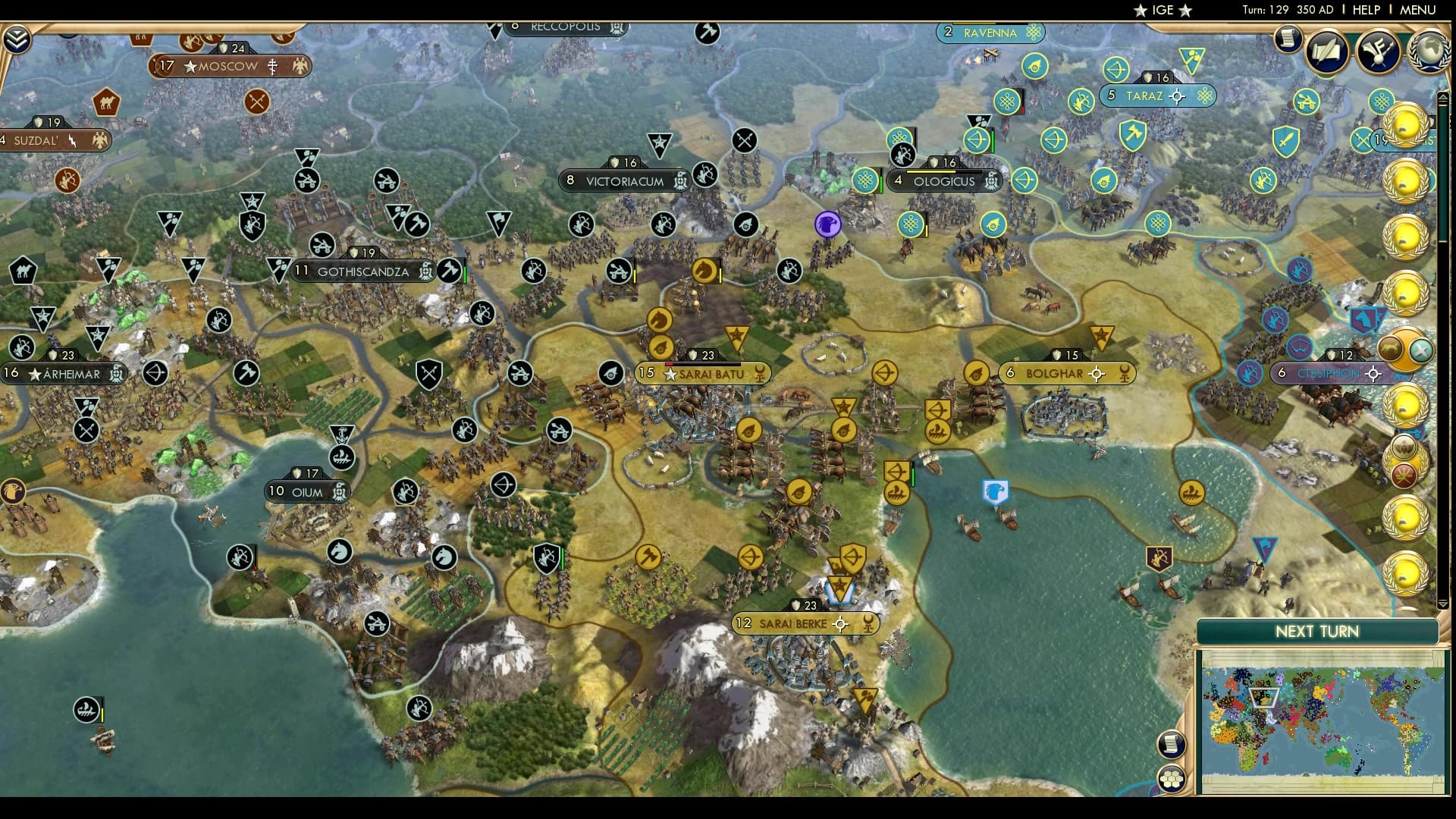
While nothing changes around Sarai Batu, Kazakhs rush to surround Ologicus, forcing me to take back my implication about Ablai Khan not being able to take anything beyond Ravenna. The city looks as good as dead, with Alaric unwilling to reinforce the city, his eyes fixed on the big price, the Golden Horde capital. Will the sacrifice be worth it?
Parthian settler status: at this point, probably stuck at home with his harlequin-loving father.
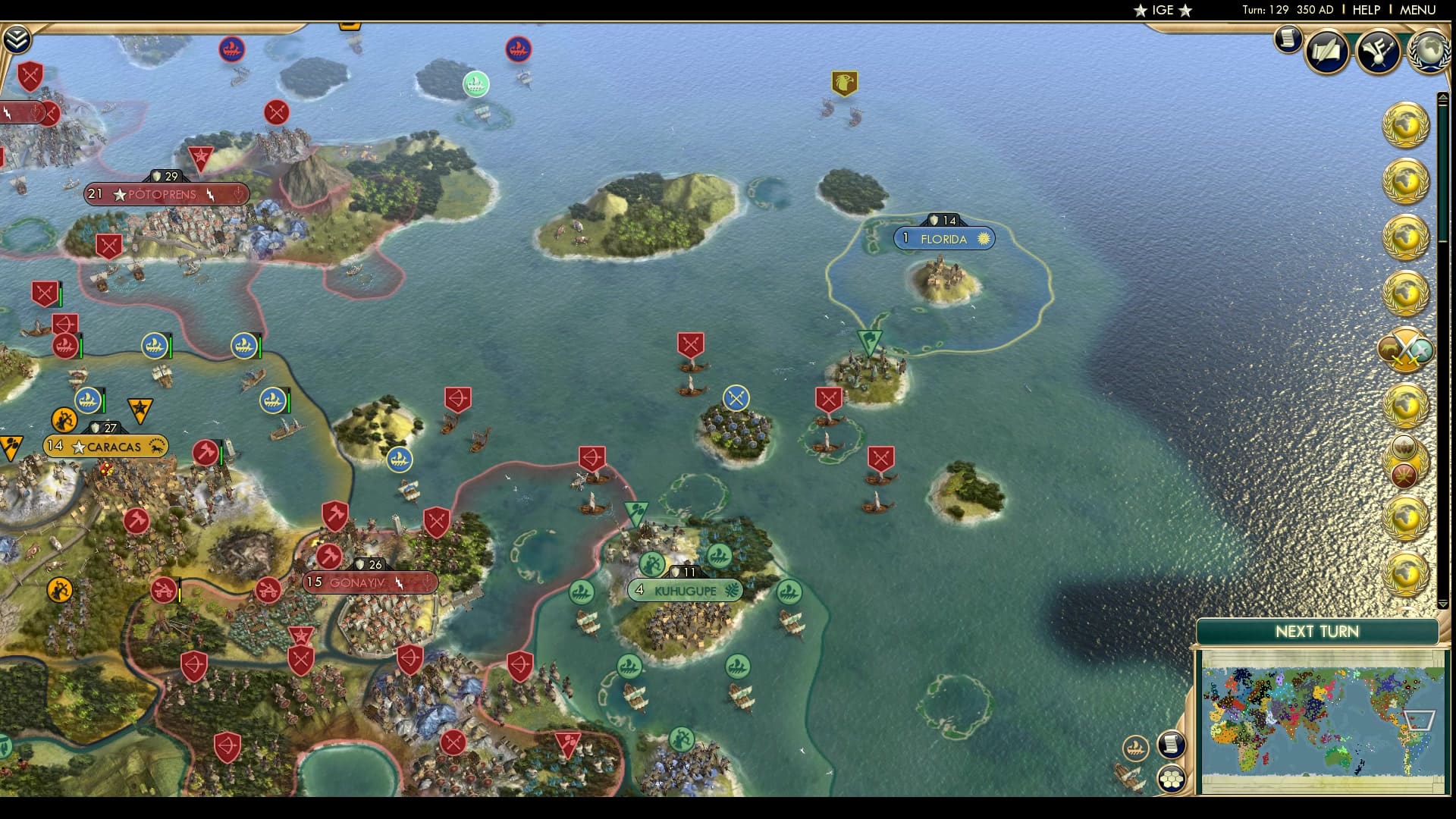
In an effort to outdo Venezuela’s Barcelona, Lavalleja settles a misplaced city of his own in the Lesser Antilles: Florida. A home to weirdos in the future, Lavalleja nevertheless isn’t the only one interested in the Lesser Antilles, as a Kuikuro settler lands nearby as well. This region will be quite the mess in the early game.
This particular scene also acts a showing of how Haiti is faring against Venezuela on land. Aided by Uruguay’s navy, the Haitian army has reached the gates of Caracas once again. Whether this strange cooperation will aid either of the two, is up to luck at this point.
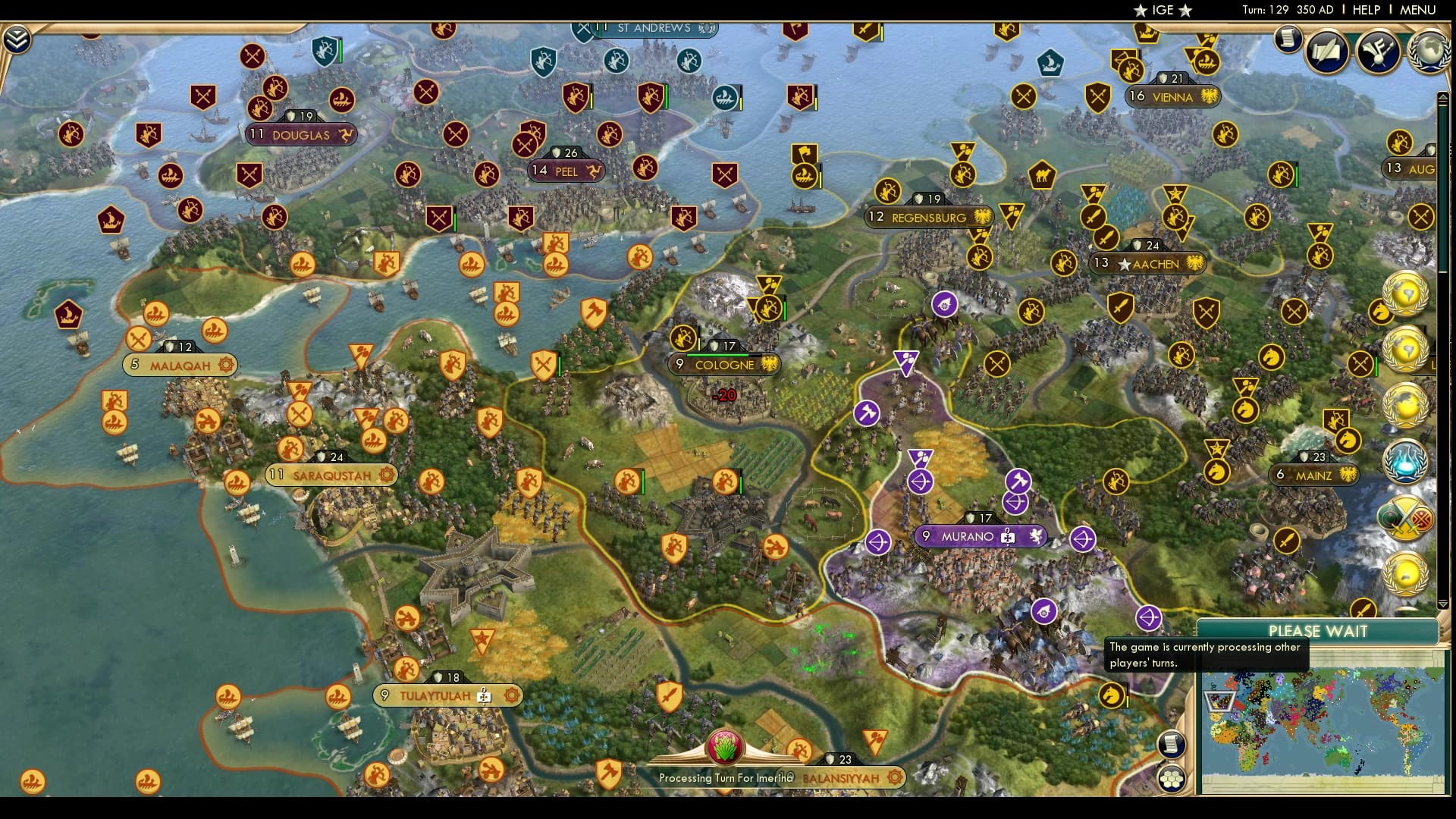
In another European war, the battle for Cologne trudges on. With the citadel south of Cologne already pillaged by Moorish bowmen, approaching the city will be much easier. Considering how limited the garrison around the city is, Abd-ar Rahman might just have a chance at taking the city, but he’ll have to play his cards right to achieve such success.
This time around, the sidebar gifts us a relevant war, as Songhai declares war on Libya in an attempt at reclaiming honor lost in the Algerian war.
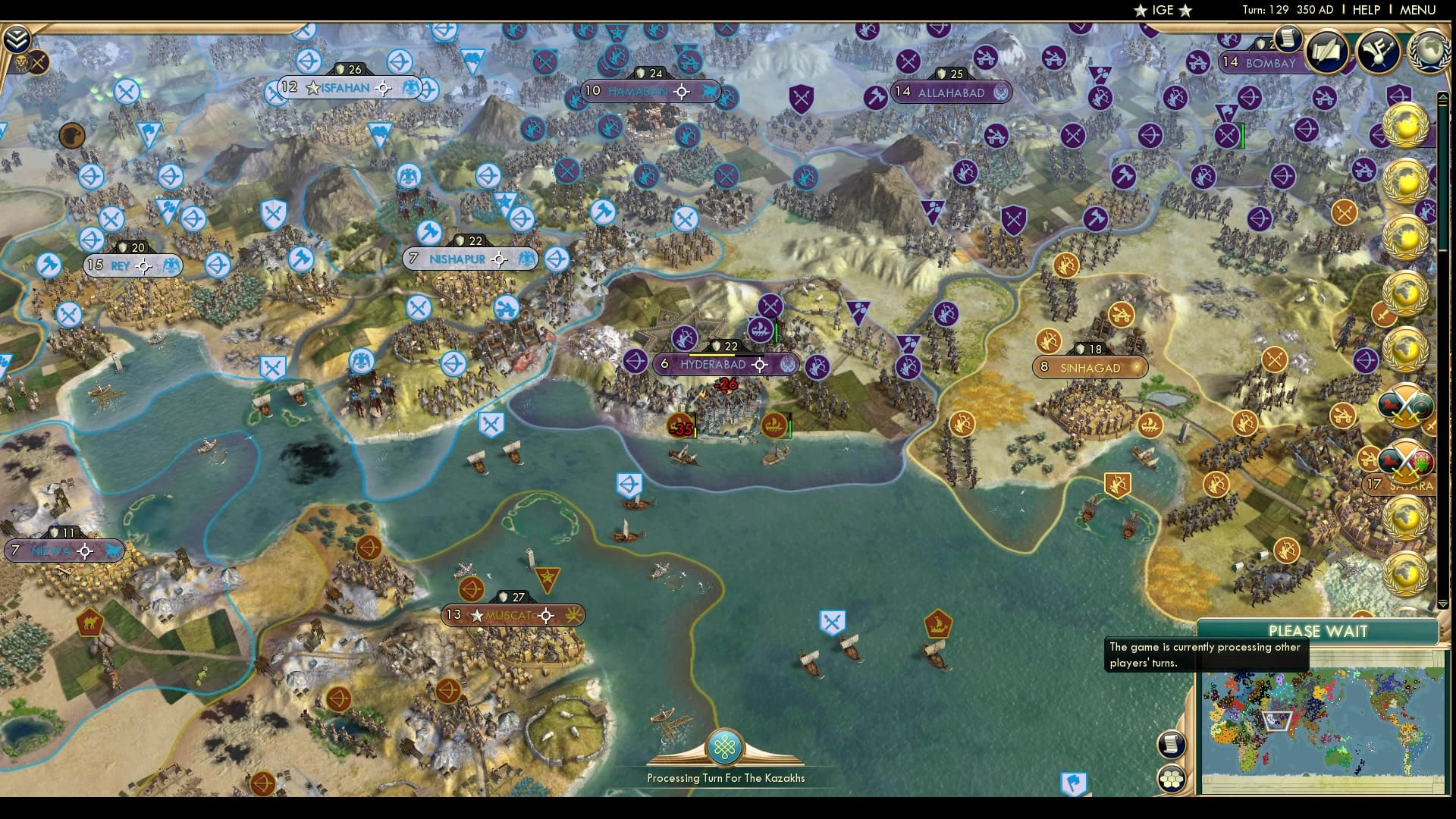
Apparently Oman is at war with India. I wouldn’t blame you for forgetting this one. Two triremes are more of a raid than an actual invasion, anyway. I’m starting to think the “bad” in Hyderabad stands for “bad invasion target”. But the Seljuq settler heading into the Indian Ocean, now that’s interesting.
The sidebar is kind today, as two civs are angry at Minos for...I don’t know, for being insane? Obviously, only Libya can reach Knossos at this point, but making another enemy out of a neighbor might’ve not been the smartest move.
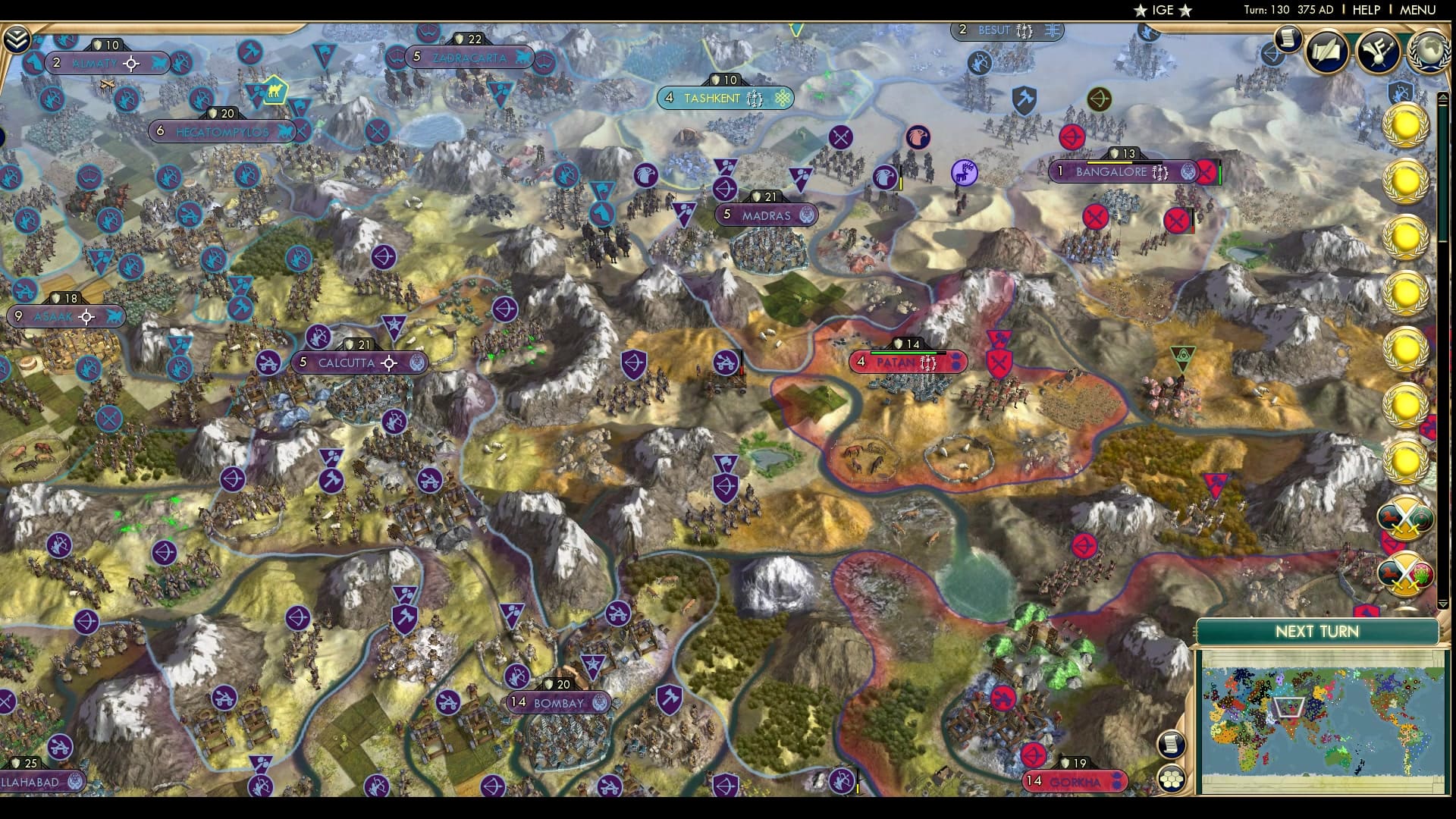
I’m surprised, in all honesty. Bangalore will probably be the first city settled by an Indian civ to fall, and it’s settled across the Himalayas. This is some next level irony right here.
Due to my unnatural obsession, I’m going to point out the Evenk Inquisitor on this slide. In case you are not aware, Inquisitors can only do stuff in your own cities. Evenks have a unique that affects inquisitors: it is a UI, available at Philosophy, and it can give inquisitors and missionaries the medic promotion. But Evenks don’t have Philosophy, and even if they did, a unit with medic wouldn’t be useful thousands of miles away from their only front. So why is the inquisitor here? That is all I want to know.
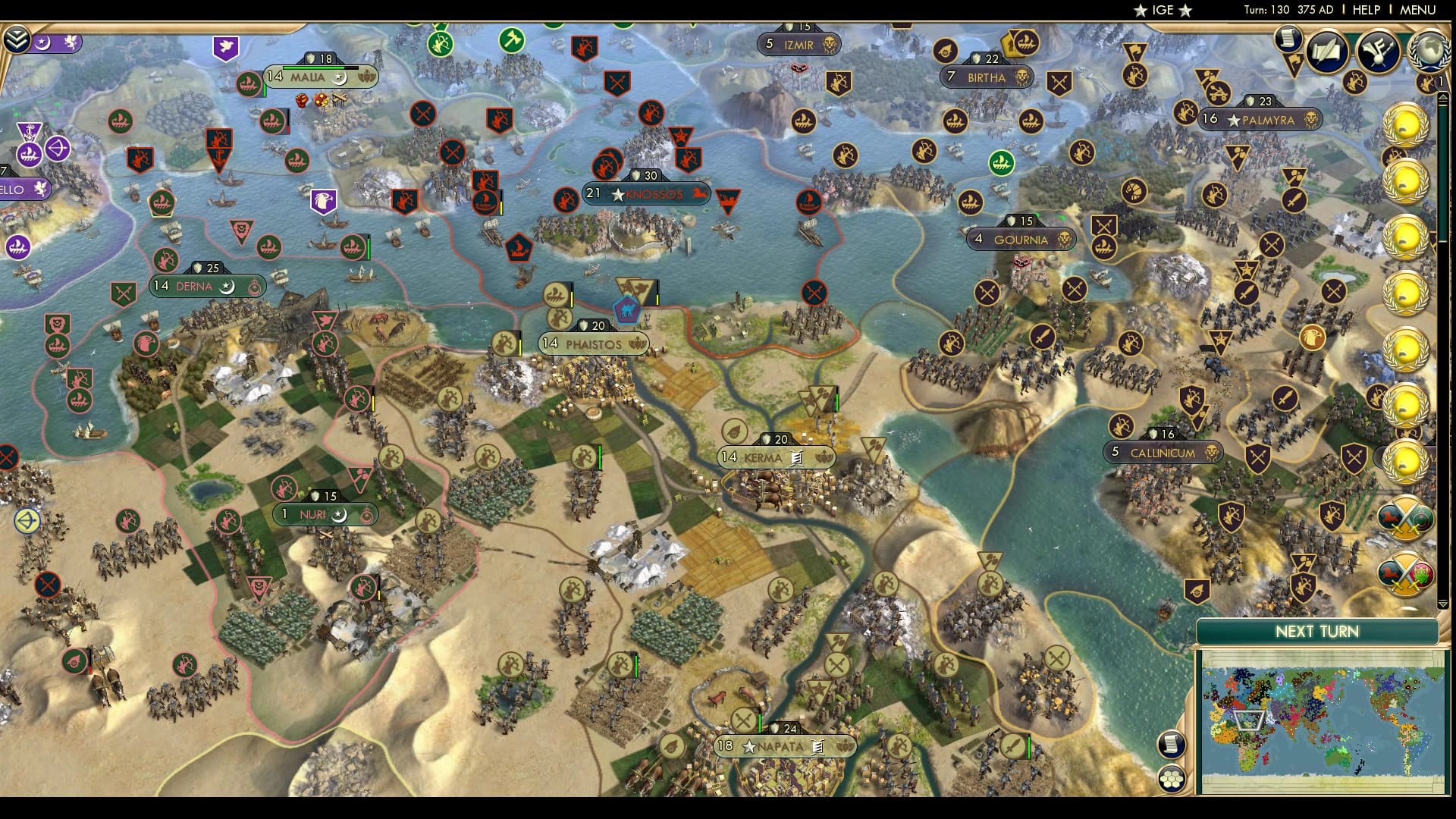
We return to the Eastern Mediterranean to see just what the Libyan-Minoan war actually means. As it stands, the two navies look fairly equal. A realization has struck me, however, as the Libyan navy strikes Malia instead of bothering to fight the Minoans. And due to the circumstances, Nubia is naturally unable to reinforce the city. Libya might’ve hit jackpot, but they will still need to defend against Songhai’s invasion force, infamous for only being competent in the Saharan desert.
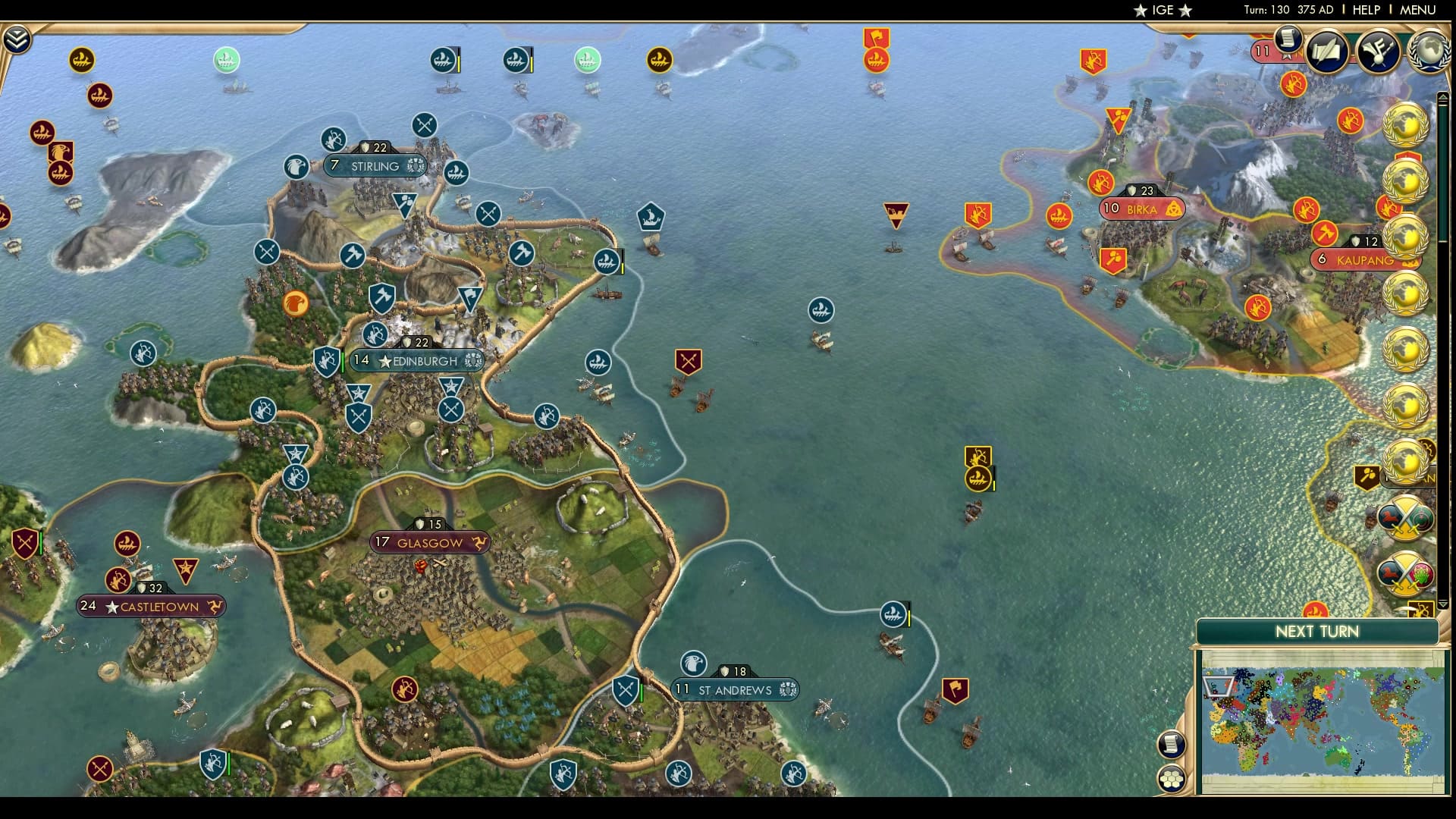
That’s gonna sting. That’s gonna leave a mark. That looks like it hurt. In a move as baffling and absurd as the peace deals of Hong Kong and Malia, Soctland gives away Glasgow, her biggest city, in a peace deal. It would only sting more if the Great Wall was built in Glasgow, but luckily for the Scots, they can still have their empowered last stands, as the wonder was built in Edinburgh. Regardless of wonders or lack thereof, the Manx have now been offered dominion over the Isles on a silver platter. Time will tell where their might is pointed in the future.
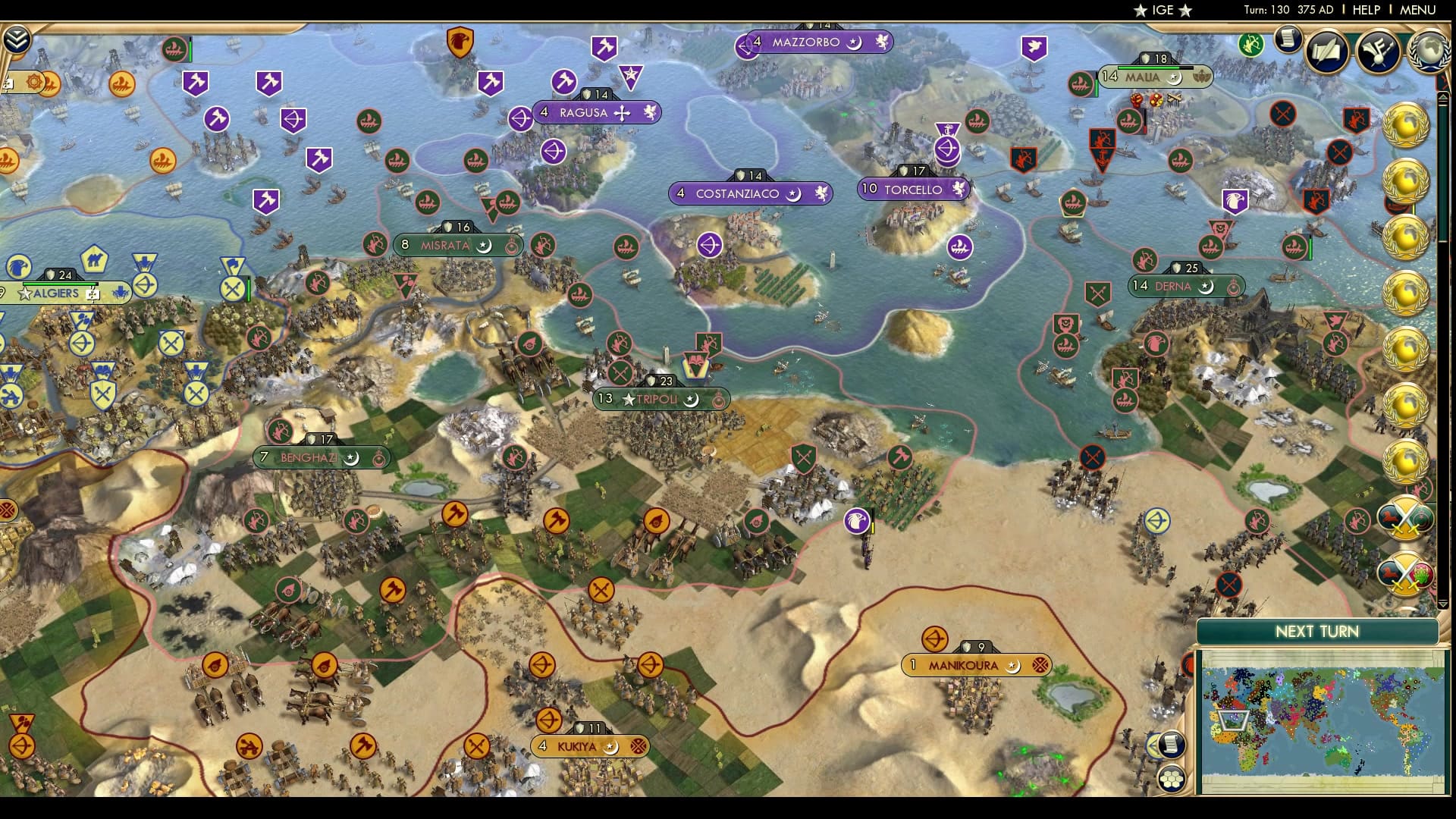
We finally get to see Libya’s front against Songhai. Libya holds the technological advantage, but the production advantage is obviously Songhai’s. And unlike in the Algerian war, Songhai has its army in the right place - pointed directly at Libya’s capital. Omar Mukhtar might be getting too big for his britches.
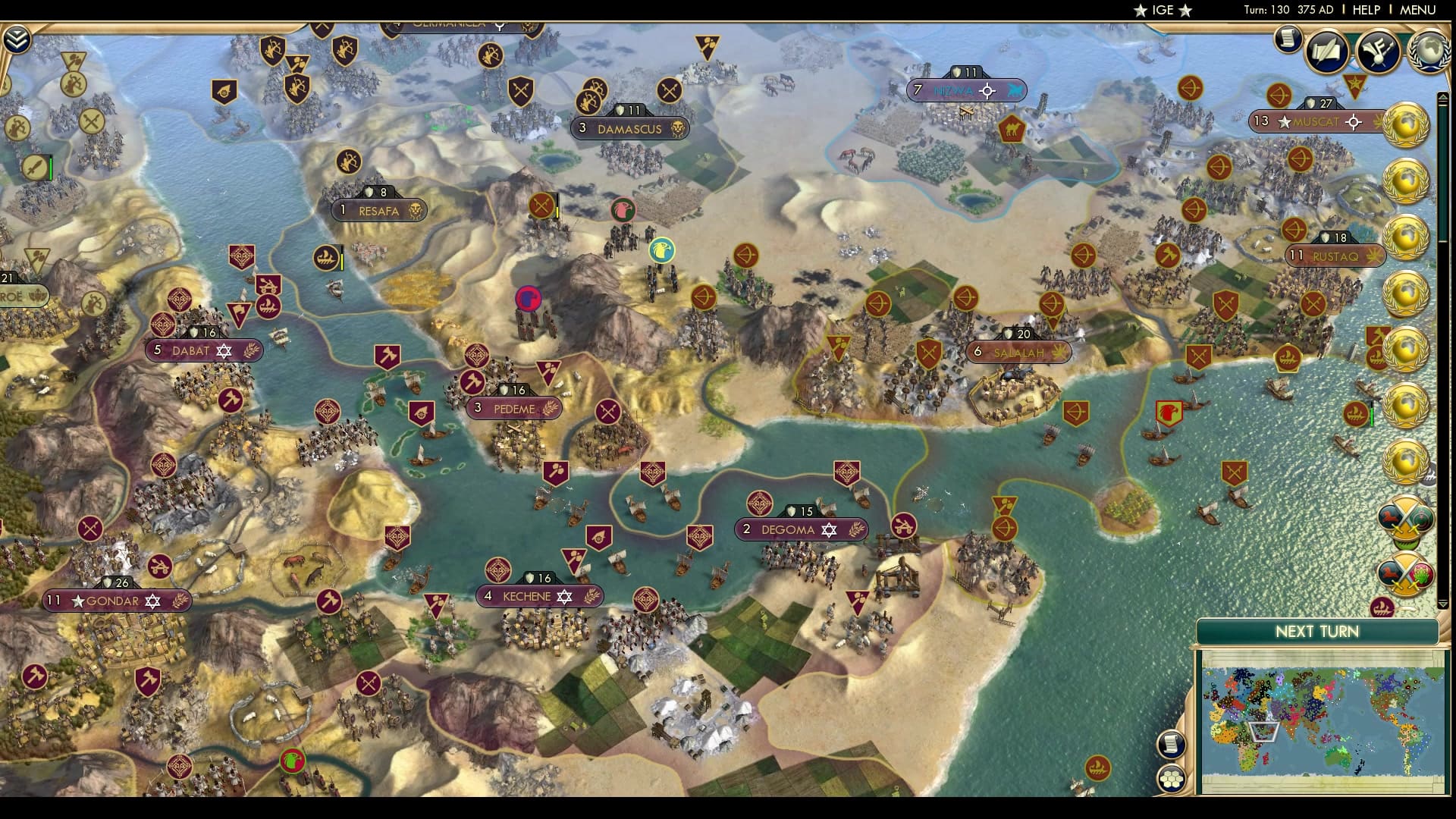
We get a bit of a breather from all the wars by looking at Southern Arabia, the meeting place of Palmyra, Beta Israel and Oman. With the capture of Pedeme, war in this region is no more. But with land running out quickly, especially due to Palmyra, the peace might be more temporary than it seems.
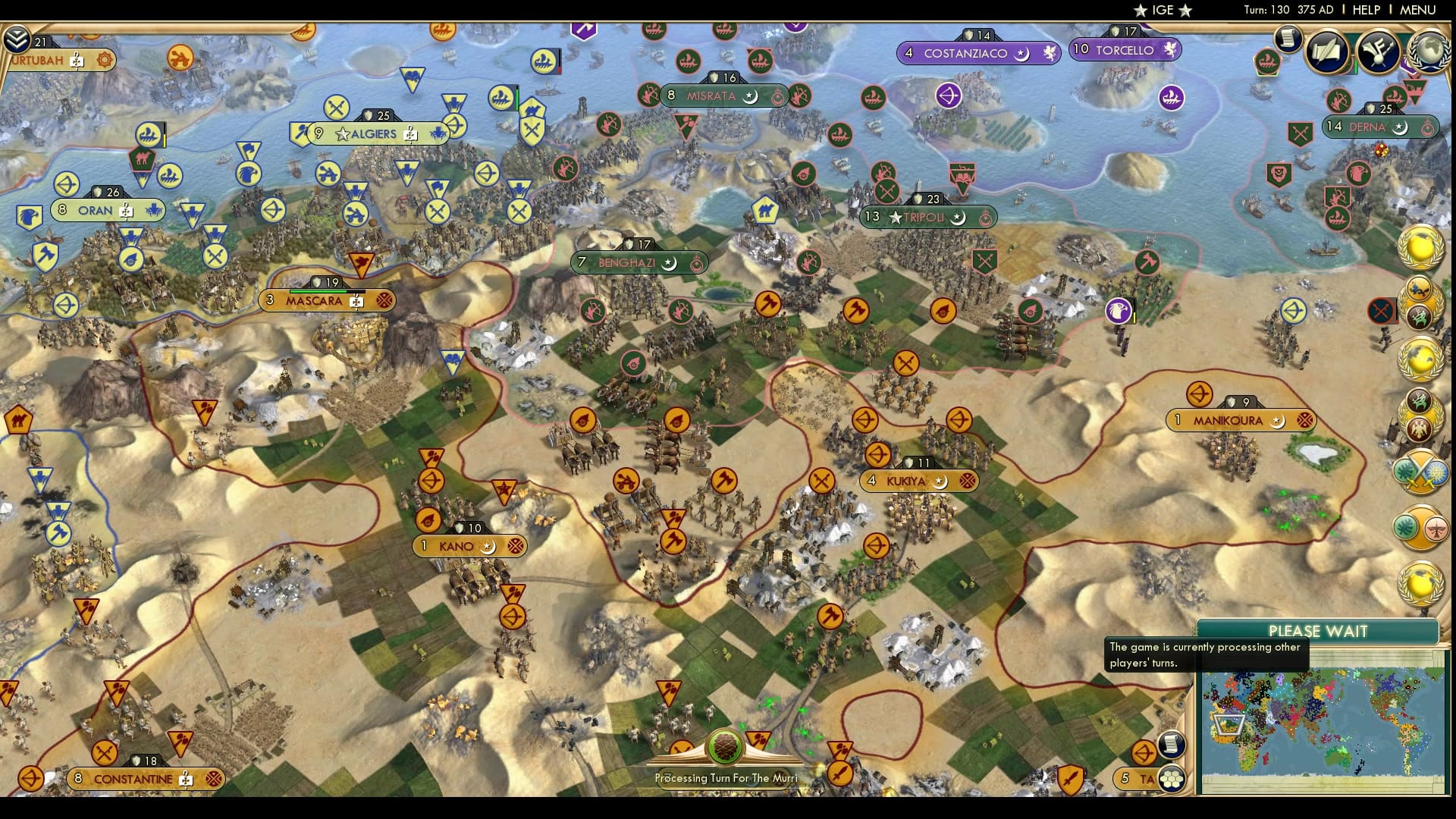
Back in the warzone, we get a better look at the desert war here, and it looks like I might’ve been wrong about Songhai knowing where to put its troops. The amount of units they seem to have sent looks very insufficient, meaning Libya might just walk away unpunished from all these wars. This might very well be a turning point for the civ that has otherwise struggled.
Exciting news are received through the sidebar, with a vast South American war. Nazca has declared war on Kuikuro once more, and this time, they have made a deal with the devil, as Uruguay has also declared war on the green civ.
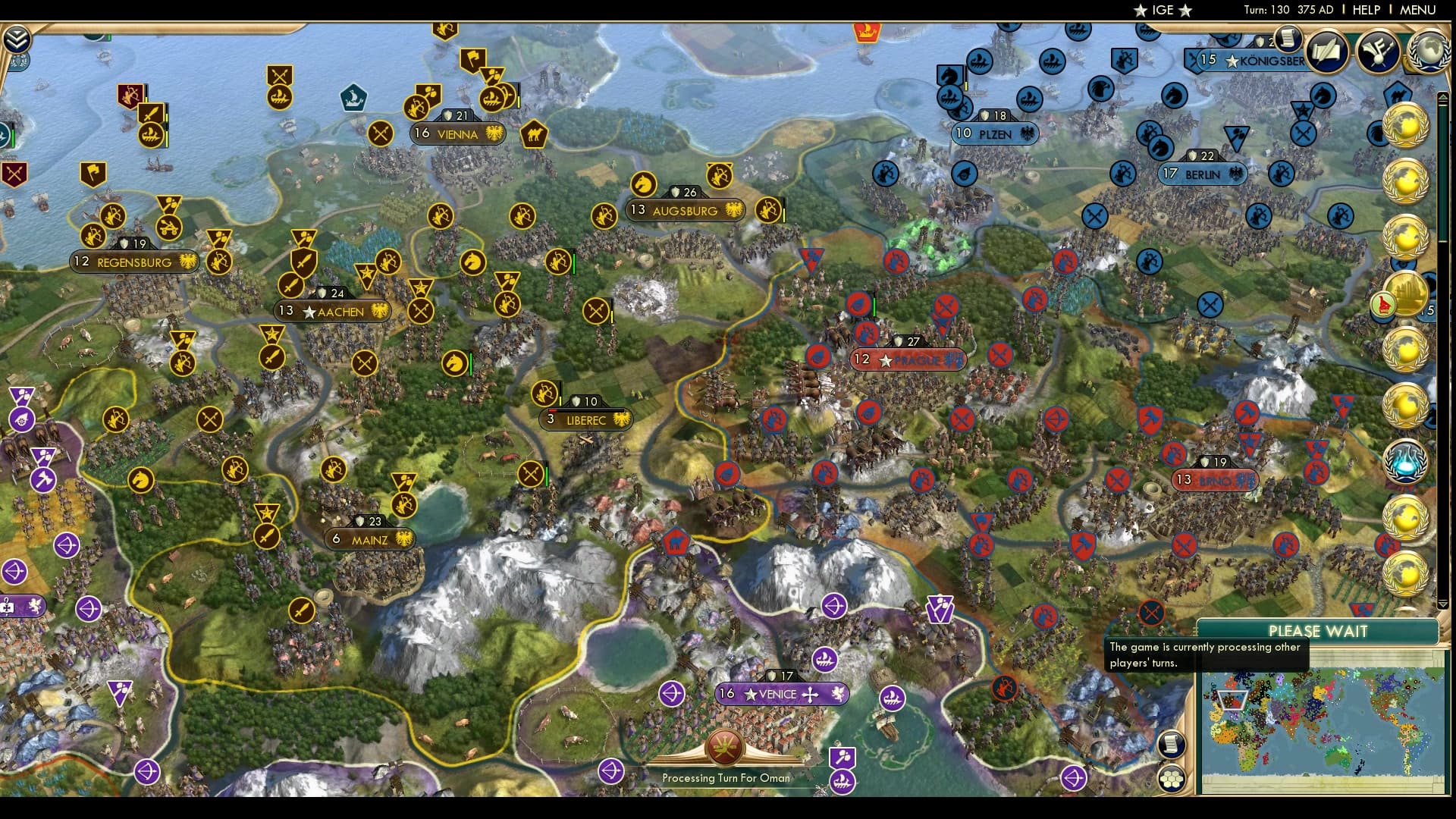
The Germans have three great generals around their capital and some embarked settlers to the north, Liberec is still in red, Havel still hates using melee units. Don’t you boys know that stagnation is death, especially in the thunderdome that is Europe?
In more heartbreaking news, the gifting of Malia seems to have displaced Minoan units all the way into Slovenia. These poor lads will likely never meet their families again. But hey, at least Great Nyatsimba Mutota has built Zimbabwe yet another glorious wonder, the Kandariya Mahadeva Temple, giving them 3 production for every religion present in the city. It represents their, uh, glory.
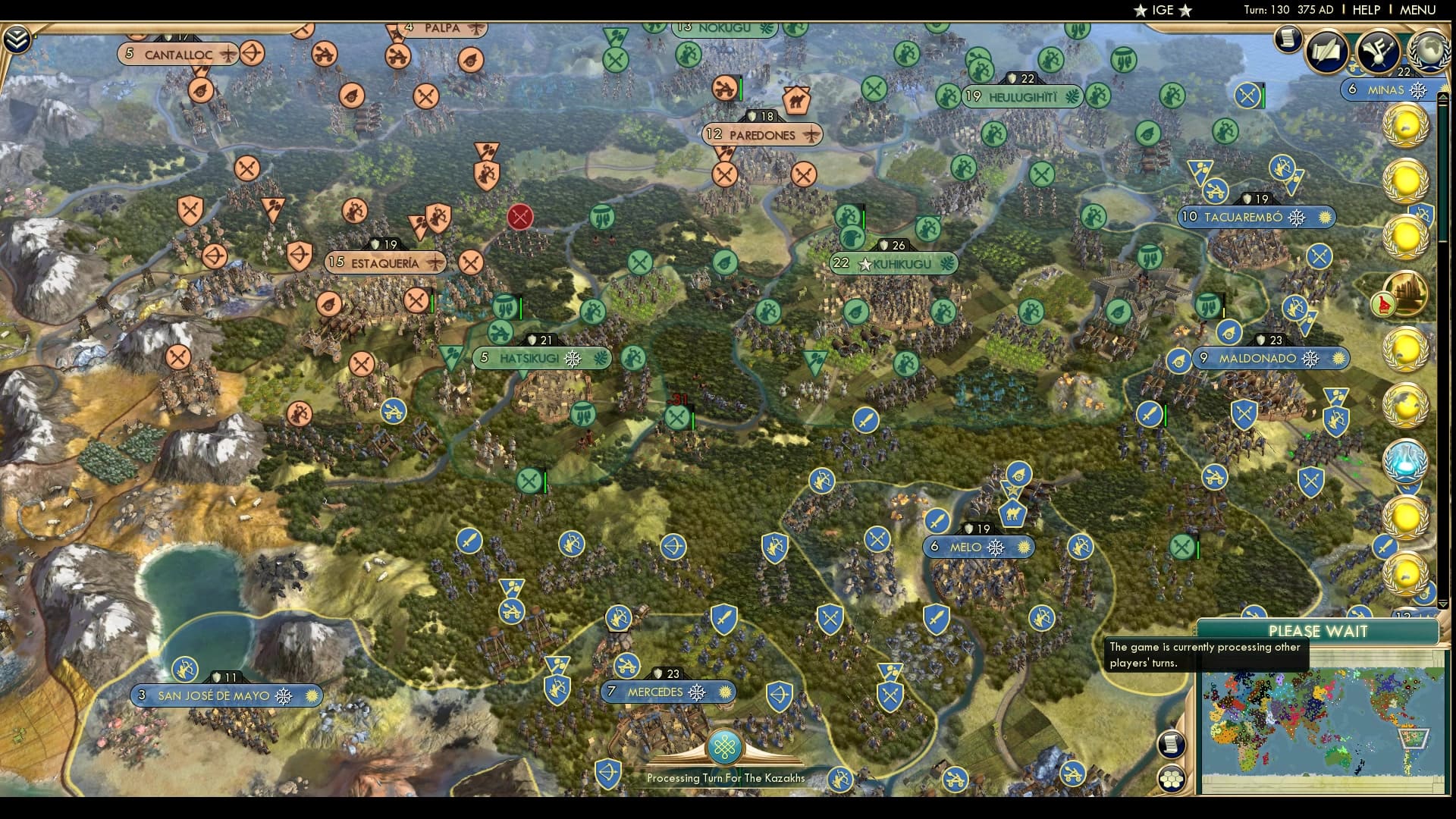
A grand shot at South America reveals to us the circumstances of the Great Amazon War. Lavalleja has raised a veritable horde of soldiers, raring to go. Cahuachi seems less prepared. He’s probably confident in Lavalleja’s ability to solve his problems for him. But this problem is no ordinary problem: Kuikuro is known for being impenetrable fortress in the Amazon. Can the Uruguayan army crack the turtle’s shell?

While Ologicus falls to the Kazakhs in background, Tokhtamysh’s last stand intensifies, and in fact, it looks like the Golden Horde army has grown since we last saw it. At this rate, Ablai Khan will capture the city sooner than Alaric can. But, there is no worry! A Goth warrior is approaching the city, only blocked by a horseman. This will be close, very close.
Parthian settler status: SETTLED
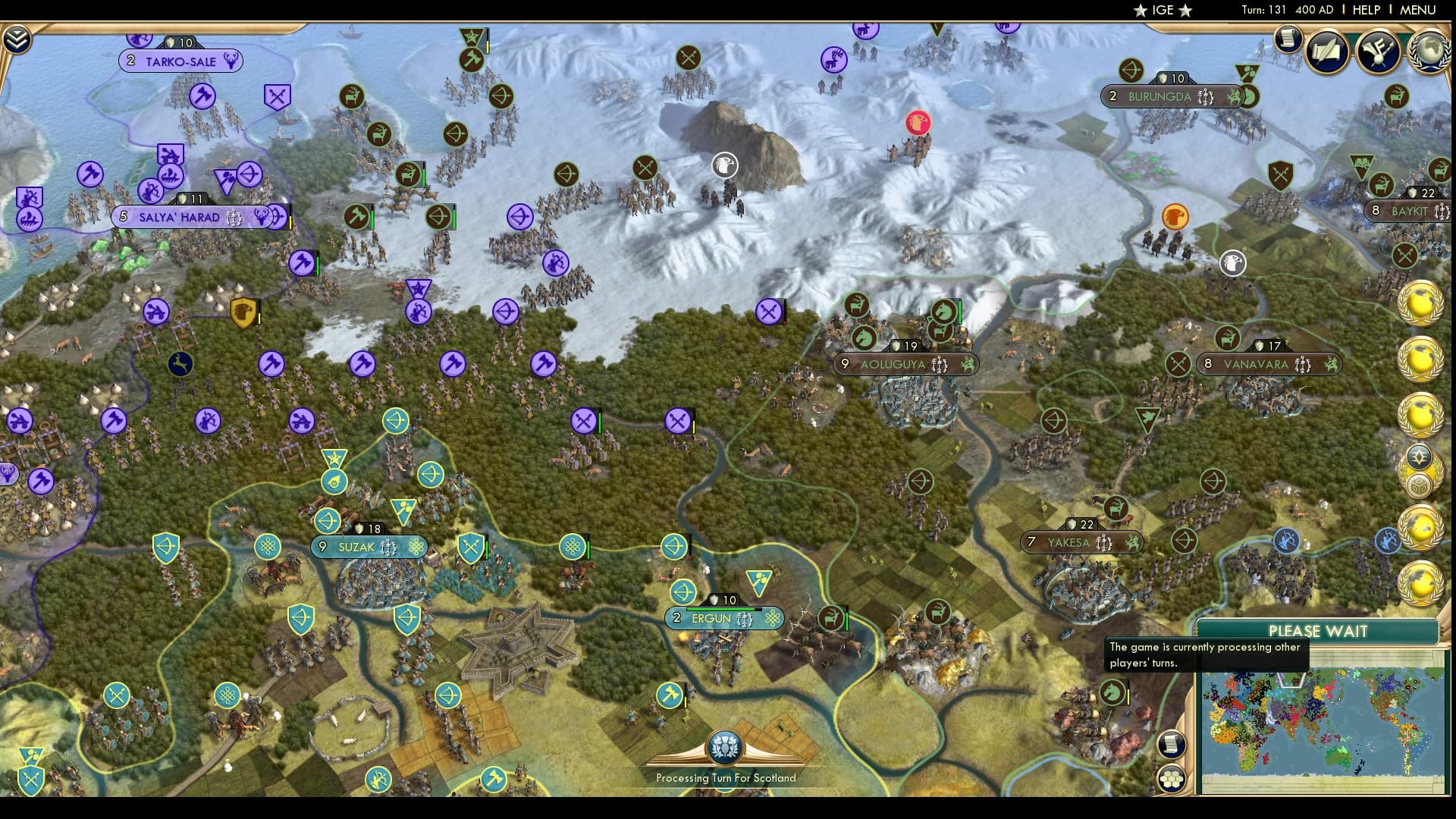
In a bid for relevancy, Nenets and Evenks announce the first ever Battle Royale on the Cylinder, to be waged between real men, to real death. Shh, nobody tell them. Excited to follow the bloody event, the local Kazakh army has opted to watch the event from Suzak instead of bothering with actual fighting near Ergun.
In the background, Iroquois and Poverty Point make peace.
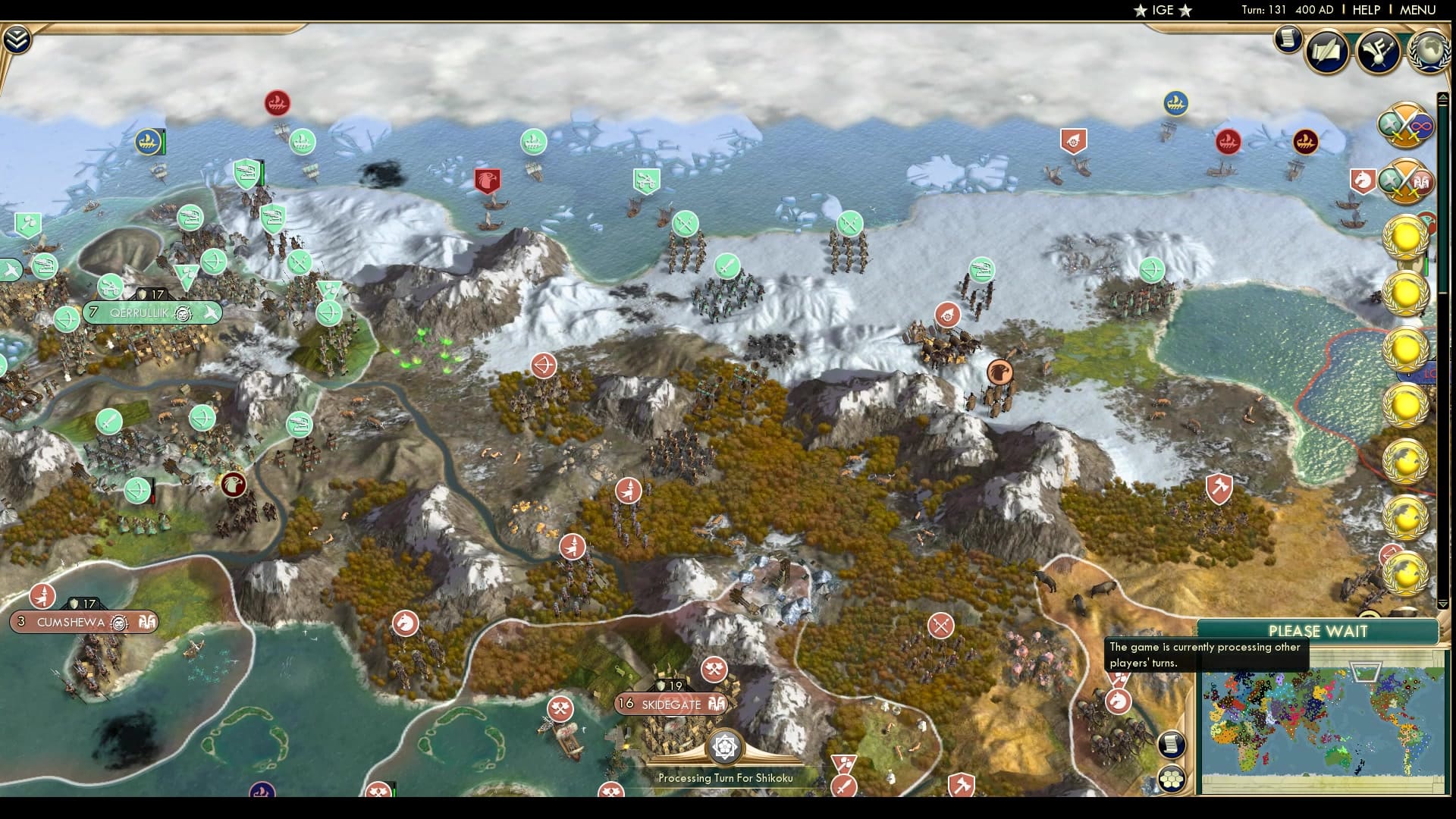
You thought Apache was getting coalitioned? Too bad, because it’s actually Yup’ik who’s getting coalitioned, trust. While Metis won’t be able to do much, Haida’s war with Yup’ik is a long awaited one. As you might remember from an earlier scene, Yup’ik do not have much of a navy, at least not near their core. Against a civ with a naval UU, this is a critical mistake. Koyah has done his best to carpet the seas in preparation for this day, and now, it is finally here. The Yup’ik are right to be afraid.
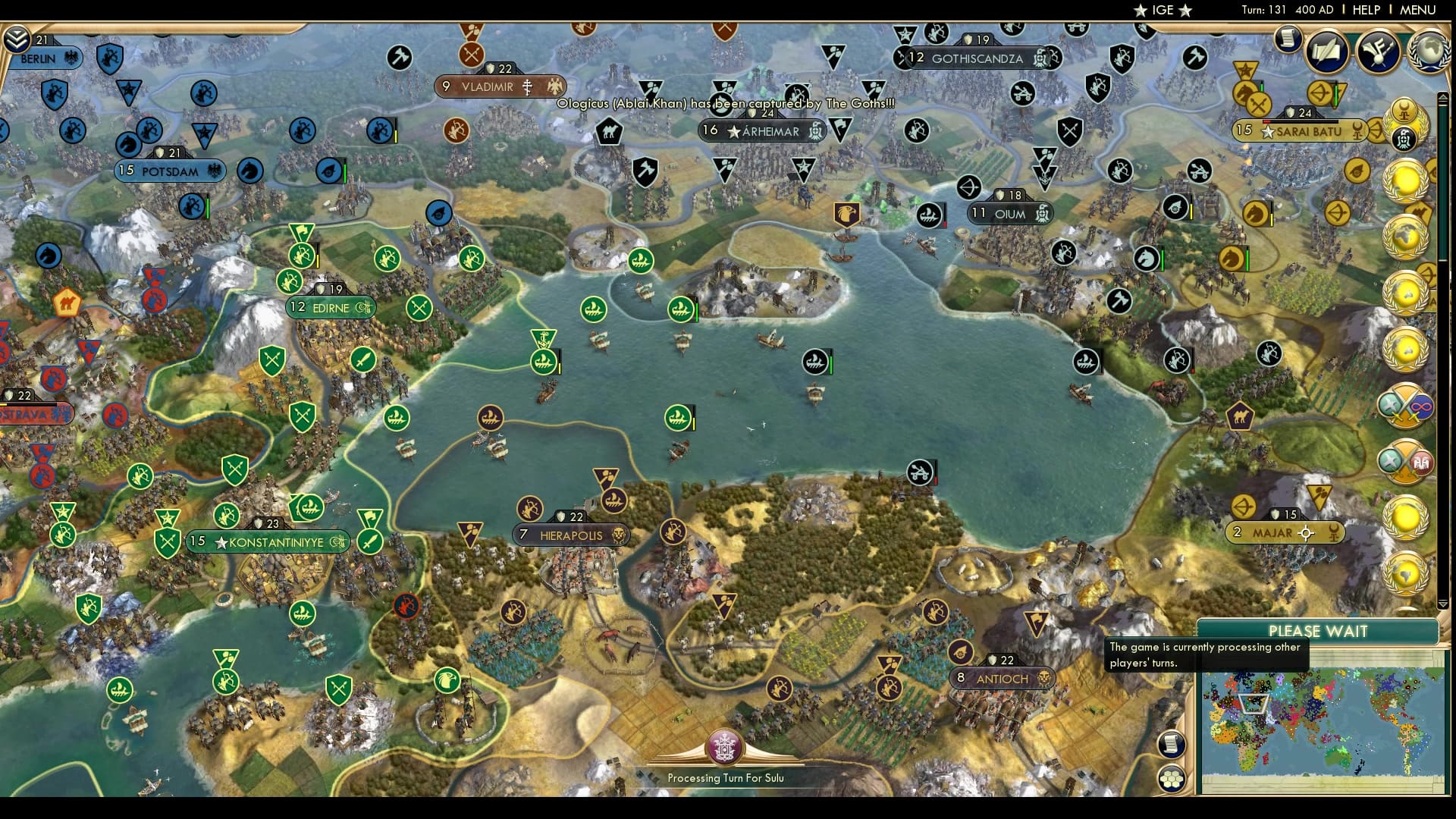
In very anticlimactic fashion, the Goth-Golden Horde war ends right as the war was going to be decided one way or another. As a tribute to Tokhtamysh’s superior diplomatic abilities, it appears that no cities have been given away, either. Tokhtamysh walks away from the war wounded, but not crippled.
Alaric does have some good news, though, as Ologicus has somehow flipped back to him. I’d like to know how, in all honesty, as the last time we saw the city, it was well and truly surrounded by Kazakh troops.
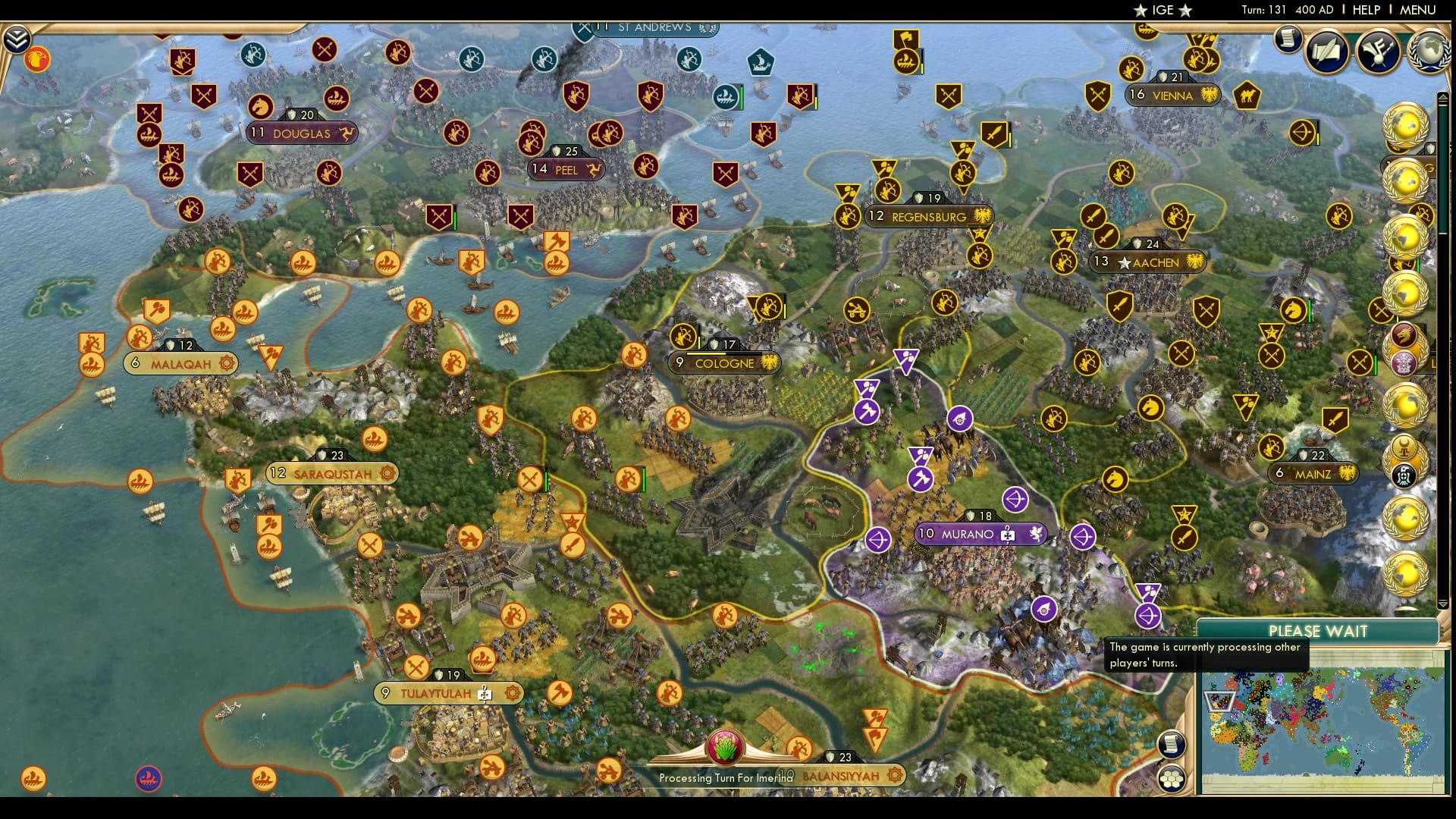
Back in France, the Moors seem oddly eager to repeat the Goth mistakes by shoving only bowmen at the German city. Triremes won’t win you the city. Any of your many melee units could do it. The Germans, seemingly noticing the lack of melee units approaching the city, relax and send a catapult or two to reinforce the city. Tokhtamysh did it, why couldn’t we do it too?
In the Far East, Ching Shih removes Sulu from the coalition pestering her. For someone just listening, that probably sounds more menacing than it truly is.
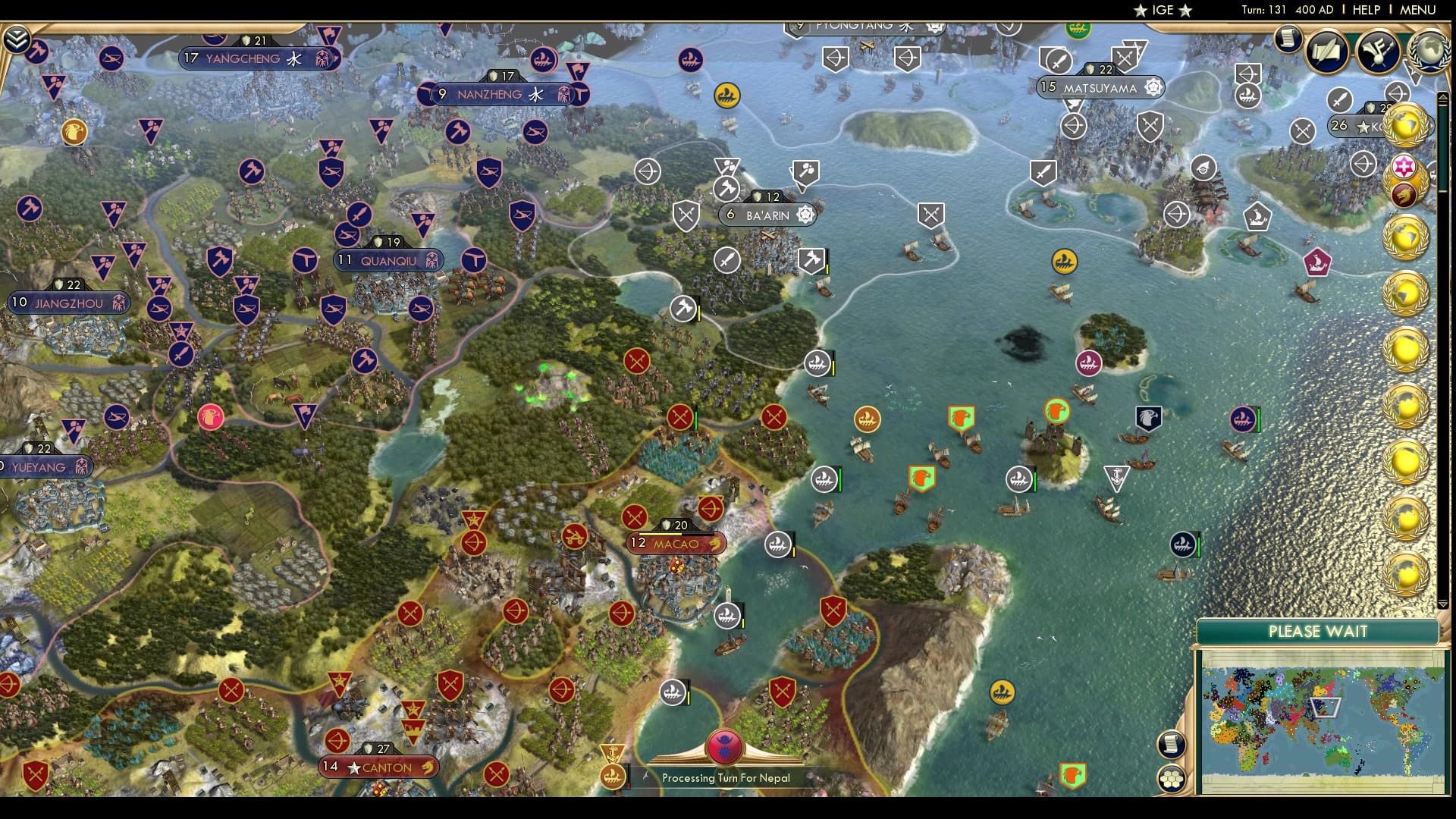
In a surprise move, Shikoku is dealing real damage to Macao, earlier deemed to be too hard to approach by sea without naval ranged units. Whether it’s enough or not is questionable, but it is an impressive showing nevertheless, and shows that Shikoku can continue to apply its competence on the seas. Just don’t mind the menacing Qin in the background.
Ching Shih removes another civ from the coalition pestering her. This time it’s Tonga. Tonga time is over.
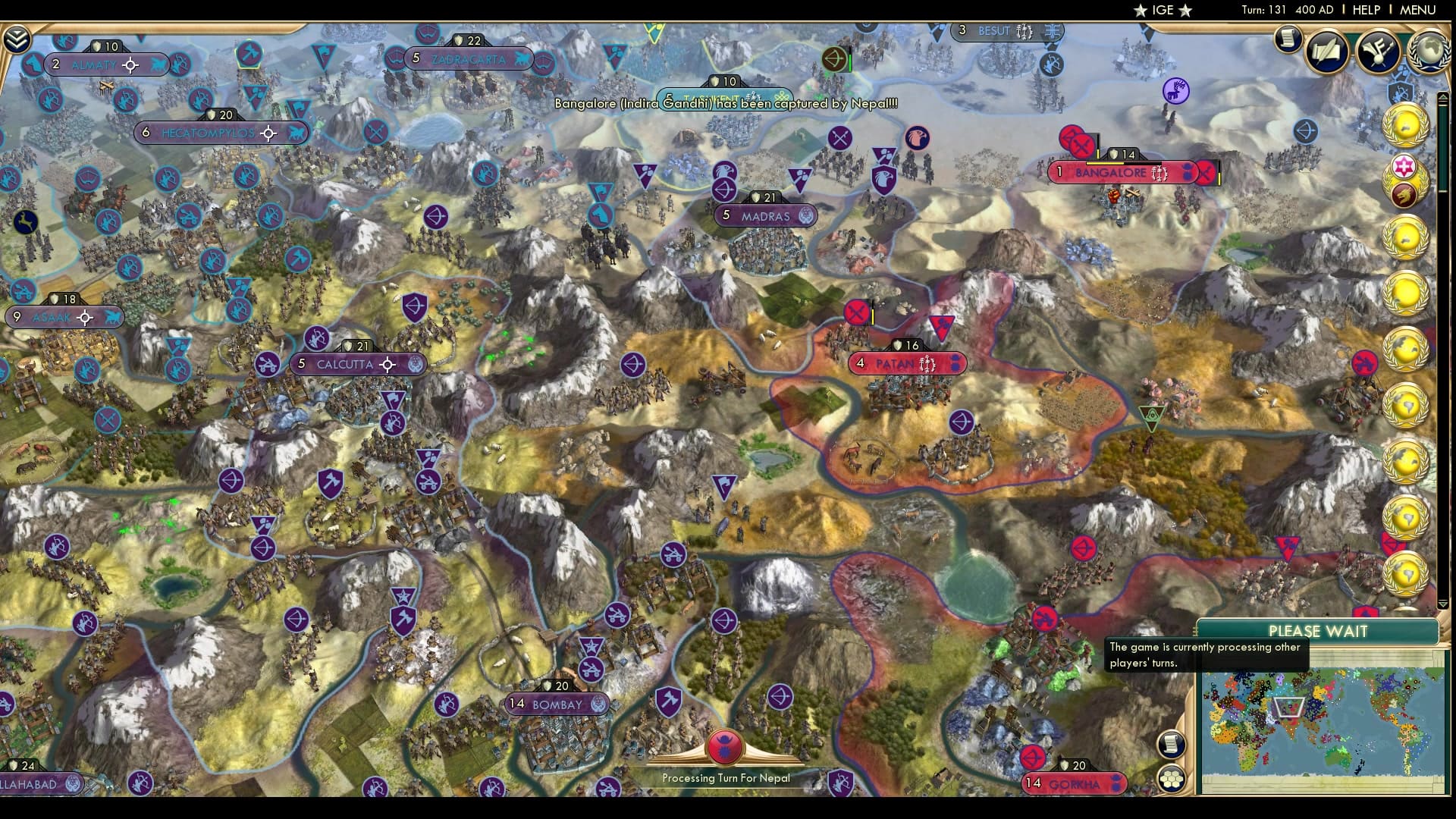
As a sequel to an earlier scene, here is Bangalore actually falling. As said earlier, it is the first city settled by an Indian civ to fall, which is incredible considering the countless wars that have already ravaged the subcontinent. Maybe a foreign power will have better luck making progress here.
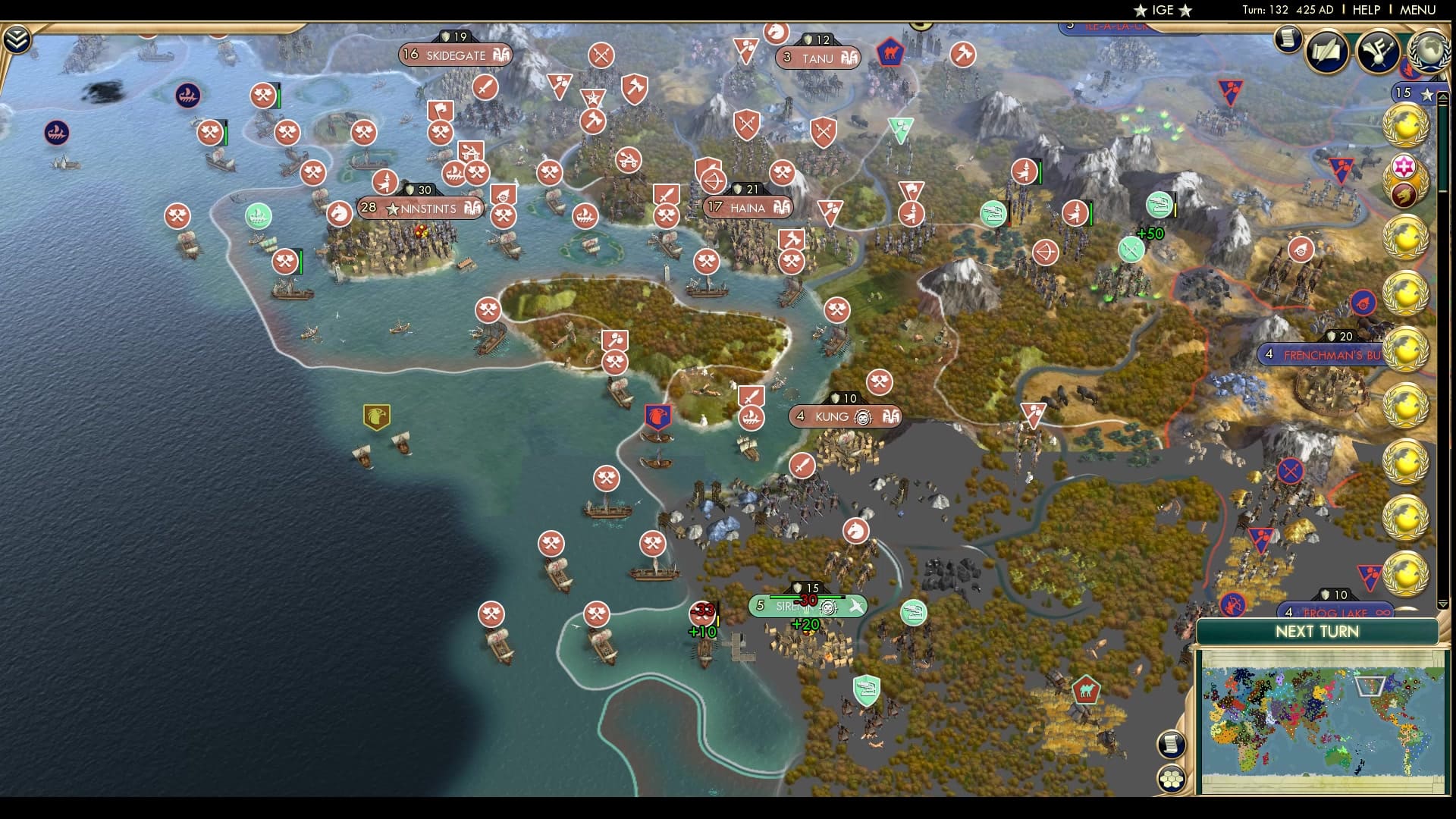
We’re given a great shot of the Haida war machine, and oh boy, it does not look good for their northern neighbor. The first victims of the war appear to be the Yup’ik forward settle, Sirenik, and some poor scouts. While a small fleet has been sent to deal with Sirenik, a majority of the warfleet appears to be headed straight for the main prize: the Yup’ik capital, of course.
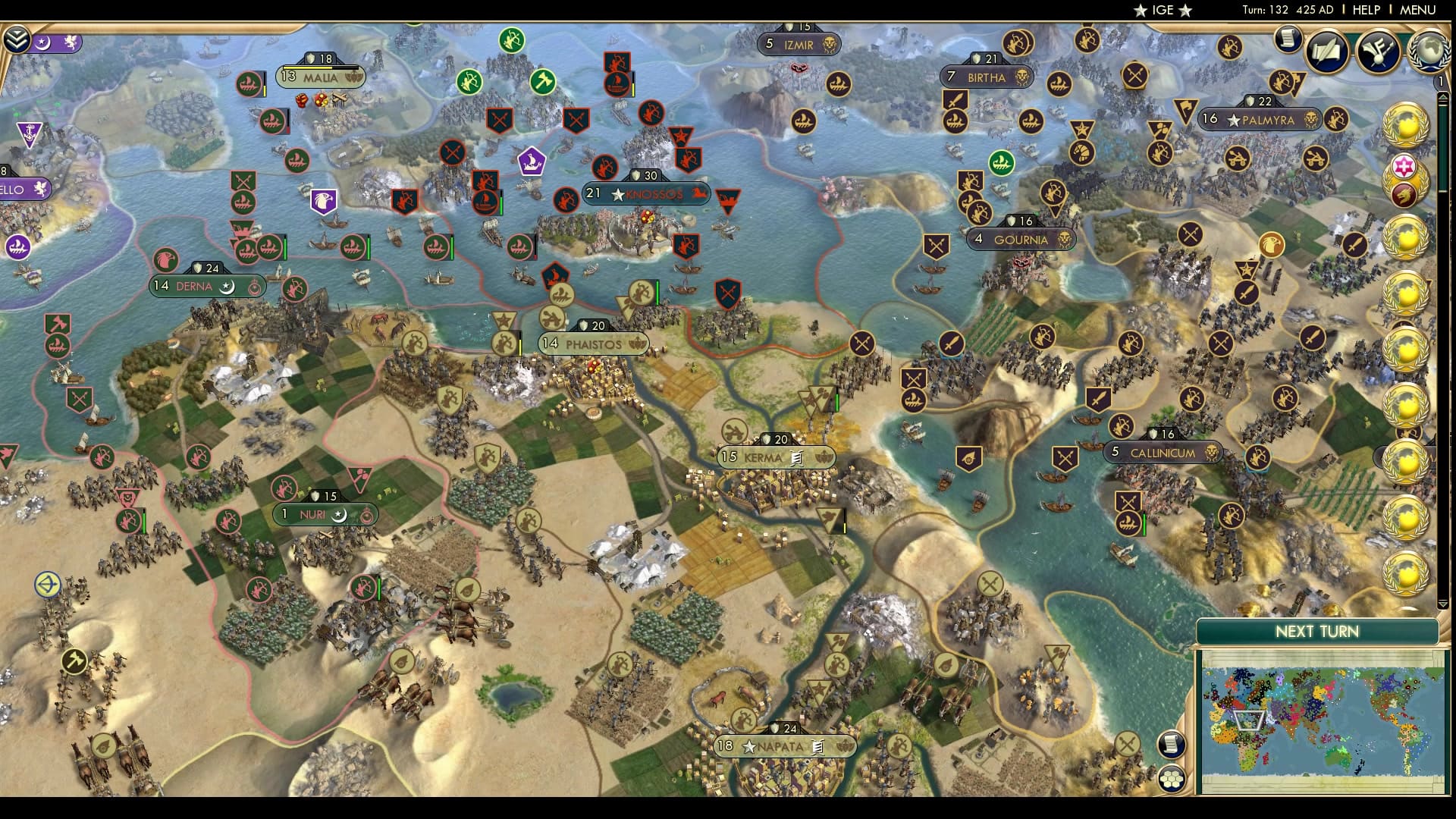
We’re back in Egypt, where we see that Omar has decided to divide the fleet’s attention between Malia and Minoa. A foolish decision, but Omar is in luck. The Palmyrene army appears to be embarking to cross the Red Sea, becoming a bit of a threat for Nubia again. With the Nubian army starting to dwindle, it’s likely that any units threatening Nuri will be pulled back. Such is Omar’s intense luck - at least so far.
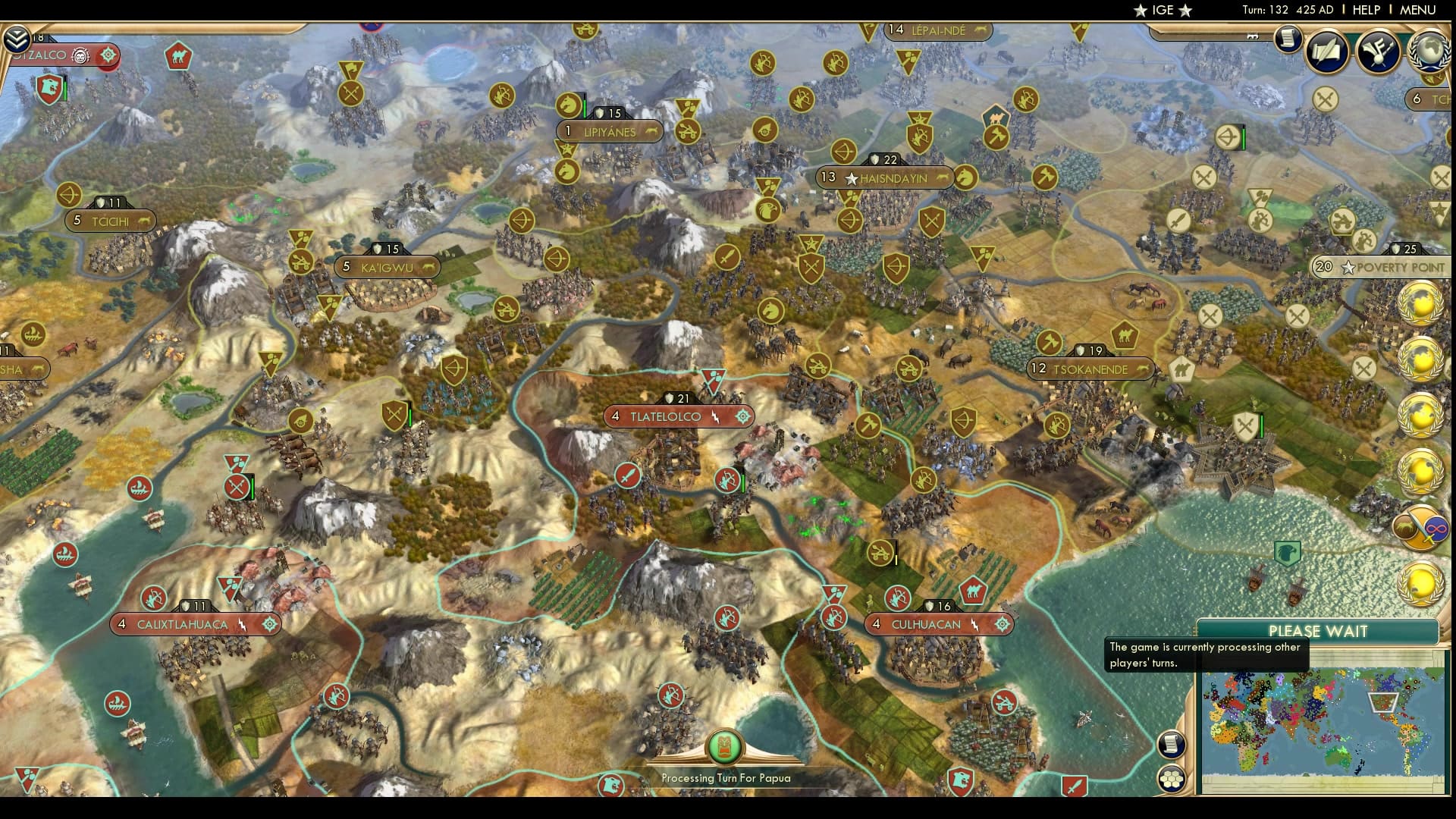
If you forgot the Apache-Aztec war, I will ever-so-slightly judge you, since it had a chance of going somewhere, at least originally. But someone who hasn’t forgotten is Louis Riel, as the Métis declare war on the distracted Apache, joining the pseudo-coalition war. Many have judged Louis’ aggression in the past, but he is out here to prove that North America is his territory, and no one else’s.
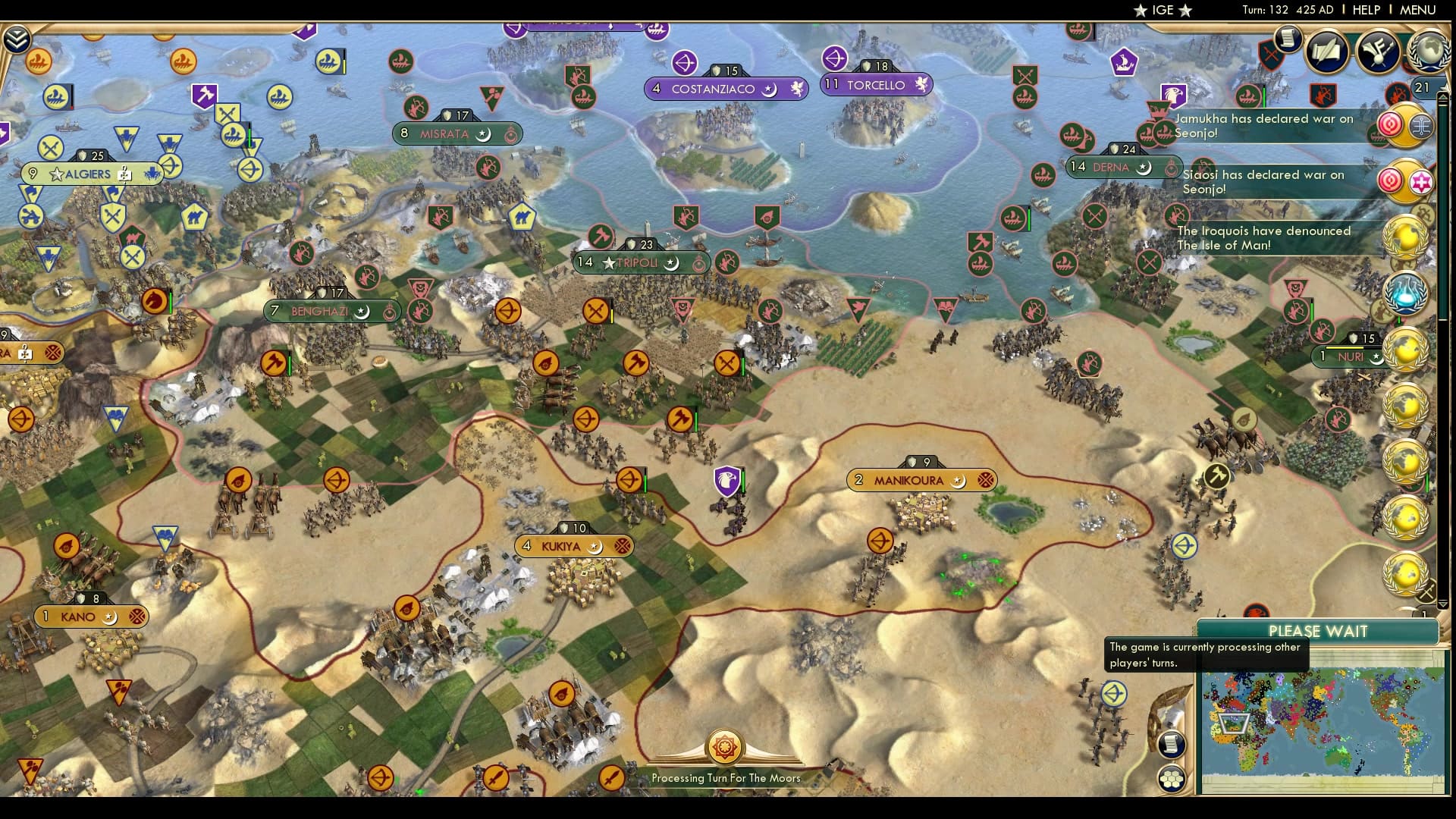
The Songhai invasion, already weakened and dispersing, does not make me confident in Askia’s ability to wage war. Maybe the Mediterranean coast is too far from the Sahara. At the very edge of this shot, Nuri falls to half health, but as you’ll remember, Nubia does not have melee units anywhere nearby, amounting to zero threat to Libya.
The sidebar tells us that Jamukha has finally made an attempt at a relevant war, but reaching Korea might be a bit difficult. Joining him is none other than Tonga, ready to continue Tonga Time.
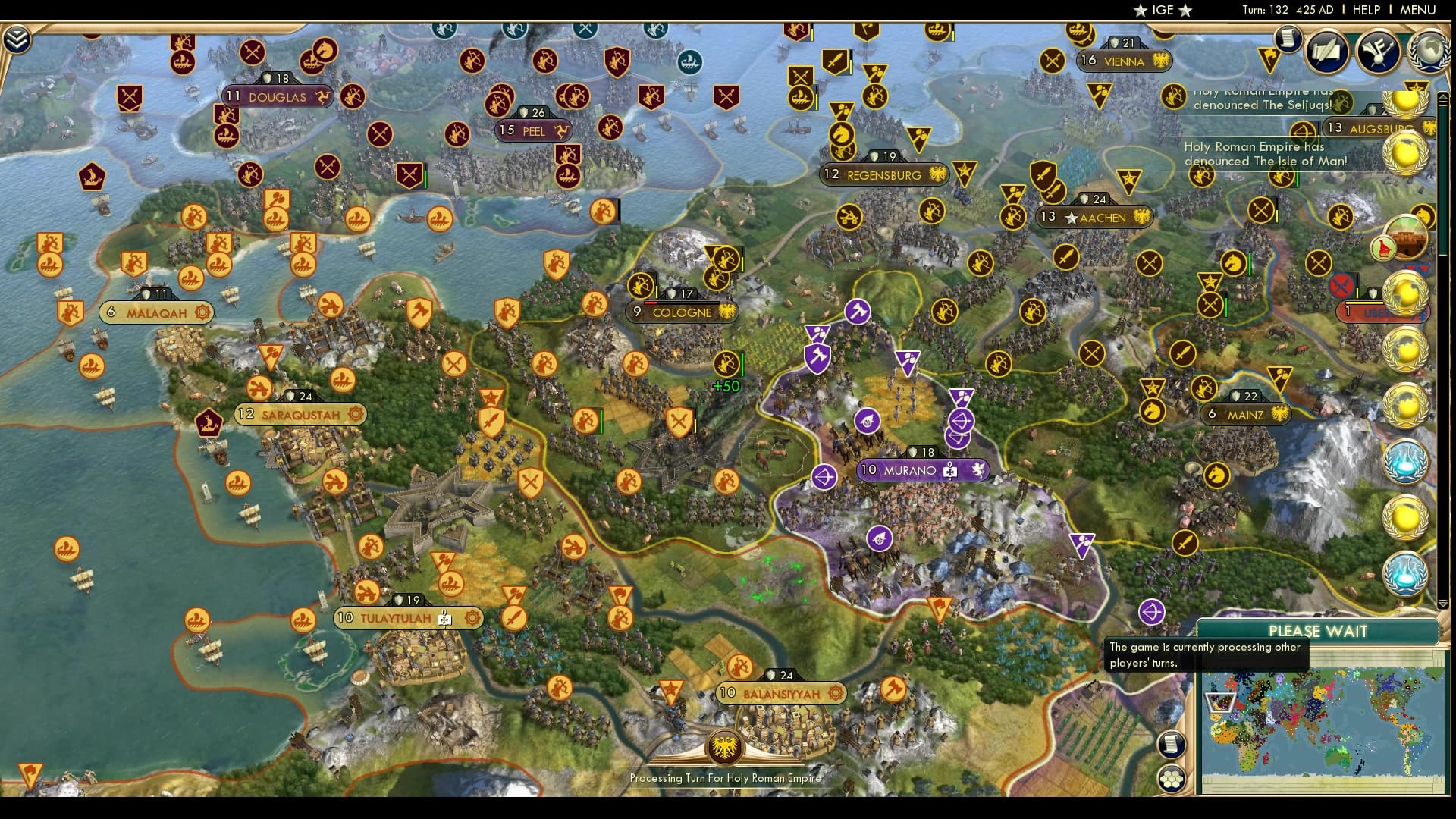
Quite abruptly indeed, the Moorish invasion force directly outside of Cologne grows in size to completely encompass the German lands west of the city. Possibly even learning from the mistakes of others, a spearman has been brought close, only blocked by a single bowman on the German side.
While peasants squabble, Glorious Zimbabwe has constructed another wonder. It is the Churches of Lalibela, giving Zimbabwe the great boon of faith from specialists. Truly, there is not a greater people on the cylinder.
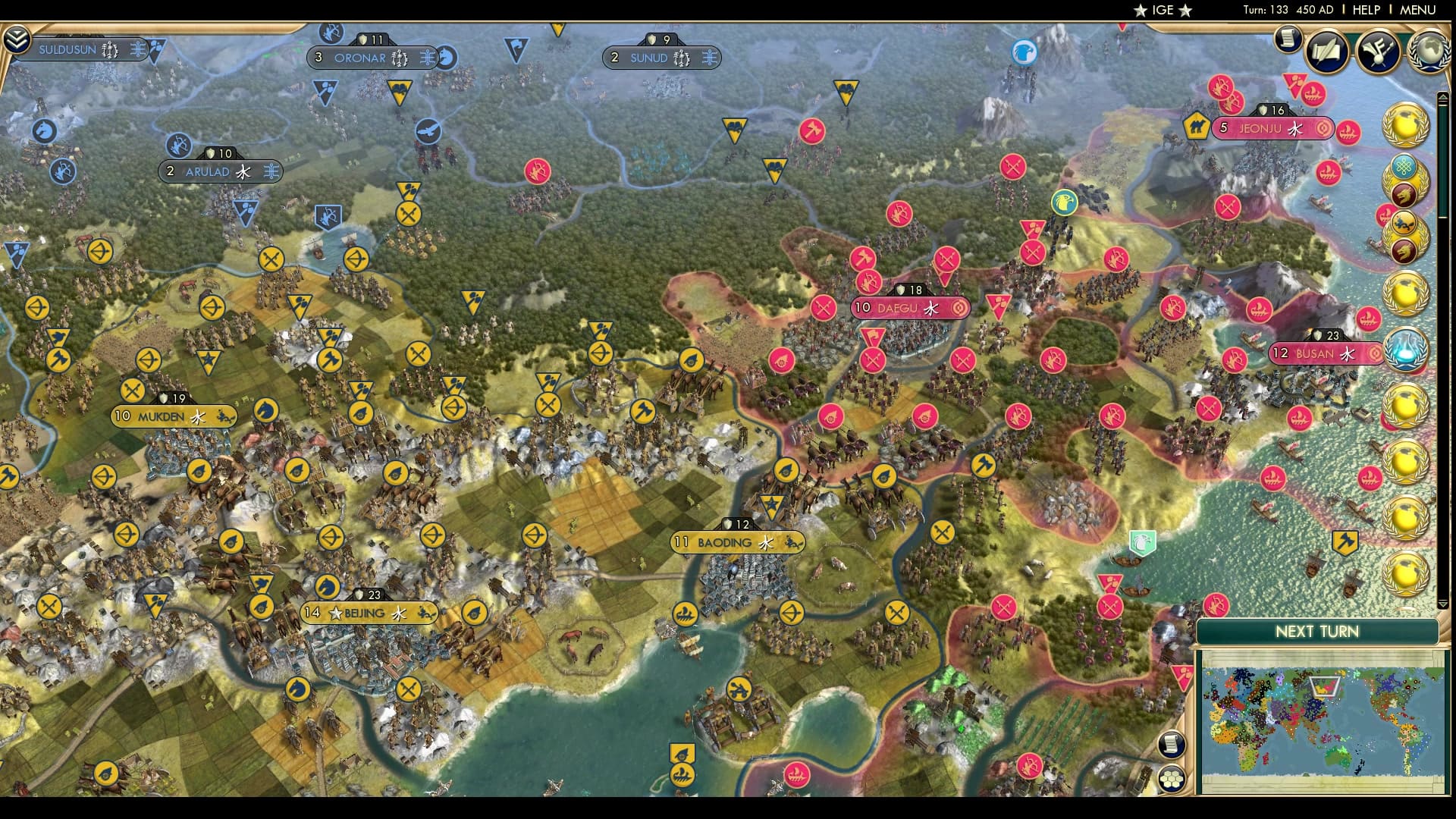
To prove to you that the Khamugs aren’t about to reach Korea and cripple them for good, here is a shot of the untapped wilderness between the two civs. Mostly missionaries dare step into these forests beyond human grasp. In truth, they are probably moving towards Kamchatka, to convert Qing’s colonies, but I like to imagine that they’re converting wild animals to Confucianism.
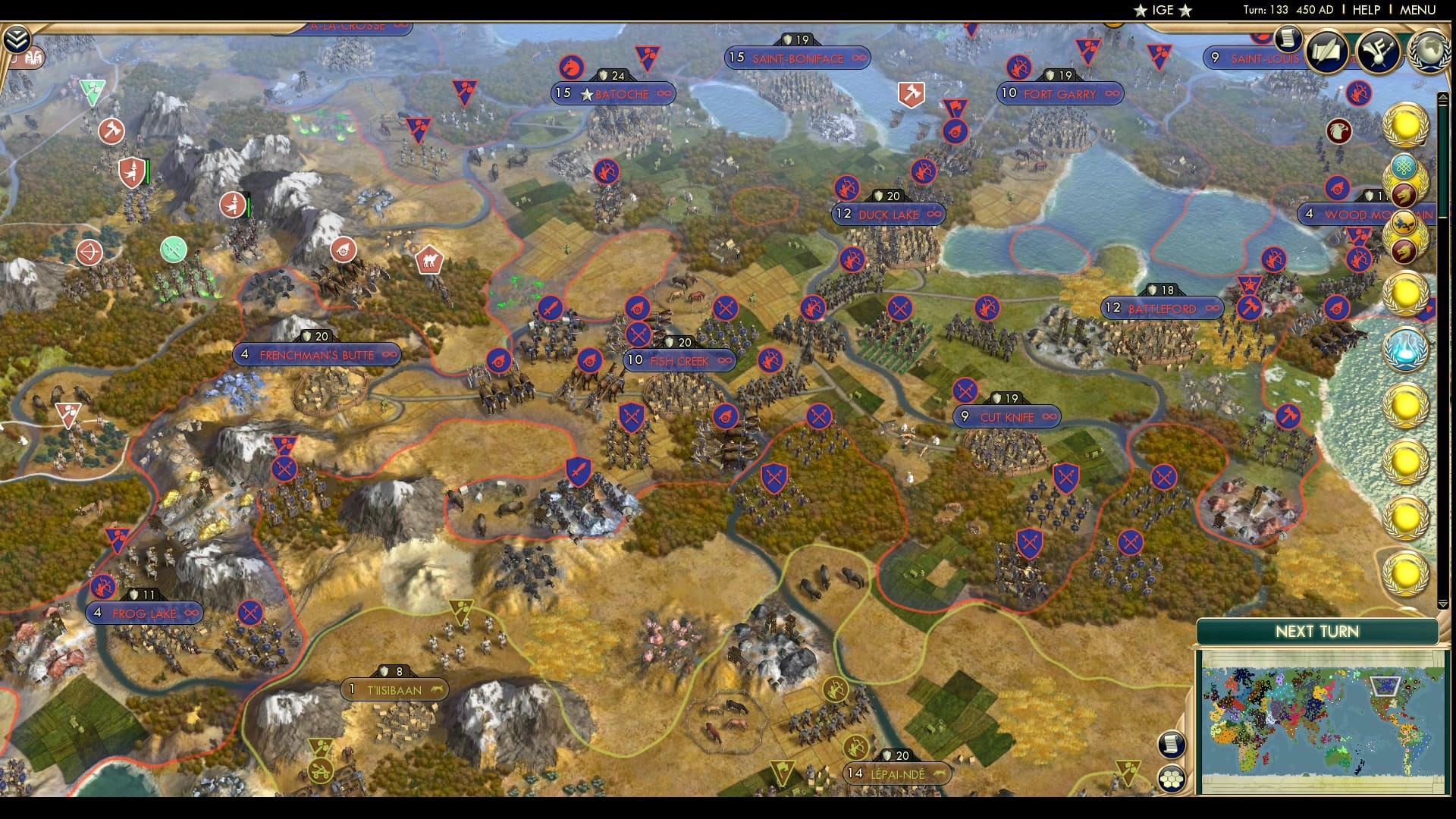
A shot of the Métis-Apache border reveals that while the Apache definitely weren’t prepared for this war, the Métis don’t seem all that prepared either. A host of dozen or so units sit near the iconic city of Fish Creek, famous for its fish, but don’t seem particularly eager to do any actual fighting. Maybe Louis’ orders of fighting were mistaken for fishing.
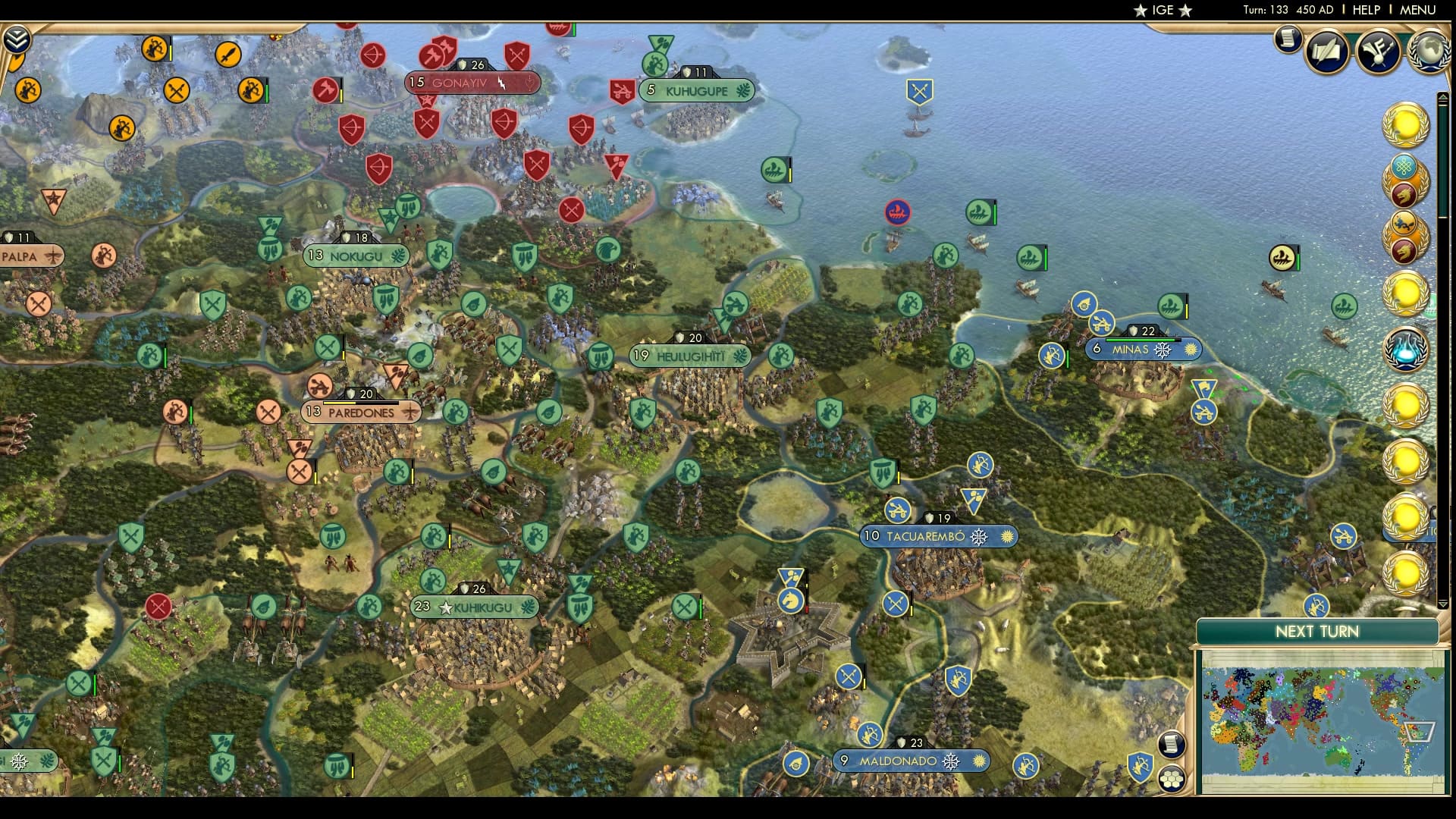
Our return to South America reveals a war so far dominated by Kuikuro. In the heart of Amazon, Kuikuro already surround Paredones. Unlike Kuikuro, the Nazca have been forced to cut down the jungle around the city to make it at least a bit useful, and this move has backfired spectacularly, allowing for an easy approach towards the city. Meanwhile on the Uruguayan front, Kuikuro has learned from the Selk’nam in building up a small navy to abuse Lavalleja’s unwillingness to build one, bringing the hurt to Uruguay. Minas is unlikely to fall, but a man can hope.
This all betrays the reality of the situation, however: south of this shot, the actual Uruguayan army is surely approaching Kuhikugu. Surely.
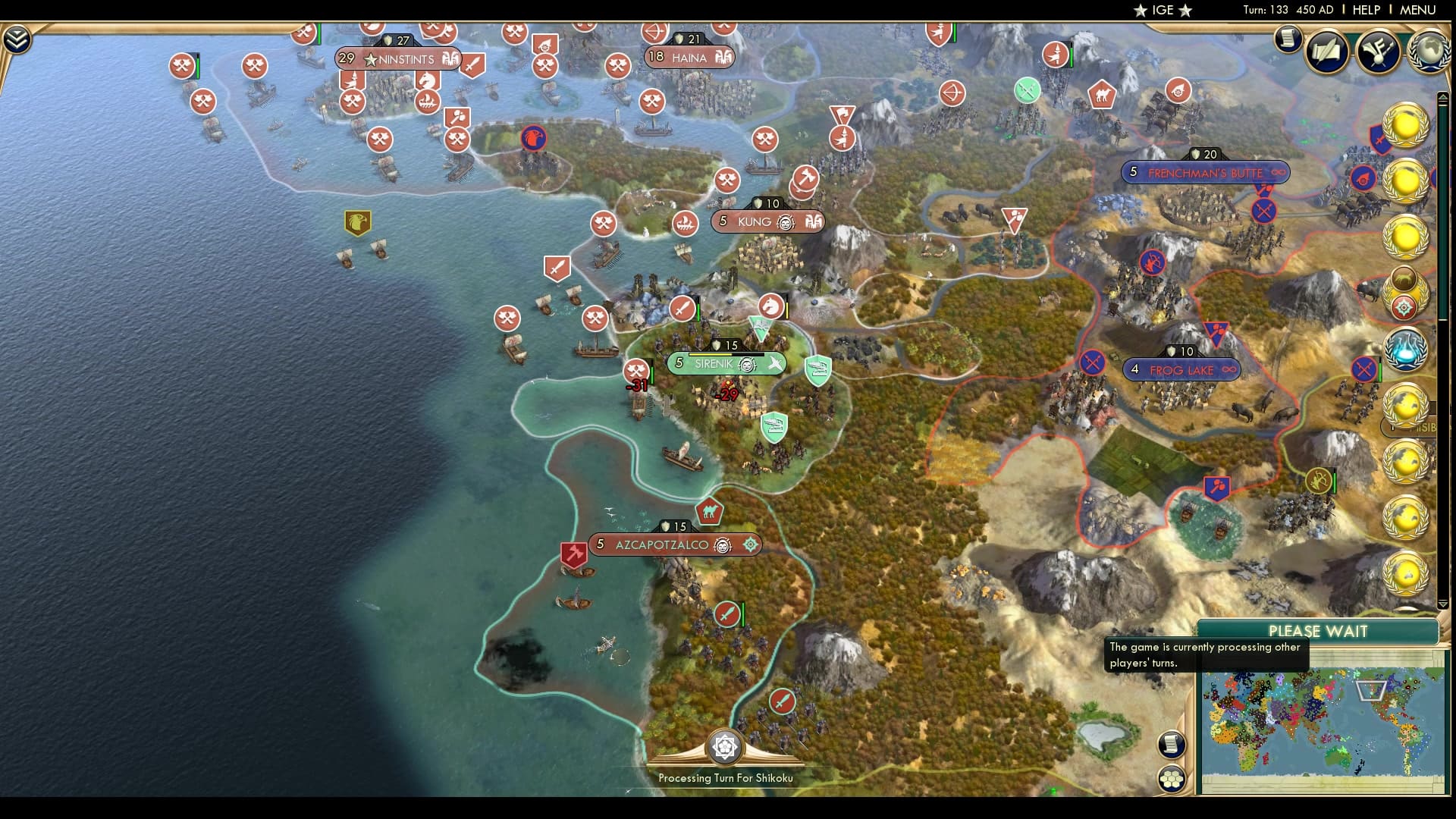
A turn passes, and Sirenik falls systematically lower. It is inevitable, I tell you. But at least the city was converted before it fell, sowing the seed of, uh, that religion of theirs. The two neighboring cities have been converted as well.
In other North American news, Apache have made peace with the Aztecs, worried that the Métis might be serious about fighting instead of fishing.
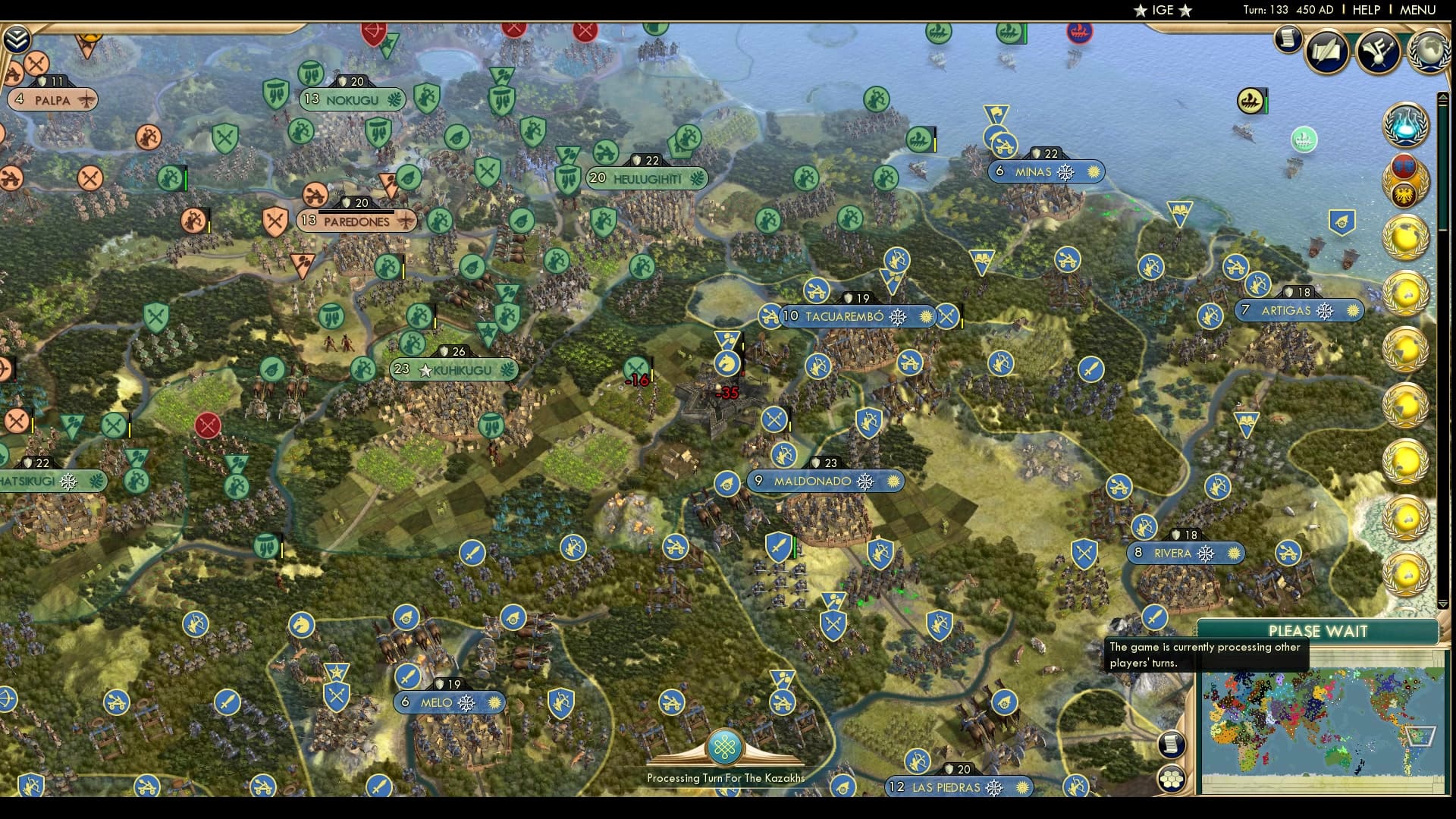
With a better shot of the Amazon, we see that Paredones has already fallen to zero, with a warrior UU within range of the city. Thus, a foregone conclusion. In further good news for Kuikuro, Uruguay seems to be taking its sweet time entering Kuikuro lands, but at least a horseman has entered far enough to pillage the great citadel that Anetü placed to more or less just piss off Lavalleja. That’s gotta have taken some massive balls.
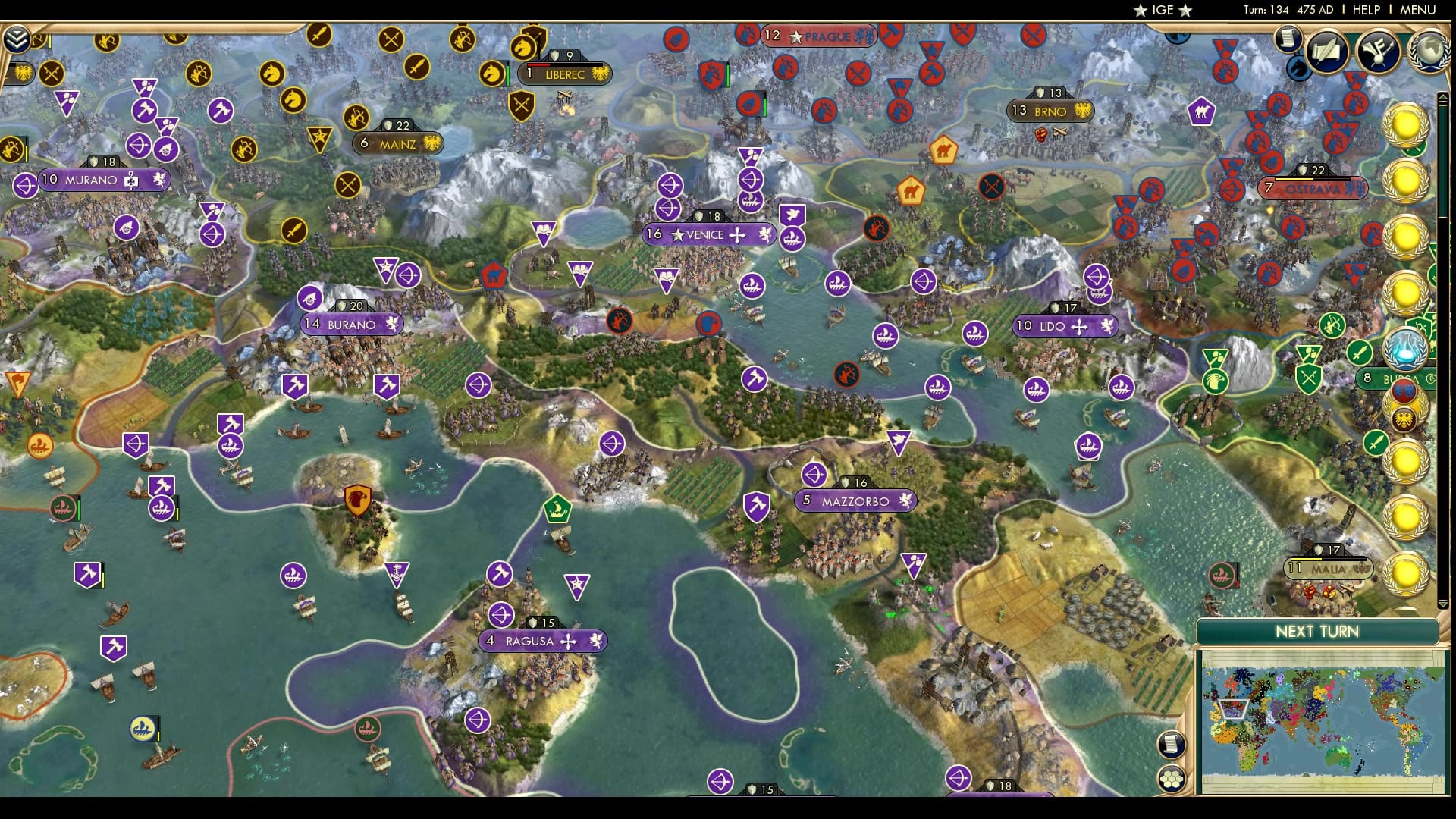
In a shot clearly taken to contrast Malia and the result of the recent HRE-Czech peace, we see that Brno is now flying brown and yellow colors. While not necessarily all that useful for the Germans, this peace is crushing to any dreams or hopes the Czechs might’ve still had. With Havel’s empire divided in two, he might as well just fuck around as much as he can from here on out. Just imagine how similar his situation would be to the Minoans’ if Ostrava had fallen to the Turks.
In equally depressing news, the Slovenian Minoans aren’t the only Minoans displaced into this direction, as there are two units in Italy as well. Poor souls.
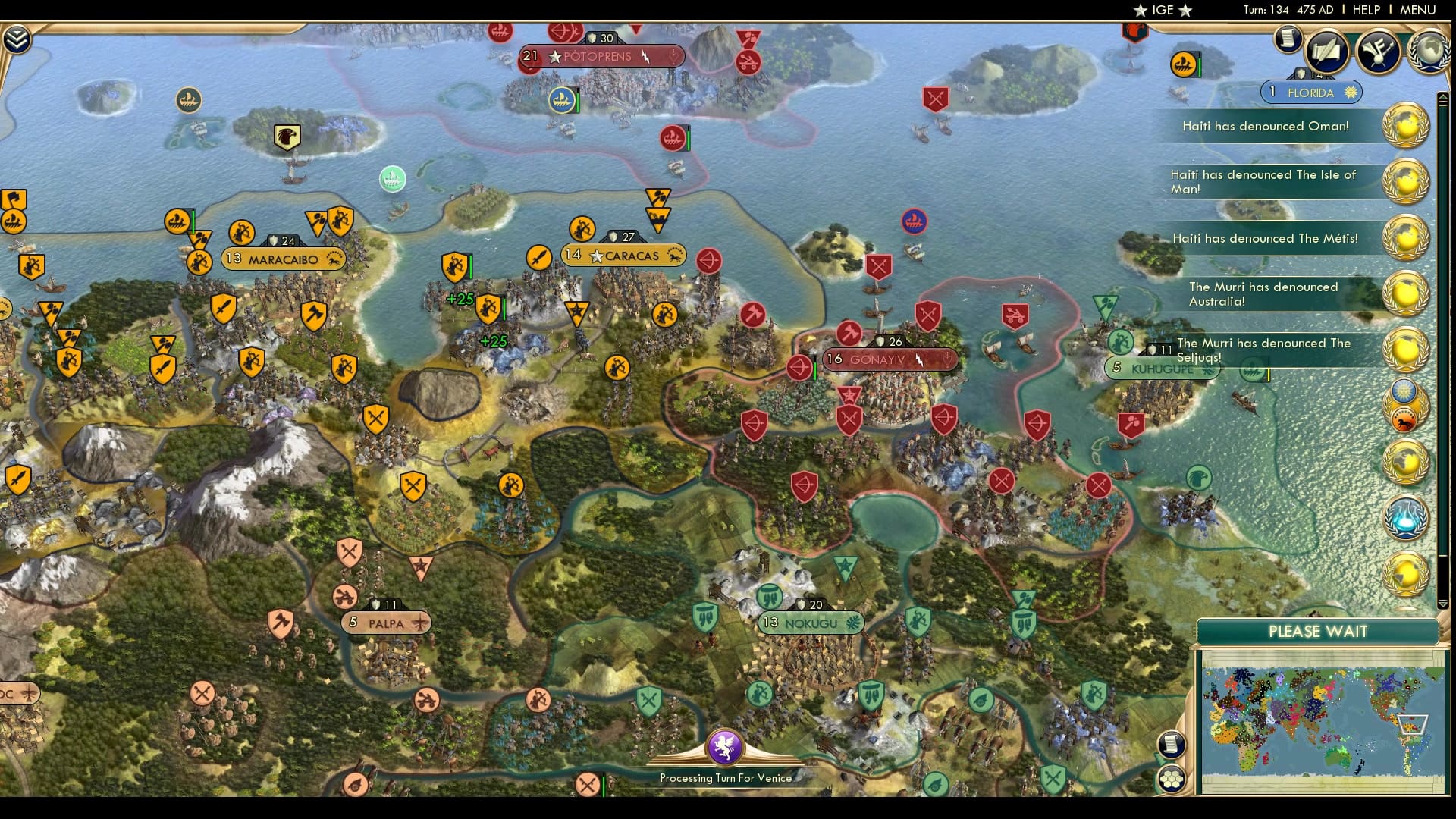
Lavalleja, frustrated by the Amazon, signs a peace treaty with Venezuela, leaving only Haiti and the Aztecs to fight the yellow beast. Judging by the unit compositions by Caracas and Gonayiv, Haiti won’t see much success here. Maybe you should’ve taken the city earlier when you had the chance, Touissant.
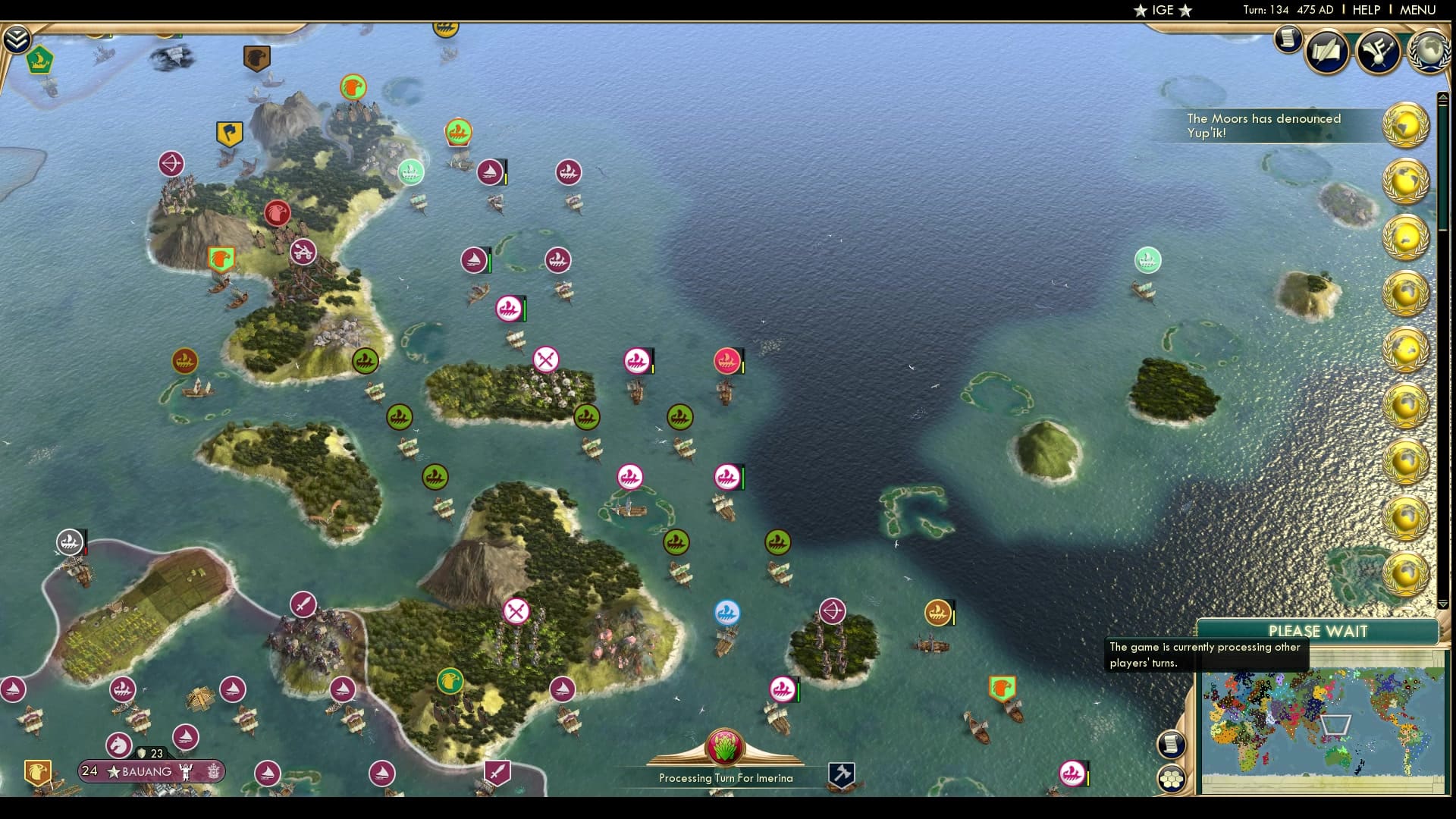
To remind you that their war is definitely important, Tonga and Korea have decided to have a small skirmish east of the Philippines. Probably more interesting here however is either the Murri fleet sailing far, far from home, or the Qing settler still going around in circles, seemingly disappointed with every single spot it could settle. Oddly infuriating is the one-tile gap of deep ocean between Palau and Mindanao we see here.
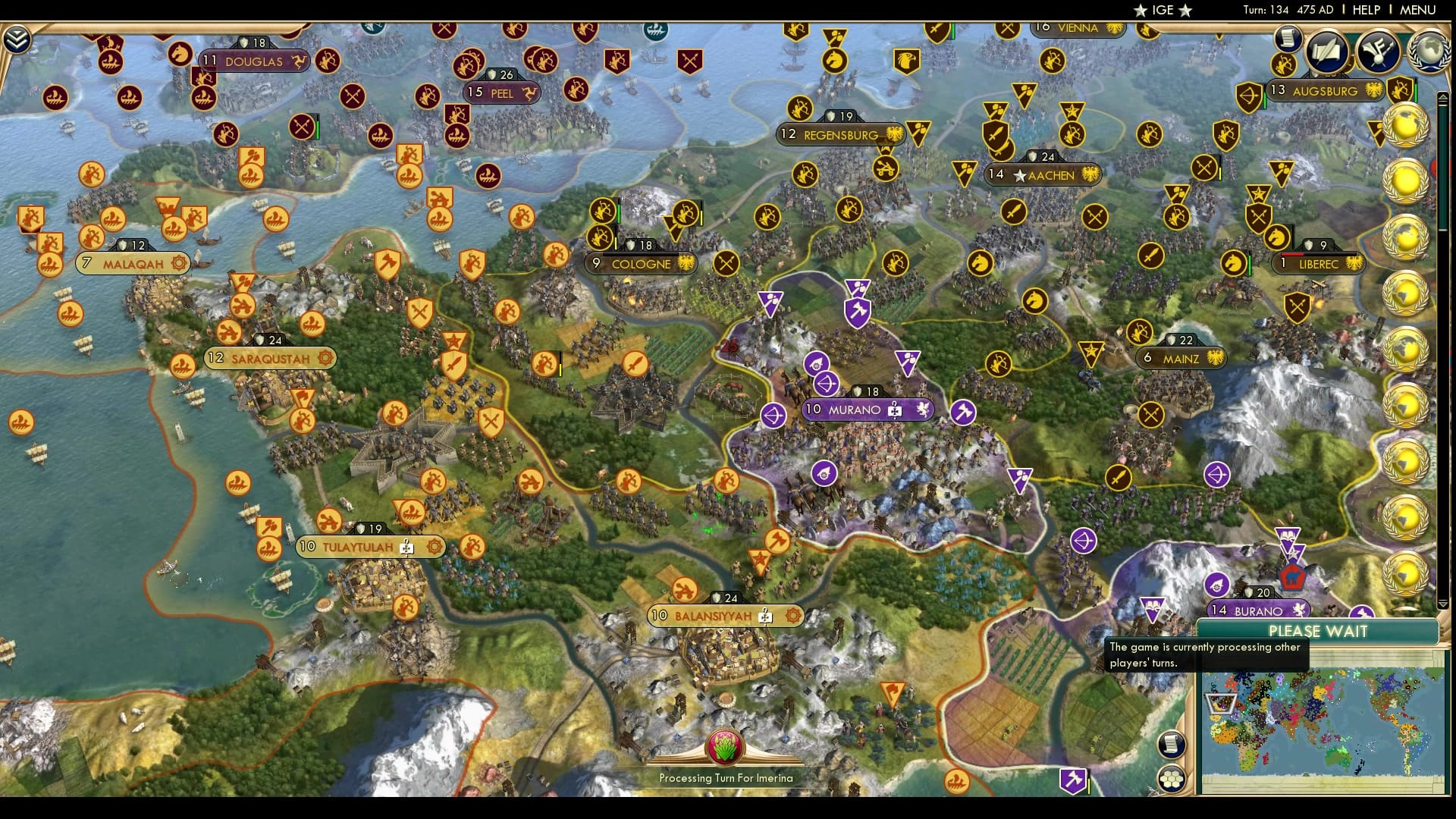
The Moorish army here, while weakened somewhat, and missing the spearman mentioned earlier, has picked up the pace and brought a swordsman to the very front of the battle. And this time, there are no pesky bowmen in the way. Will the city fall next turn?
I have received a transmission from BC telling me that on turn 134, the HRE has researched Theology, thus sending them into the Medieval era and changing their leader to Suryavarman II. Maybe Khmer lad can turn the tide of the Moorish war?
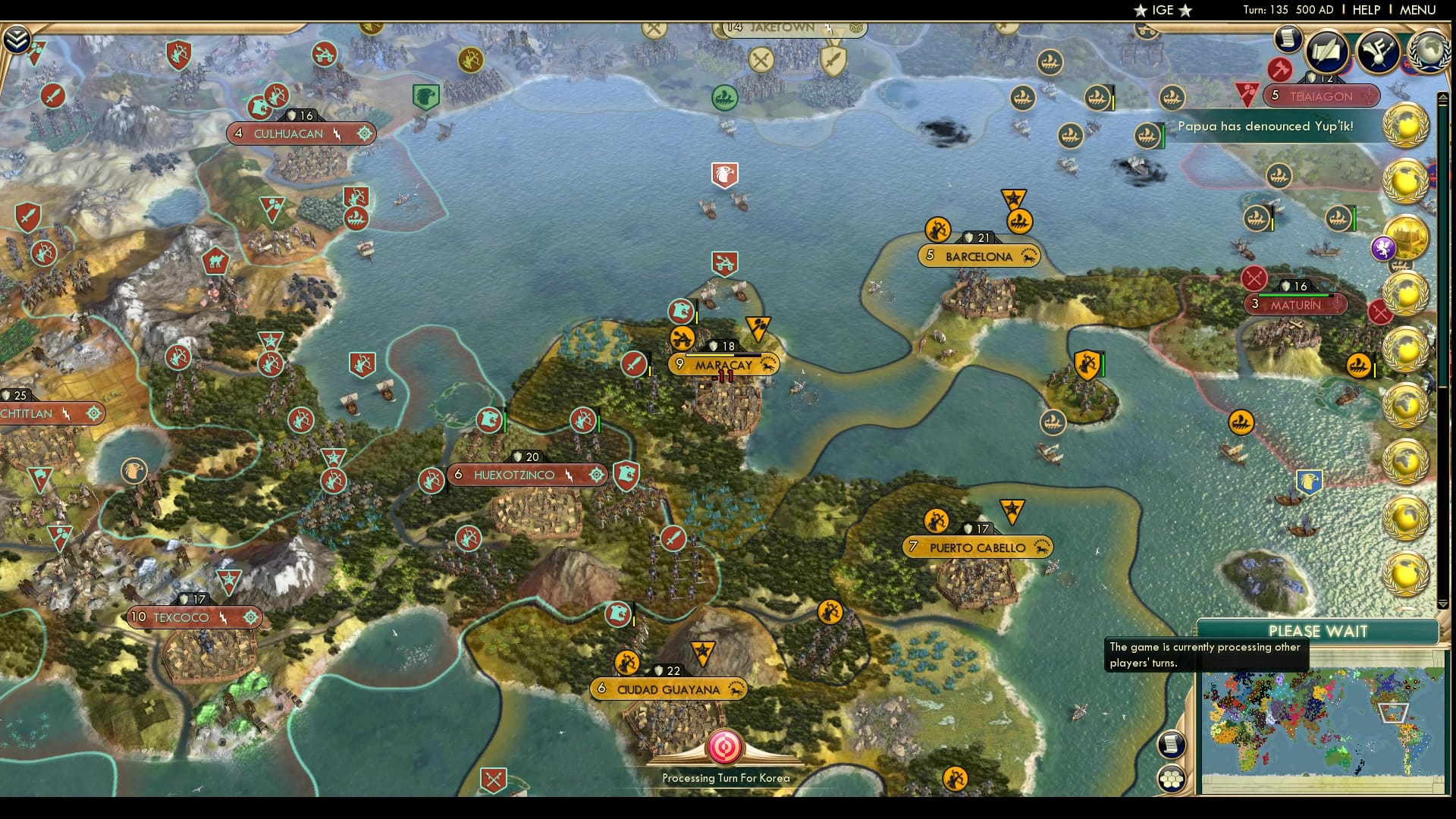
The Apache are out of the picture, and the Aztecs return to attacking Maracay. This attack seems doomed as well, judging by how few men Montezuma has sent to attack the city again. You really would benefit from a navy here, Monty. But the only coastal Aztec city on this side of the continent is a 4-pop city, so I guess I should’ve expected the lack of naval support.
On the sidebar, Venice builds the Great Mosque of Djenne, improving the missionaries bought in the city with the wonder. Lots of religious wonders this part.
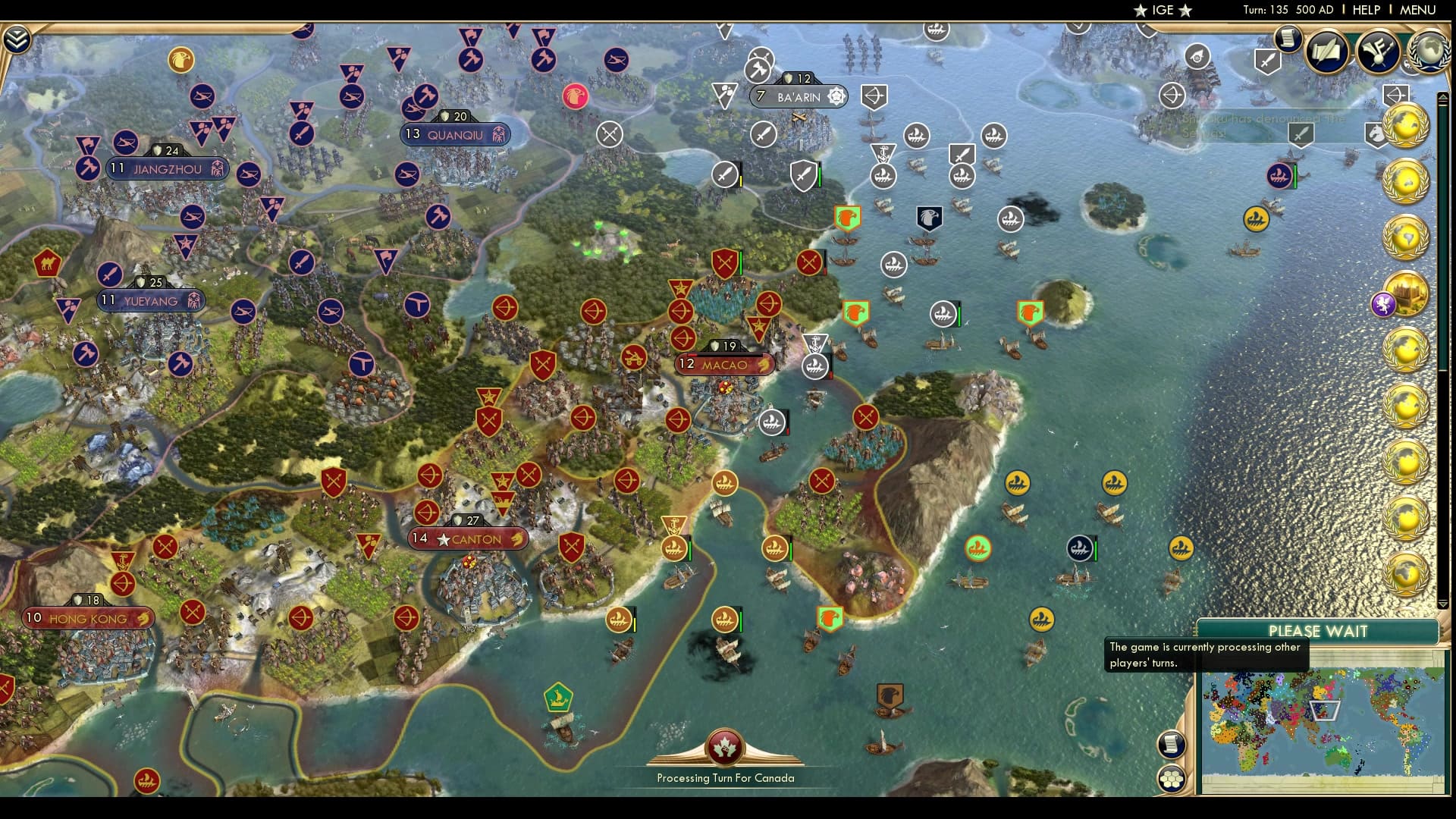
Against all expectations, Ryoma has managed to damage Macao all the way down to red. The city, hard to approach by sea and surrounded by ranged defenders, has nevertheless taken a beating, and more reinforcements seem to be ready to go every time we look at this region. Can Ryoma actually take the city?
You might’ve missed it in the midst of the good dozen or so war declarations last part, but Maratha is indeed at war with the Pirates as well, and for that, Shivaji has sent a small fleet to aid Ryoma. Or perhaps the ships are here to snipe the city and take credit for Ryoma’s achievement?
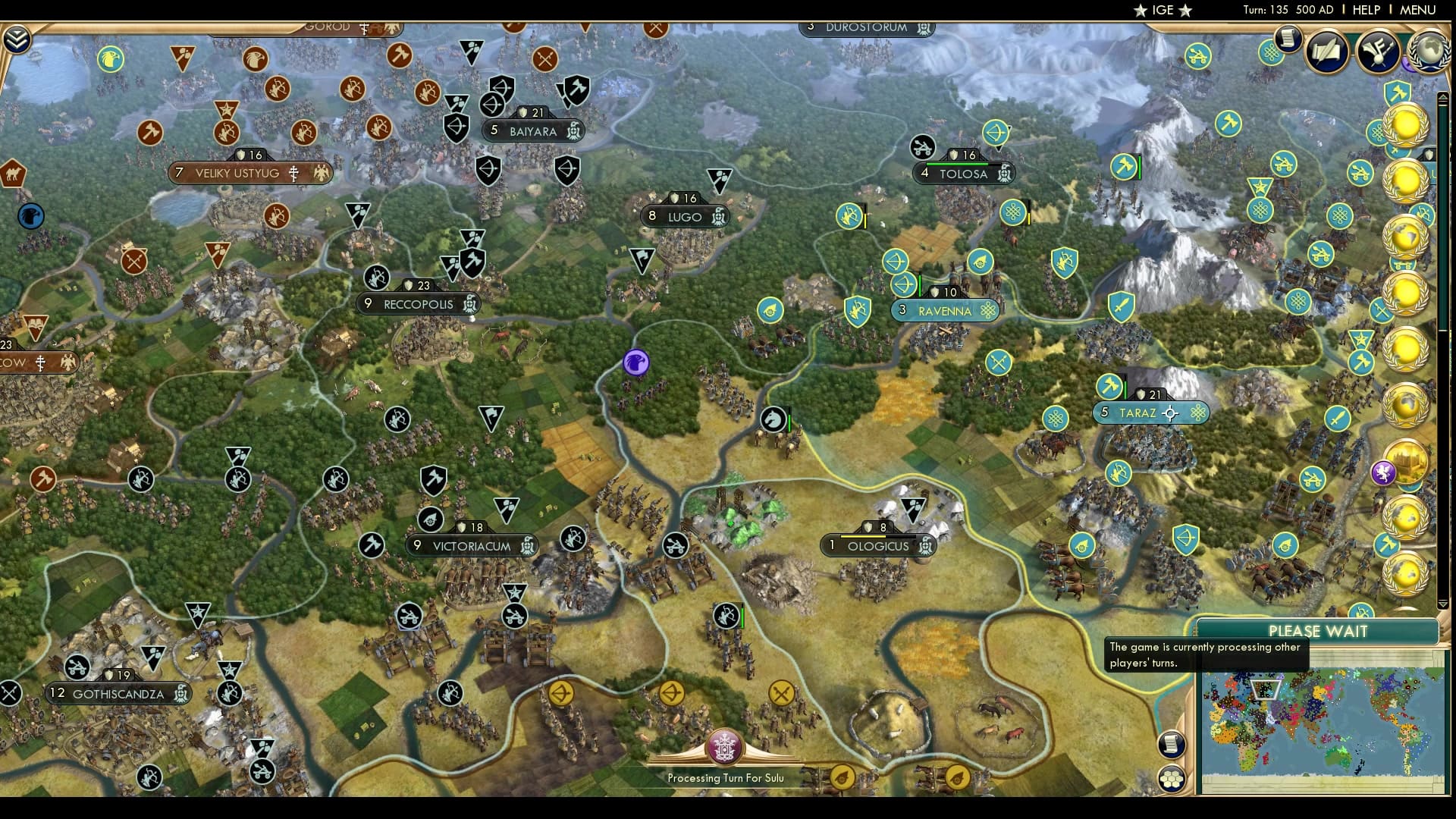
Both the Goths and the Kazakhs seem oddly disinterested in Ologicus here. Only a Goth worker resides in the city, as military units from both sides are avoiding the city like the plague. Indeed, looking for another target, the Kazakh army has jumped north to bully Tolosa instead. Tolosa looks to fall as well, and this one should extremely difficult for the Goths to flip back. How much more is Alaric willing to bleed?
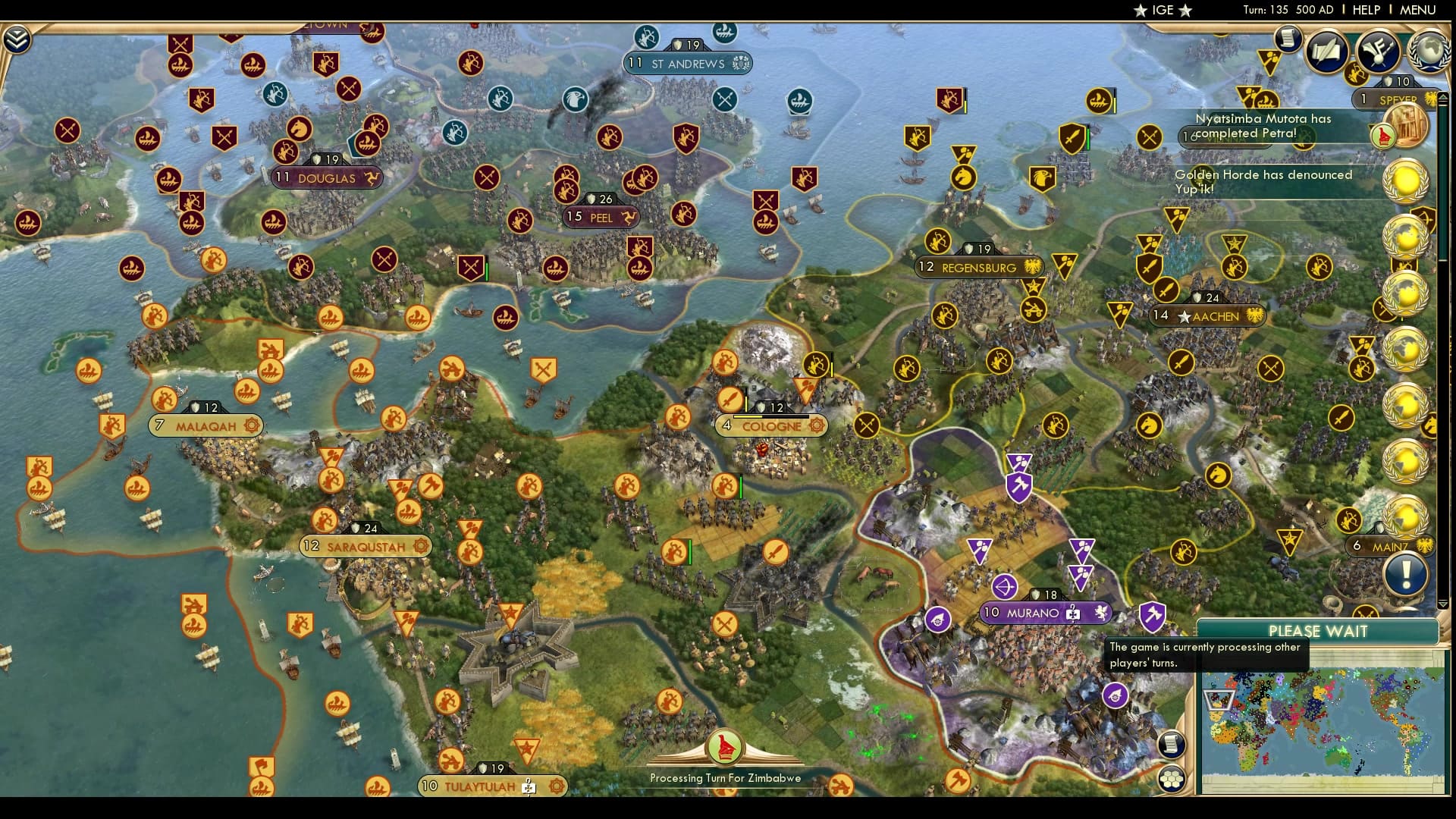
And just like that, a turn later, Cologne has fallen to the brave Moorish swordsman. The Germans, realizing they no longer smell good, send a contingent of bowmen alongside a spearman to recapture the city. But Moorish supporters should not worry for the city flipping back, as a second Moorish swordsman is already approaching, ready to recapture the city if it were to fall back in German hands. And even behind that swordsman, a backup spearman is incoming.
On the sidebar, Zimbabwe builds the Petra, making desert tiles useful in the city it was built in, which BC has told me to be Zvongombe. The city is situated on the edge of the Kalahari Basin, but unfortunately has a lot of flood plains near it. The flat desert near the city will benefit from the wonder, though, and either way it represents the eternal glory, might, etc. of Zimbabwe.
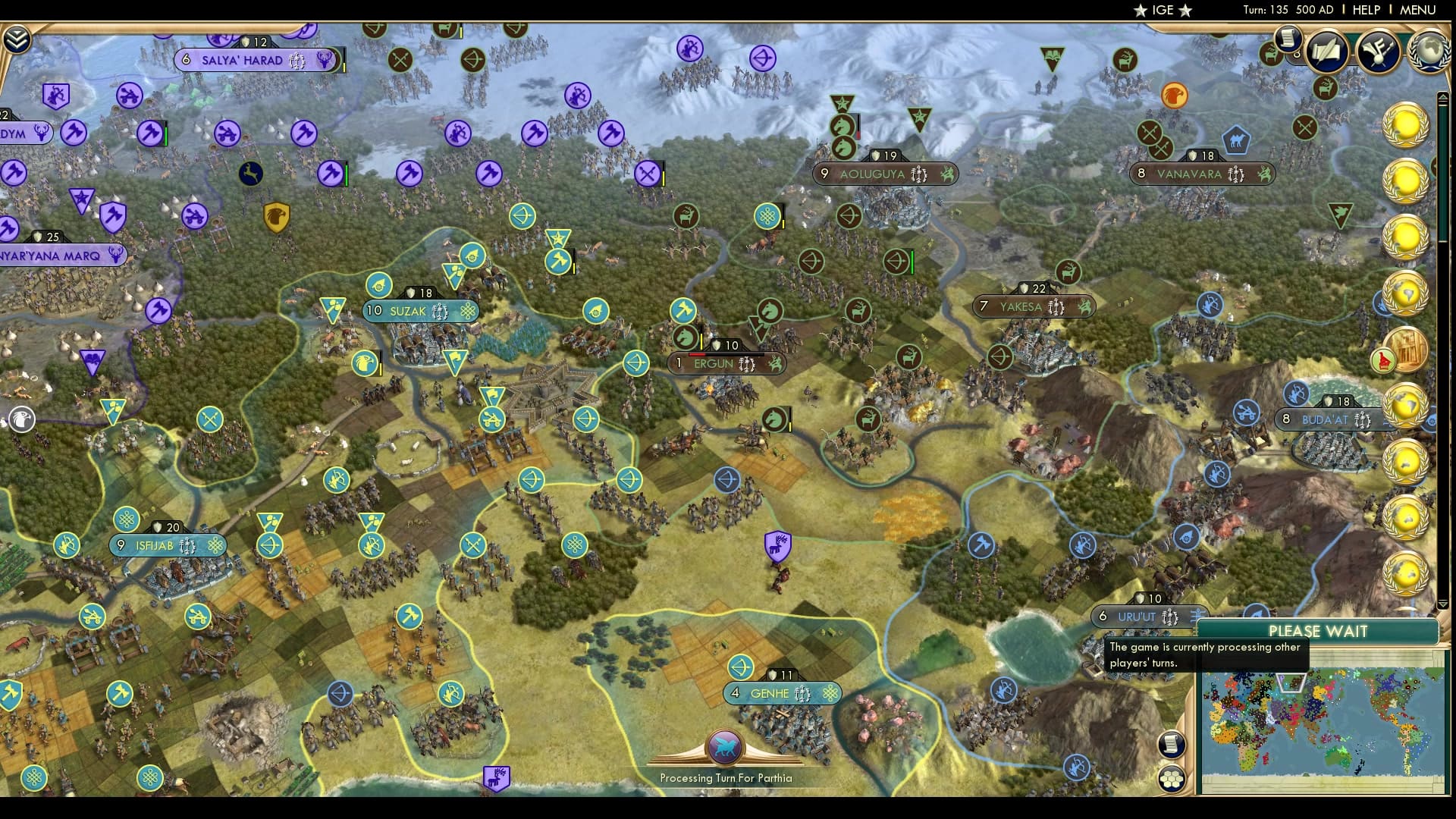
The Kazakh army, awoken from its daze by the fall of Ergun and the wrath of Ablai Khan, realize that the Siberian Battle Royale was probably just an elaborate ploy to distract them. This might very well be true, considering the only other observers of the event were scouts from the Sami and the Golden Horde. To me it seems like the city will easily flip, and then flip some more, before inevitably falling to Kazakh hands in a less temporary sense.
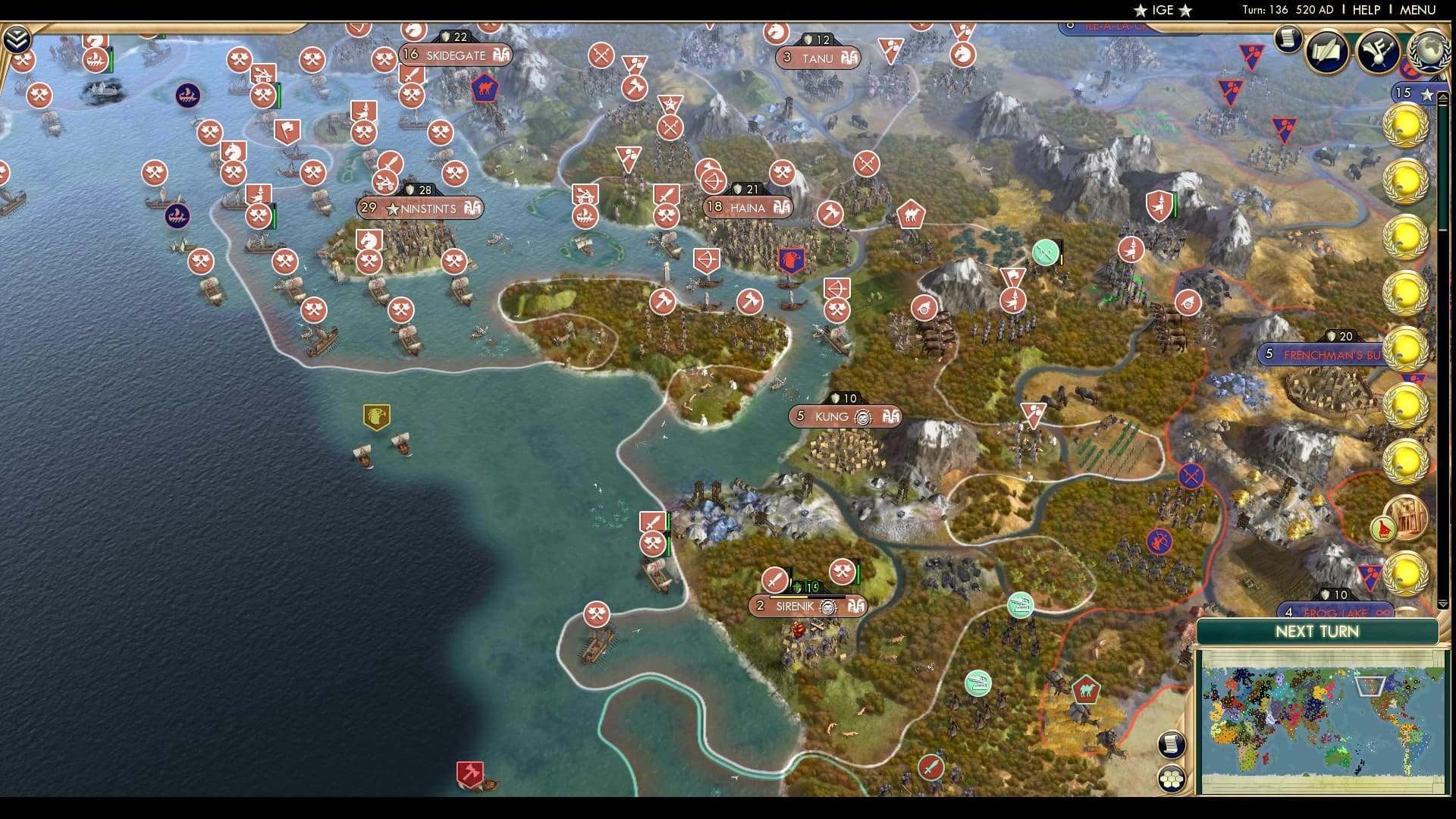
A return to Cascadia reveals to us that Sirenik has indeed fallen to the efficient Haida war machine. A massive fleet of War Canoes, accompanied by a good half a dozen embarked units, is seen slowly funnelling towards the Yup’ik core. Better start praying to your gods, Inuit-replacements.
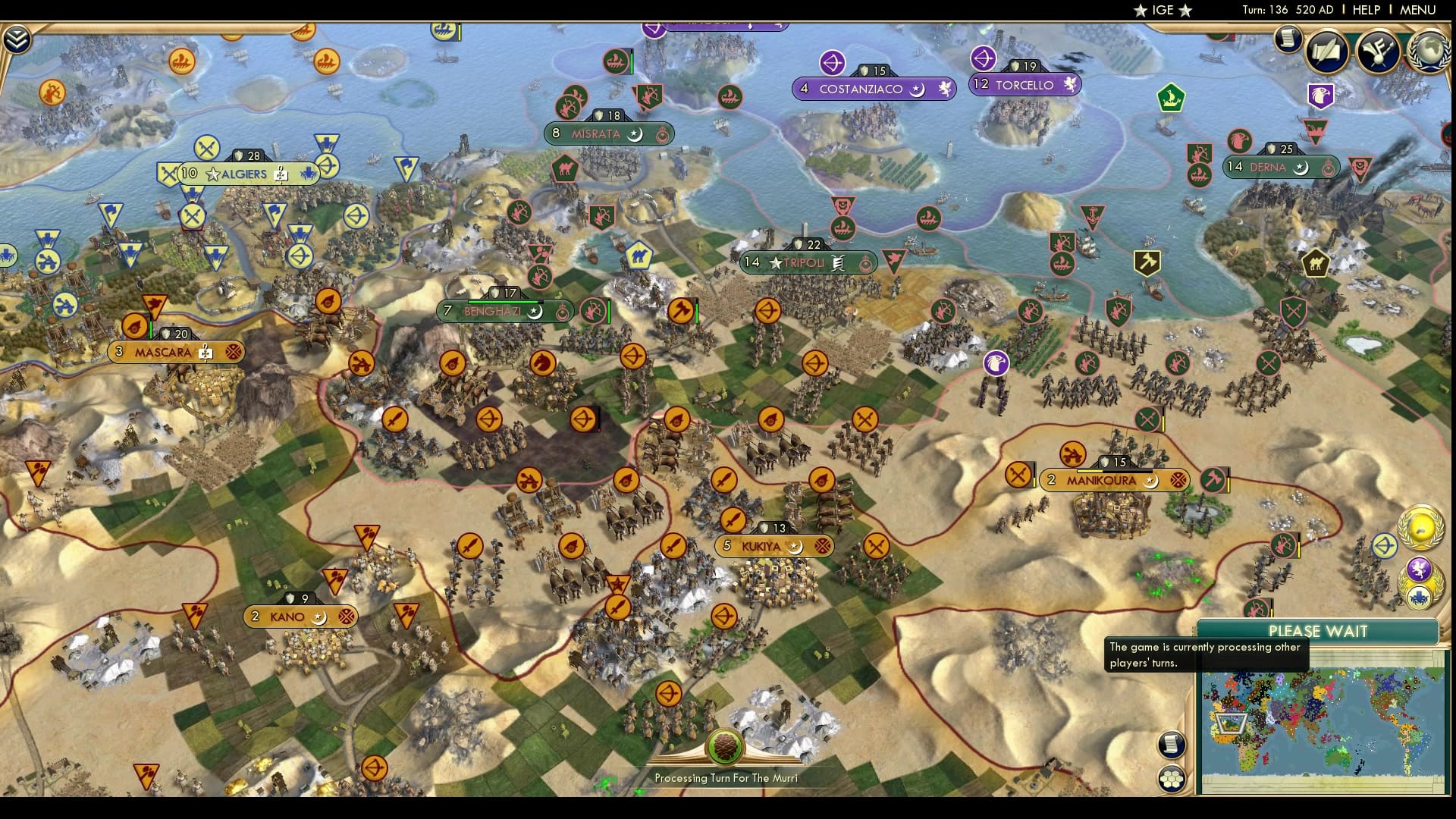
Back in North Africa, Askia seems extremely intent on capturing a Libyan city, as his invasion force of said civ has doubled in size from when we last saw it. Either Benghazi or Tripoli looks doomed to fall, and while this all is happening, Omar Mukhtar seems to be concentrating his troops on Manikoura, a city Songhai settled earlier this part. To this end, he seems to have reduced the garrison in his core cities: there is currently no land unit resting in Tripoli. I get you’re getting cocky, Omar, but don’t you think this is a bit far?
On the sidebar, Venice makes peace with Algeria after an embarrassing defeat.
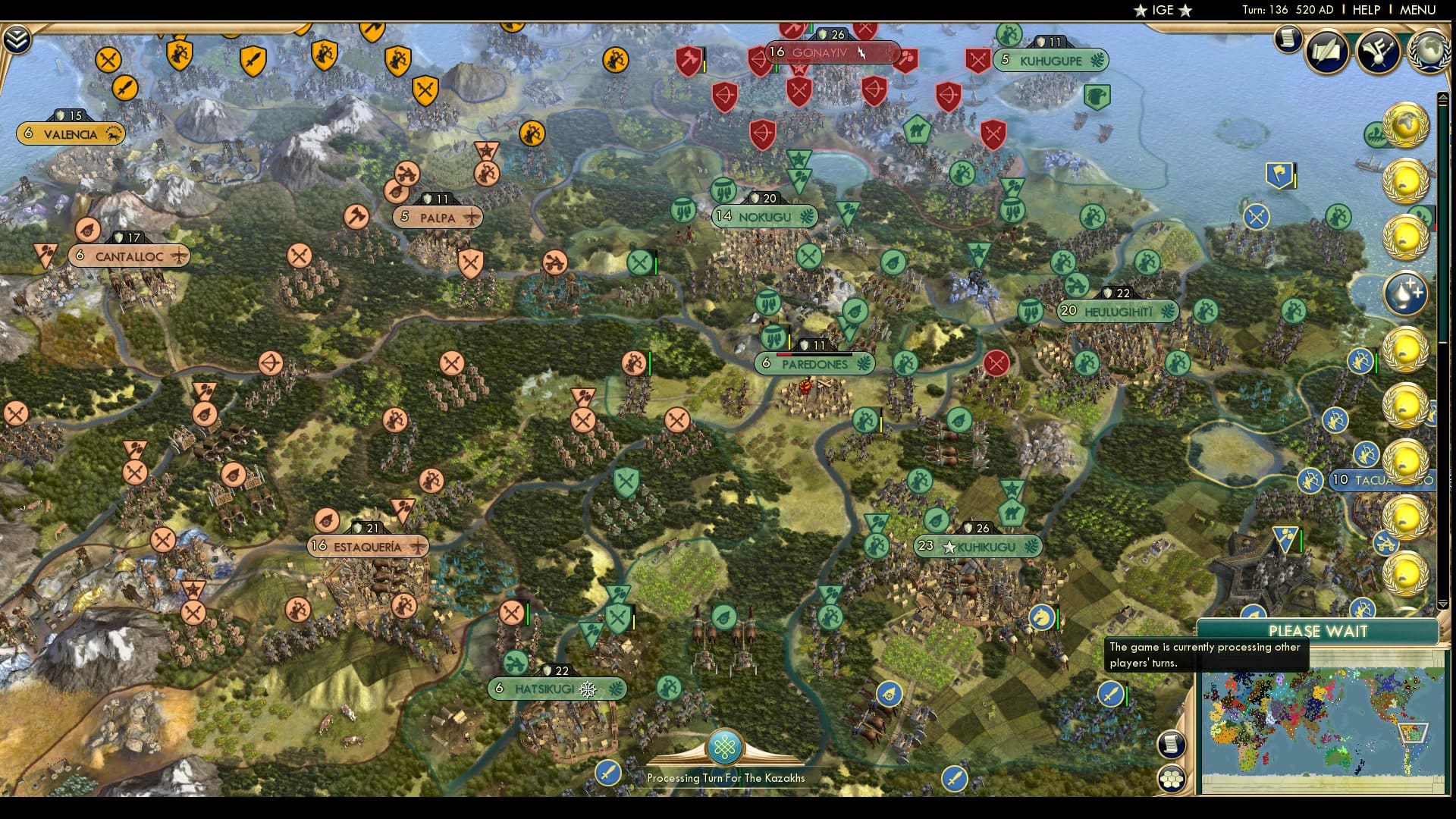
We jump back into the Amazon War, where Paredones has fallen to Kuikuro. Cahuachi seems to have little chance of retaking the city. But every coin has two sides, and the capture of Paredones heralds the arrival of Uruguayan troops, which are finally reaching the gates of Kuhikugu. But as before, it is good to be skeptical, for Kuikuro is still unlikely to suffer from any real consequences.
On the coast down the river, Uruguay embarks a settler into the waters ruled by Kuikuro’s navy. Nice going, Lavalleja.
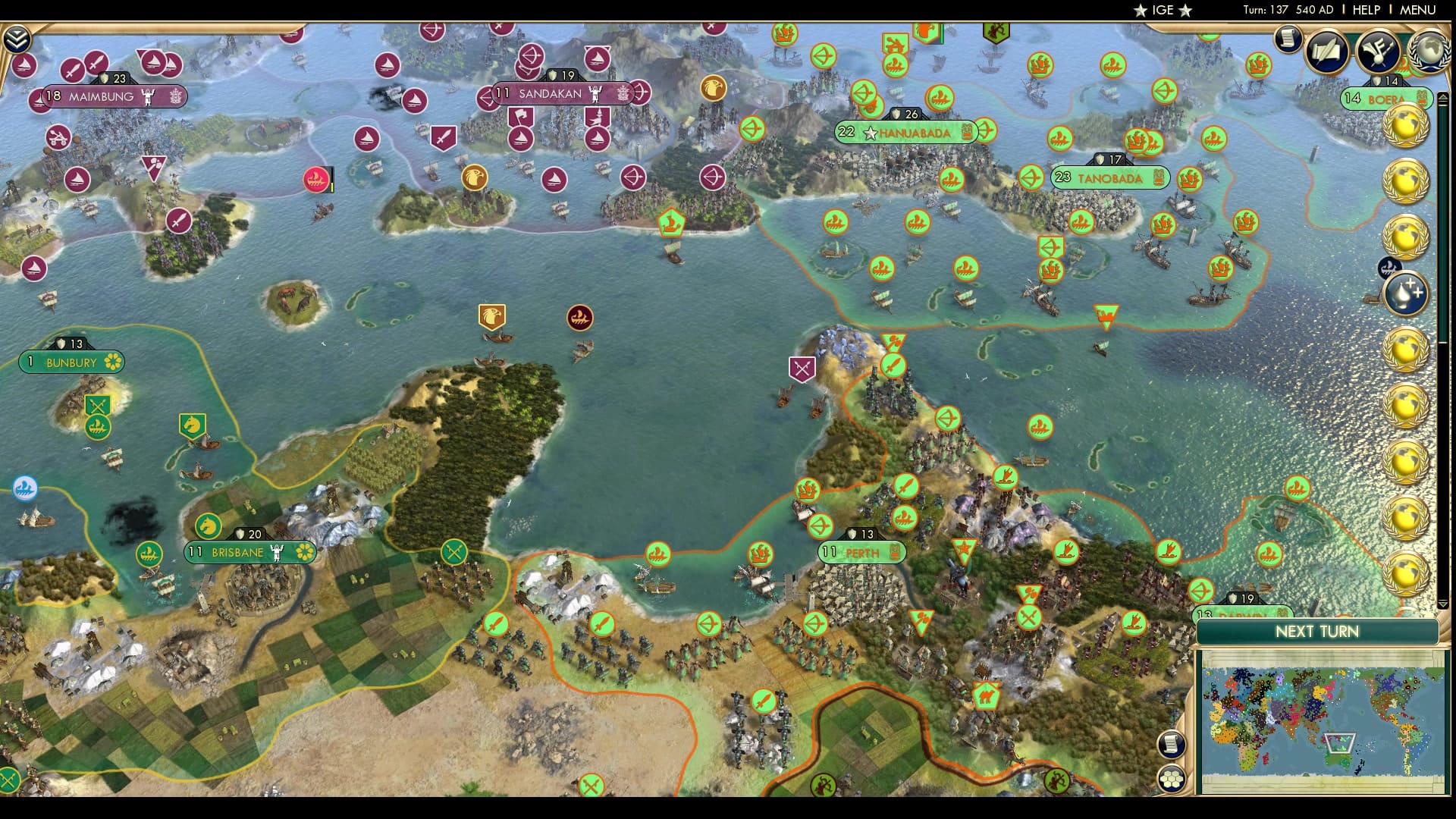
The centerpiece of this shot is the Arafura Sea, here positioned squarely between the three powers of the region, Sulu, Papua, and Australia. While Australia focuses on settler spam and Sulu focuses on an efficient tech rate, Papua has managed to be the first in this region to reach Compass, and thus, the carracks you see here. Sulu’s trireme replacement and Australia’s bare-bones garrisons would stand no chance, should Papua desire to repeat its earlier success. Because in this region, navy is everything - at least before the Modern era, that is.
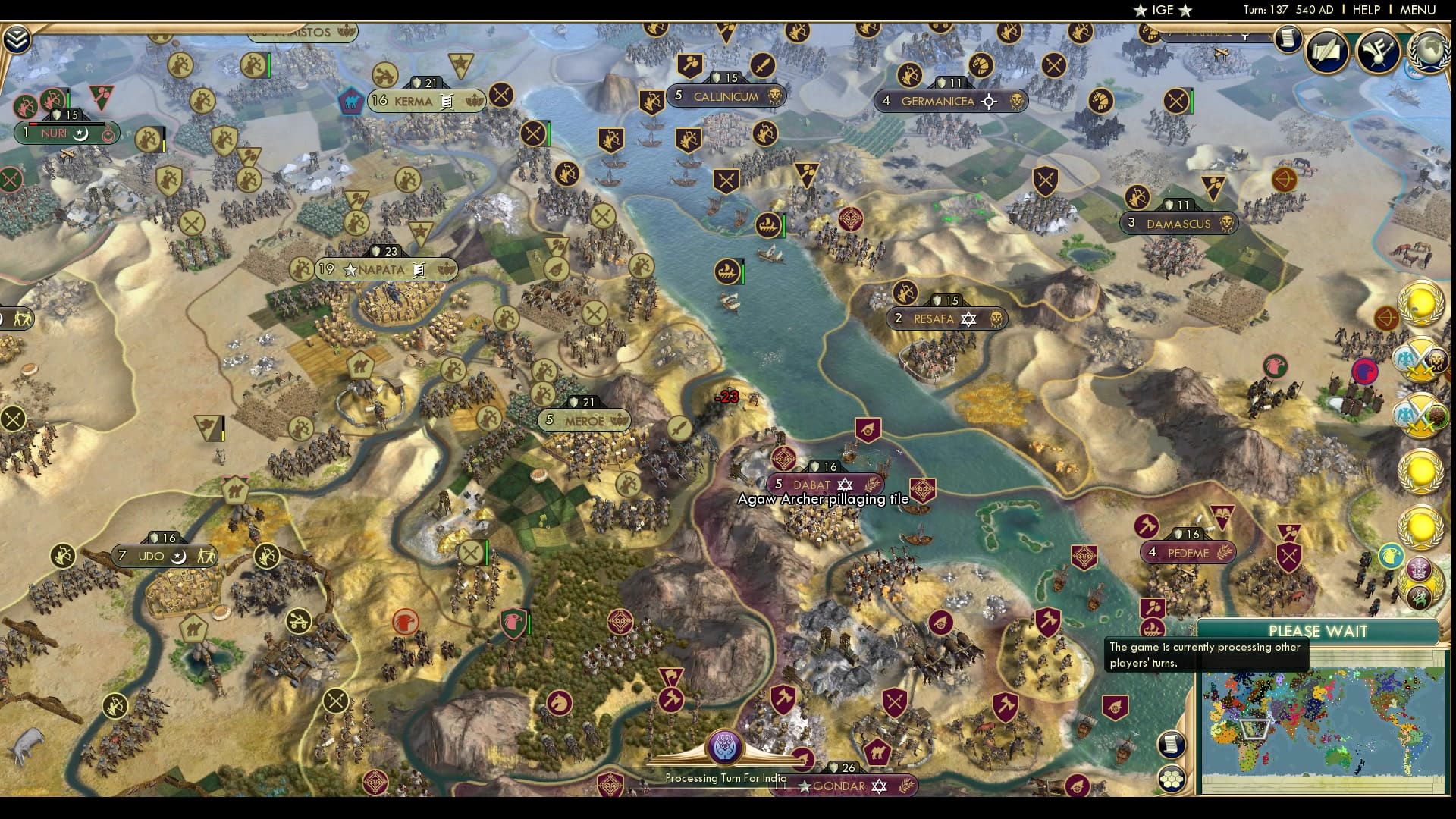
Piye, still convinced he can take Nuri back, has inadvertently allowed Palmyrene troops to land upon his shores. Though, I’ll give it to him, Palmyra is still unlikely to pose a threat, and the same goes for Beta Israel, who are opting to simply fire potshots at the Nubian troops garrisoned by Meroe. That strange text you see is the Beta Israel UU doing its tricks: when it attacks an enemy unit, it pillages the tile under that unit. A novel concept, certainly.
On the sidebar, we notice that a certain war has been rekindled. This could spell trouble for the Seljuqs...
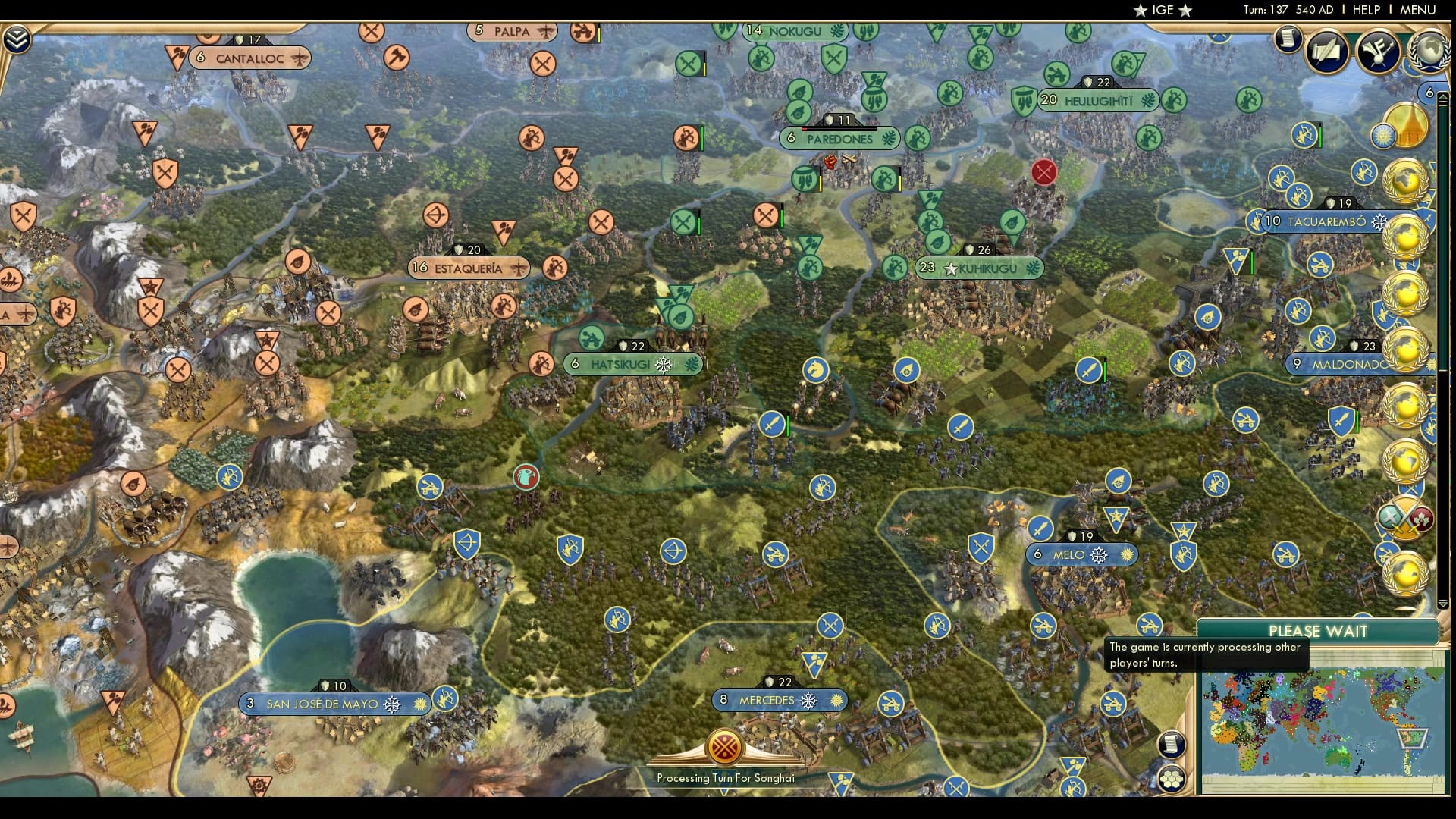
An excellent overview shot of the Great Amazon War shows that an entire wave of Uruguayan troops is about to reach Kuikuro’s cities. And yet, they seem too few, and too divided, targeting two cities at once. Nazca could definitely flank Hatsikugi from their side, but their troops are all over the place as well, with a small concentration by Estaqueria, possibly ready to go and cooperate with Uruguay around Hatsikugi. For now, it is hard to say where the war will go from here, if anywhere.
While his troops trudge through the Amazon, Lavalleja builds the Shwedagon Paya, improving the science of the city in which it was built, and also makes religious buildings give science alongside faith. One could easily consider it the best wonder of the Medieval era.
Oh, and Canada declares a war of their own against Yup’ik, in what is probably an attempt at making friends in Haida or Métis.
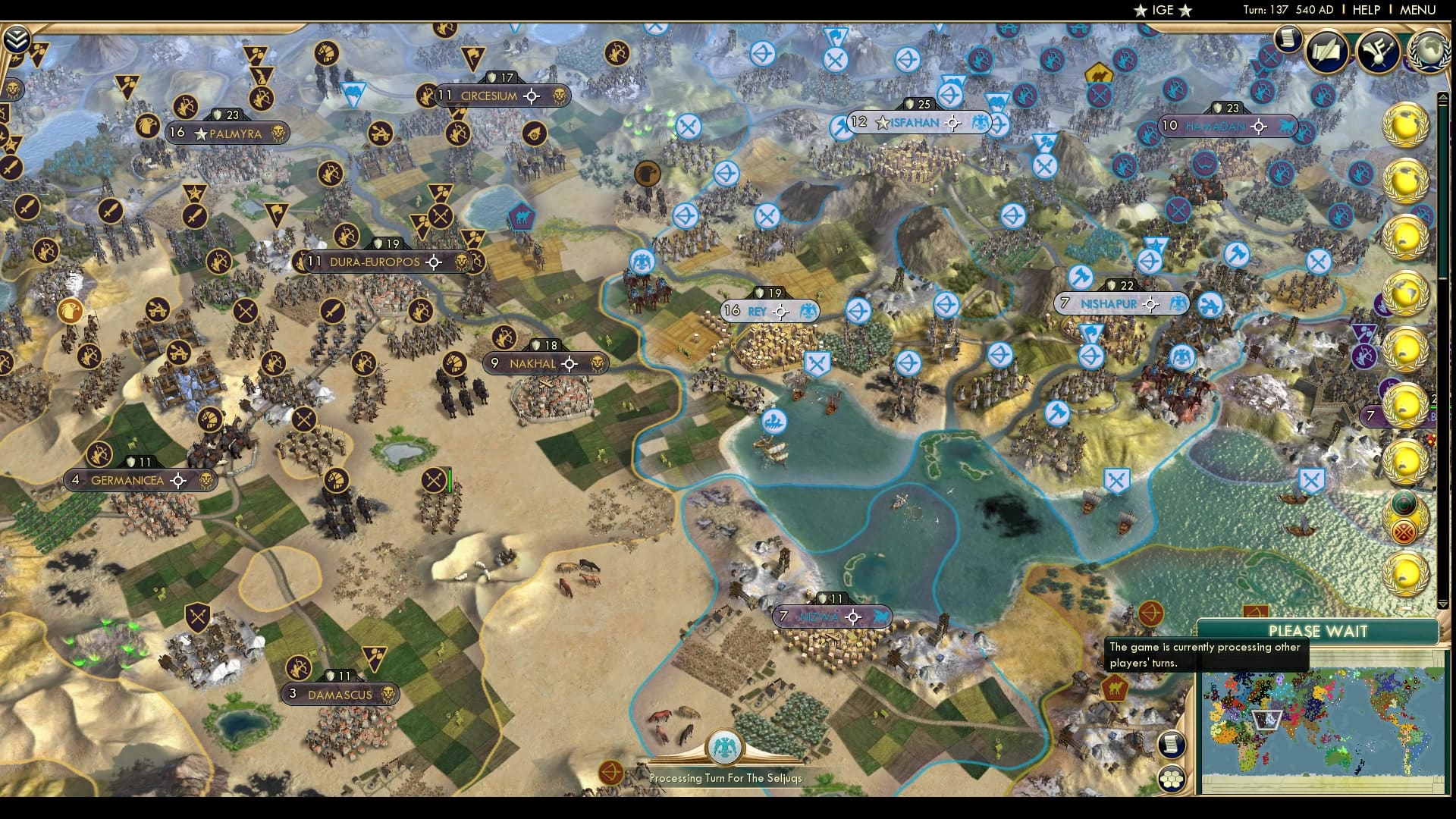
While the border here between Palmyra and the Seljuqs is not quite militarized at the moment, that will soon change. A veritable horde of Palmyrene troops is approaching Rey from the west, holding both the quality advantage and the quantity advantage. In truth, all Zenobia needs to do is push long enough, and Rey will be hers. Both sides have their mounted UU, but the Seljuq one is a chariot archer replacement in comparison to the horseman replacement that Palmyra has, and the Palmyrene one is clearly stronger either way. This will be an exhilarating bloodbath.
In the background, Songhai makes a sudden peace with Libya.
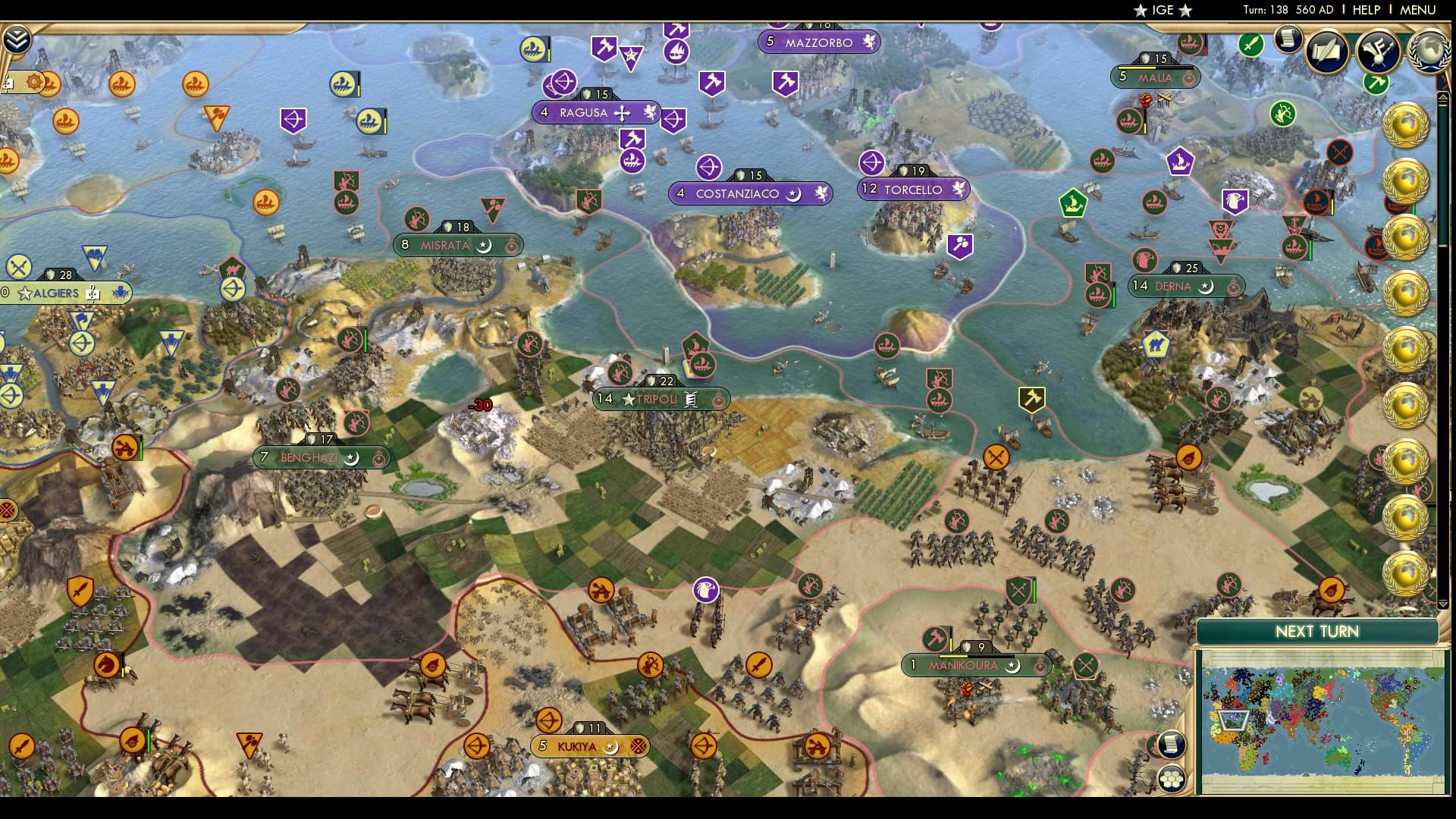
Forcing me to eat every single one of my words, Omar Mukhtar does the impossible. Malia has fallen into his arms, and against Songhai, he has managed to capture Manikoura right before making peace with Askia, resulting in a net gain of cities against a top 10 civ. Askia’s war record is getting worse and worse, while Omar’s is becoming quite impressive. At this point it might be an insult to call it luck, but if this is all luck, it would most certainly be ultimate luck.
On this slide we note that Venice has...caravels? No, he shouldn’t have those. Caravels require astronomy, and astronomy requires education, and education requires a bunch of techs Venice does not yet have. And not only that, but the Venice we’re using has a Caravel replacing UU, the Noleggiatore. So what’s going on in here? Perhaps BC can tell us what’s going on in here.
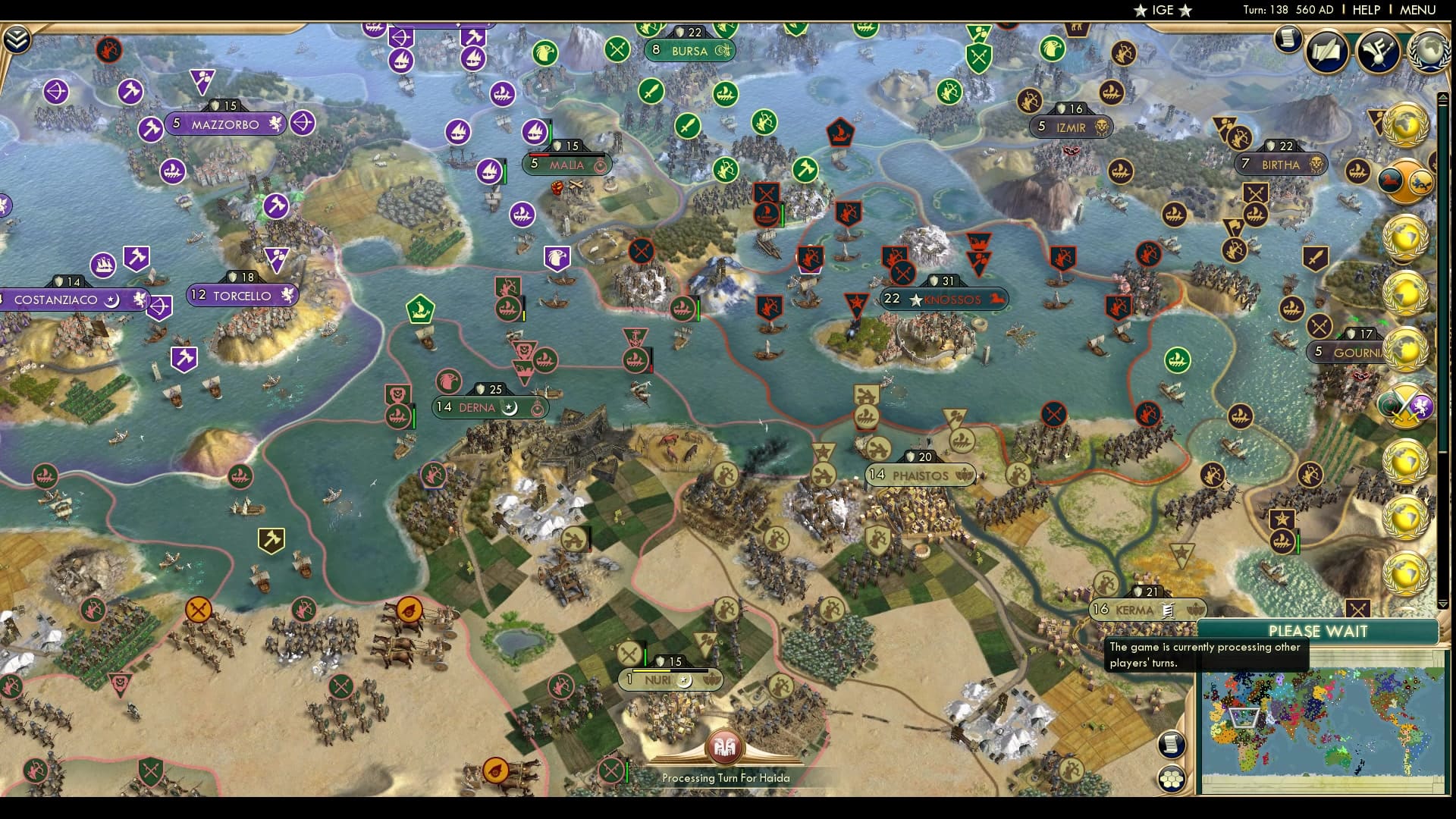
And in the very next scene, it all falls apart. Venice, clearly building a grudge with the Maghreb civs, declares a war on Libya, aided by the peculiar caravels, but also by what appears to be the Venetian galleass replacement in Constanziaco. It is the Great Galleass, and it is very similar to the galleass UU of vanilla Venice, except it also receives a whopping +100% combat bonus against cities, making it quite the city-murdering machine. Attacking a weakened Libya might be the best decision Enrico could’ve done, meaning Omar’s insane luck might’ve finally ran out.
Additionally, Nubia has captured Nuri, though Libya could still take it back at least once.
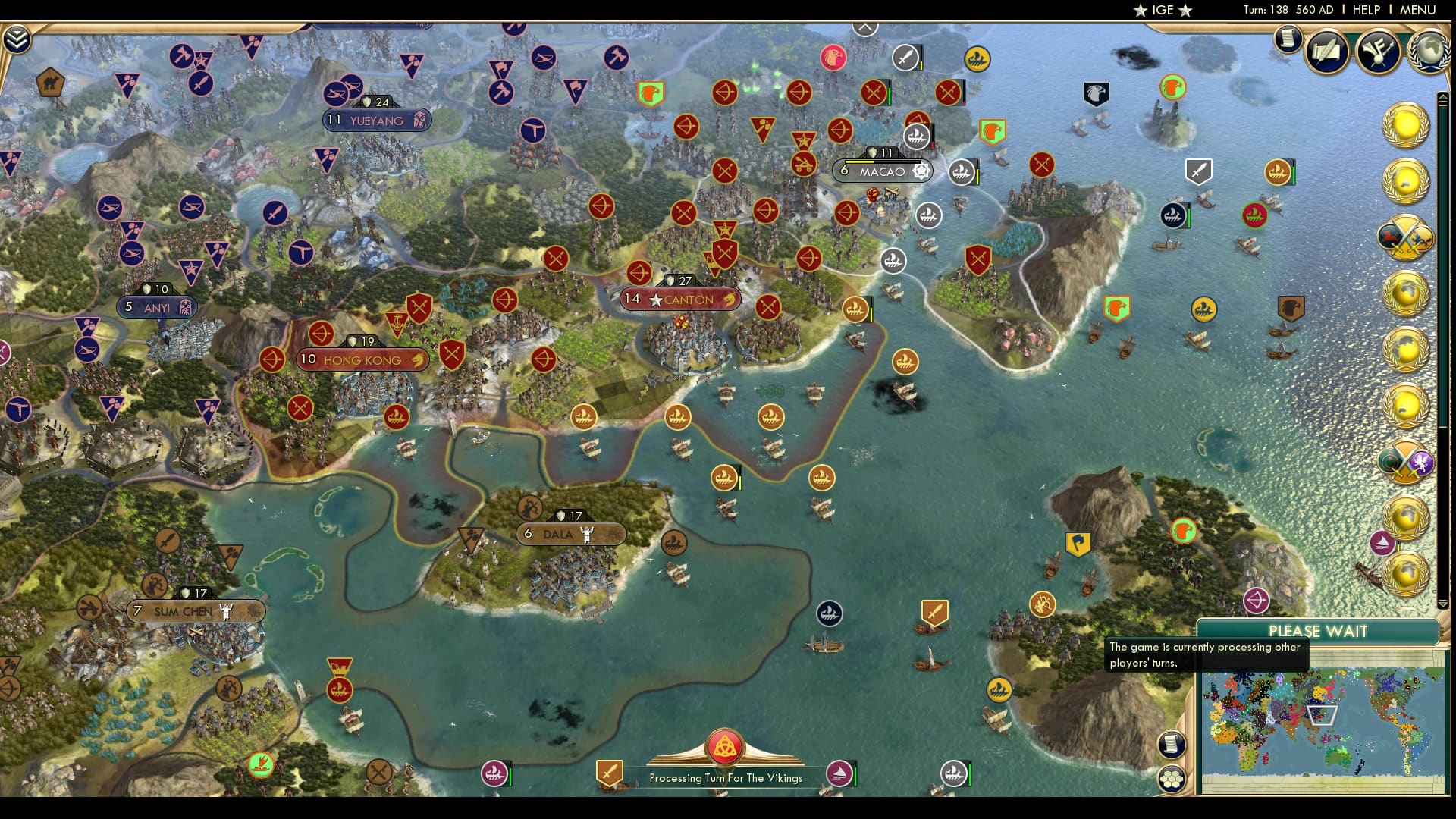
Against all odds and expectations, Shikoku has captured Macao! With Ching Shih’s troops outside of the city consisting entirely of ranged units, and Ryoma lacking the ability to kill units near the city itself due to a lack of galleasses, it would seem that Ryoma can keep the city for the foreseeable future.
Meanwhile, the Marathan navy is dilly-dallying around the Canton capital, in a way similar to how the Qing settler is still dilly-dallying around Luzon.
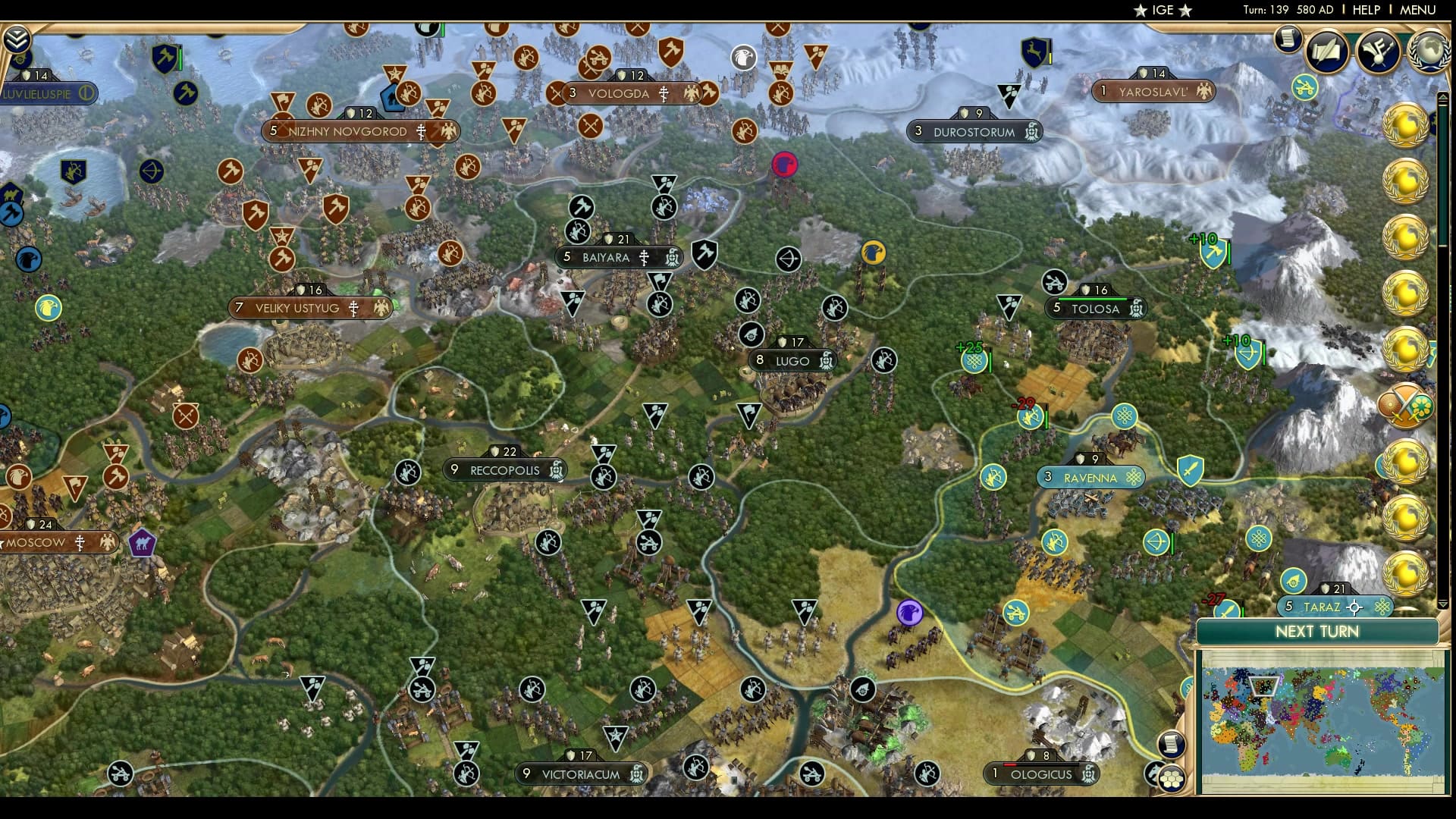
An observant observer will notice that the Goths are rapidly bringing troops towards the Kazakh war. Recapturing Ravenna will obviously pose a problem with how well Ablai Khan is garrisoning the city right now. Alaric will also have to hurry if he wishes to reinforce Tolosa, as the city still looks unprepared for a proper fight, but then again, the Kazakhs don’t seem particularly eager to give them that fight.
There would be a longer intermission here about how useless Yaroslavl’ is, but you’ll find the war declaration on the sidebar to be more interesting, and the next scene will tell you why.
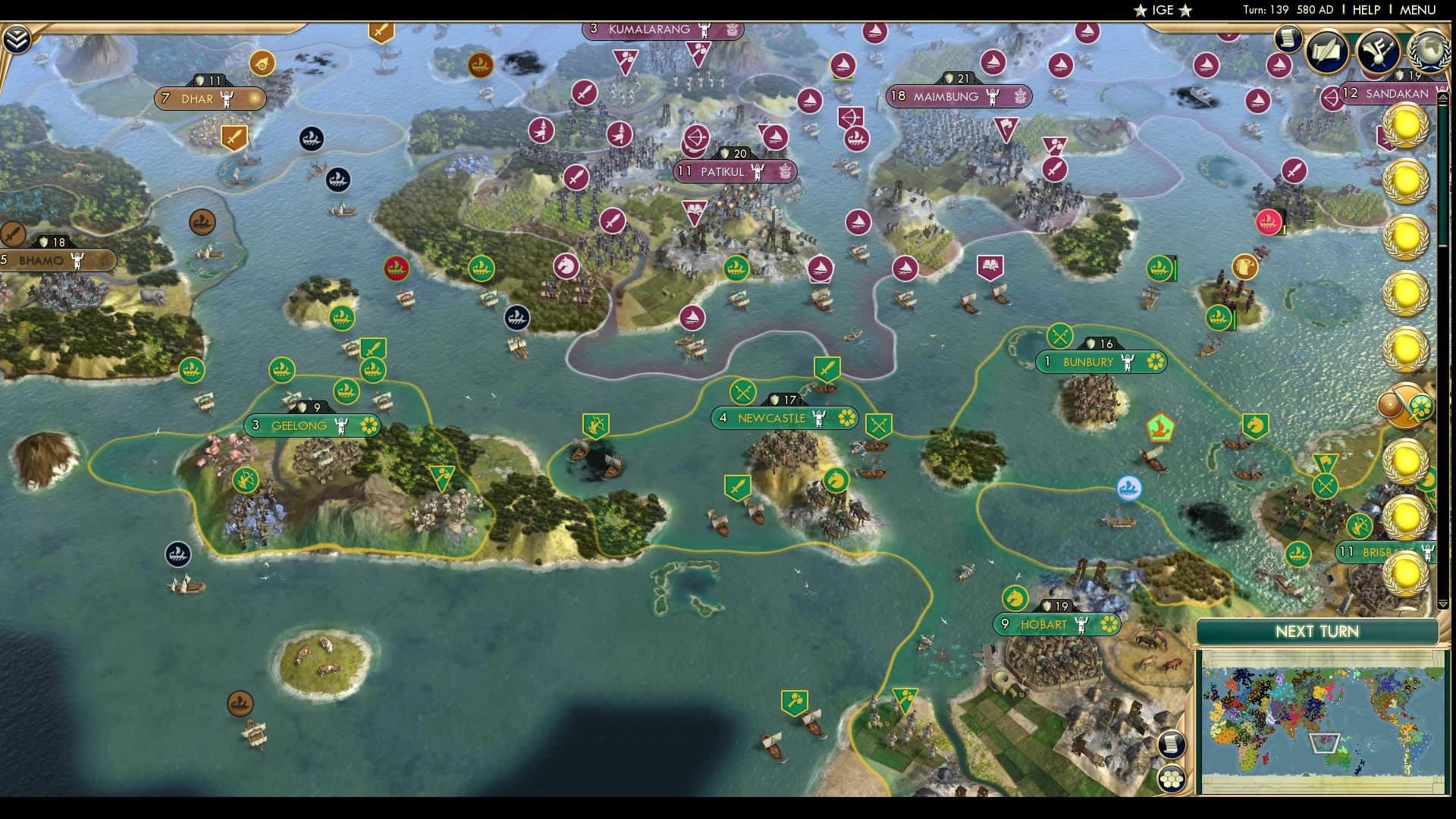
Indeed, the recent Australian and Marathan colonies are surprisingly close to each other! Only six tiles from Geelong to Dhar. Unfortunately for people who were looking forward to a proper bloody colonial war, the sea between the two colonies is quite thin. Maratha may look underprepared here, but if you remember a scene from earlier this part, you’ll know that quite a large contingent of troops was coming this way. It is quite believable that there is a large assortment of troops just outside of this shot.
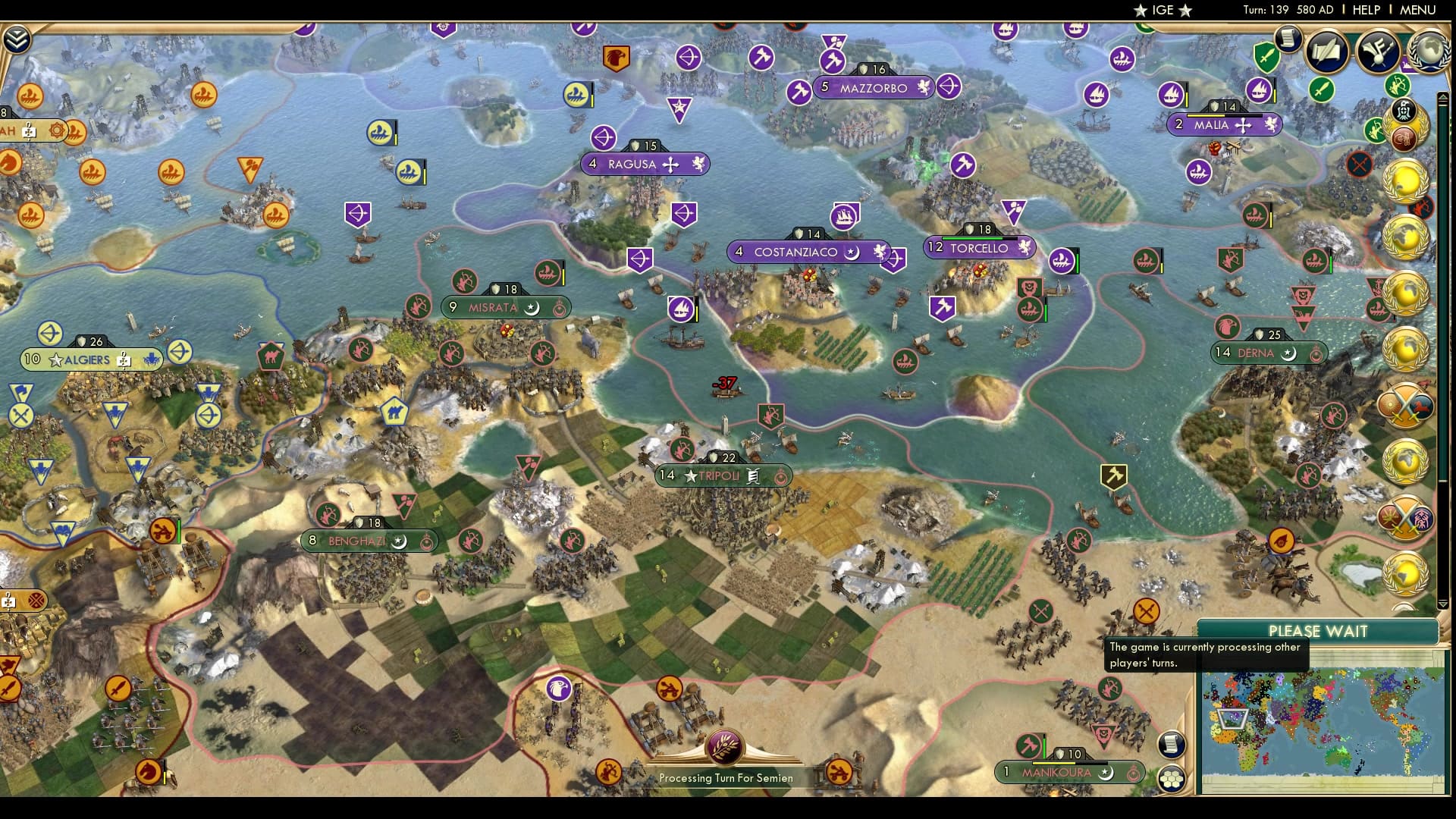
Back on the Mediterranean, Malia has fallen to Venice as expected, making Venice the fourth owner of Malia in a single part. Will Malia become the most-flipped city of the cylinder this season? It certainly has the central position to enable that. Ignoring Malia for a bit, though, Omar continues to prove that he is still confident in his luck by sending his triremes off to directly attack Venetian cities instead of bothering to prepare a proper defense. You know, I like a confident lad as much as the next narrator, but don’t you think this is a bit far?
In the background, Turks and Goths make peace, bringing some much needed peace to the Black Sea.

Piye proves that he still holds at least some cards in his hands by pushing the Libyans away from Nuri, and by doing his best to ignore the occasional Palmyrene units landing on his shores. A thought crosses the reader’s mind: could Nubia turn its defense against Libya into an offensive while Venice distracts the green civ? The potential is there, but they’ll need more than one melee unit in that case. Entering medieval era, as shown by the sidebar, should also help Piye here.
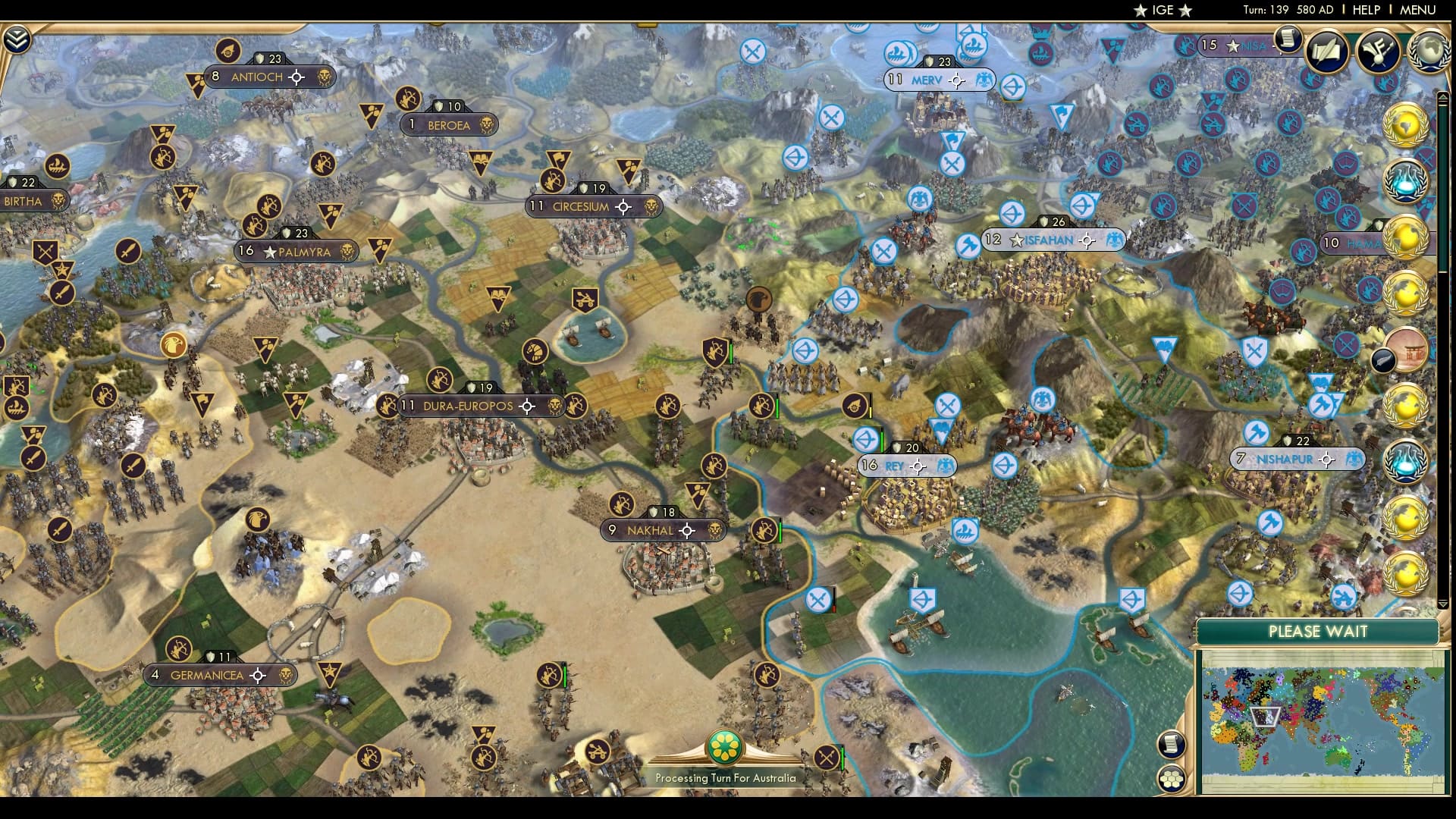
Returning to the fertile crescent shows to us that the Palmyrene horde we saw earlier has dispersed, leaving maybe ten units to attack Rey. But to be fair, the Seljuq garrison has gotten slightly weaker as well. The last two turns must’ve not been kind to the participants of this war. Or maybe Zenobia is just not taking this war seriously enough.
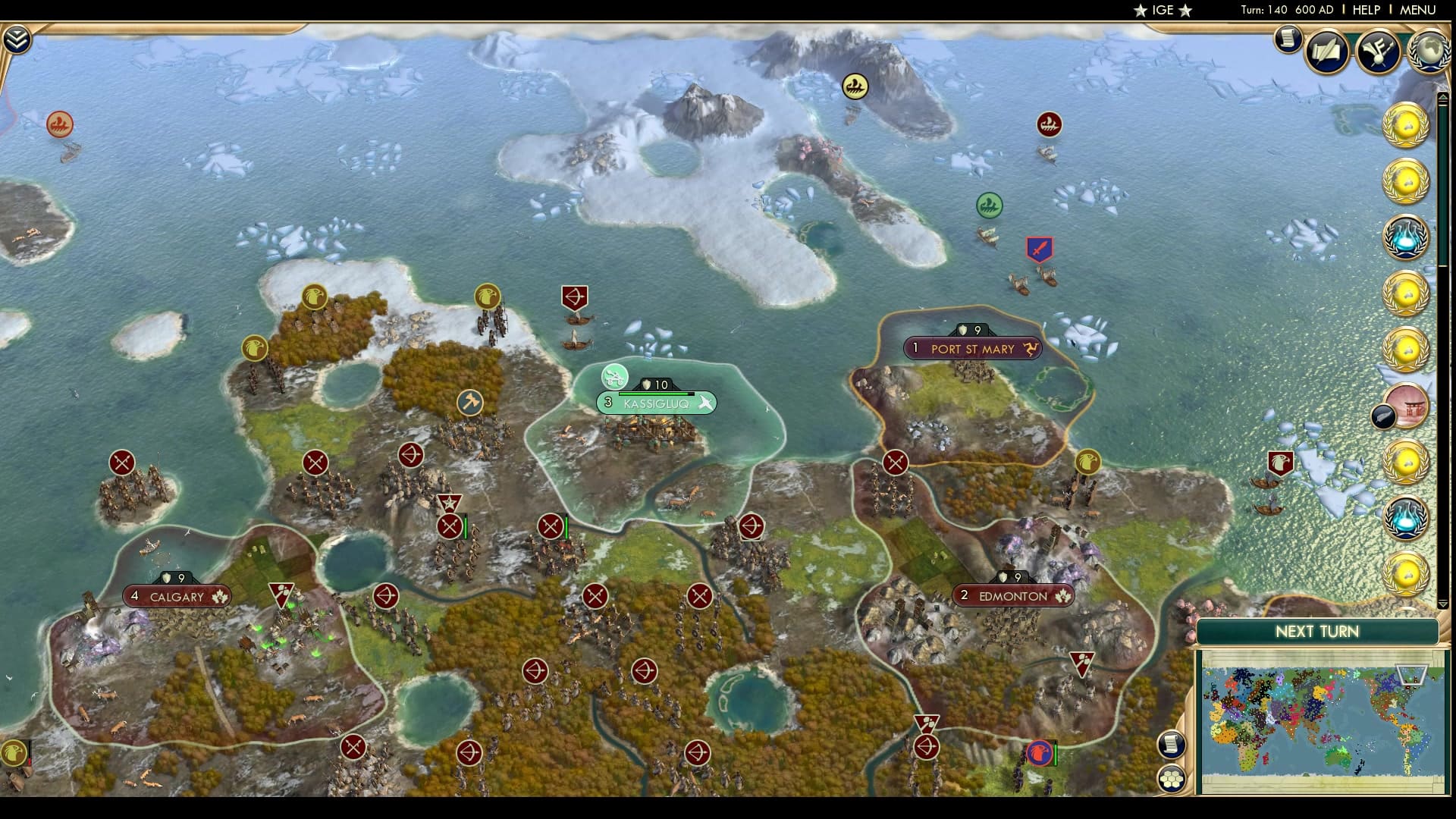
Canada? Being competent? Well I’ll be! The Canadian war declaration we saw earlier was relevant after all, as the adventurous Yup’ik settler finally settled down in Quebec. It is saddening that their great adventure is about to end like this, but such is life on the cylinder. Where even Canada will take a city from you if they can take you off guard. In more light-hearted news, Manx settle another city, this time in Labrador. The IRL Port St Mary is apparently named after a Chapel which is no longer there, so that’s cool.
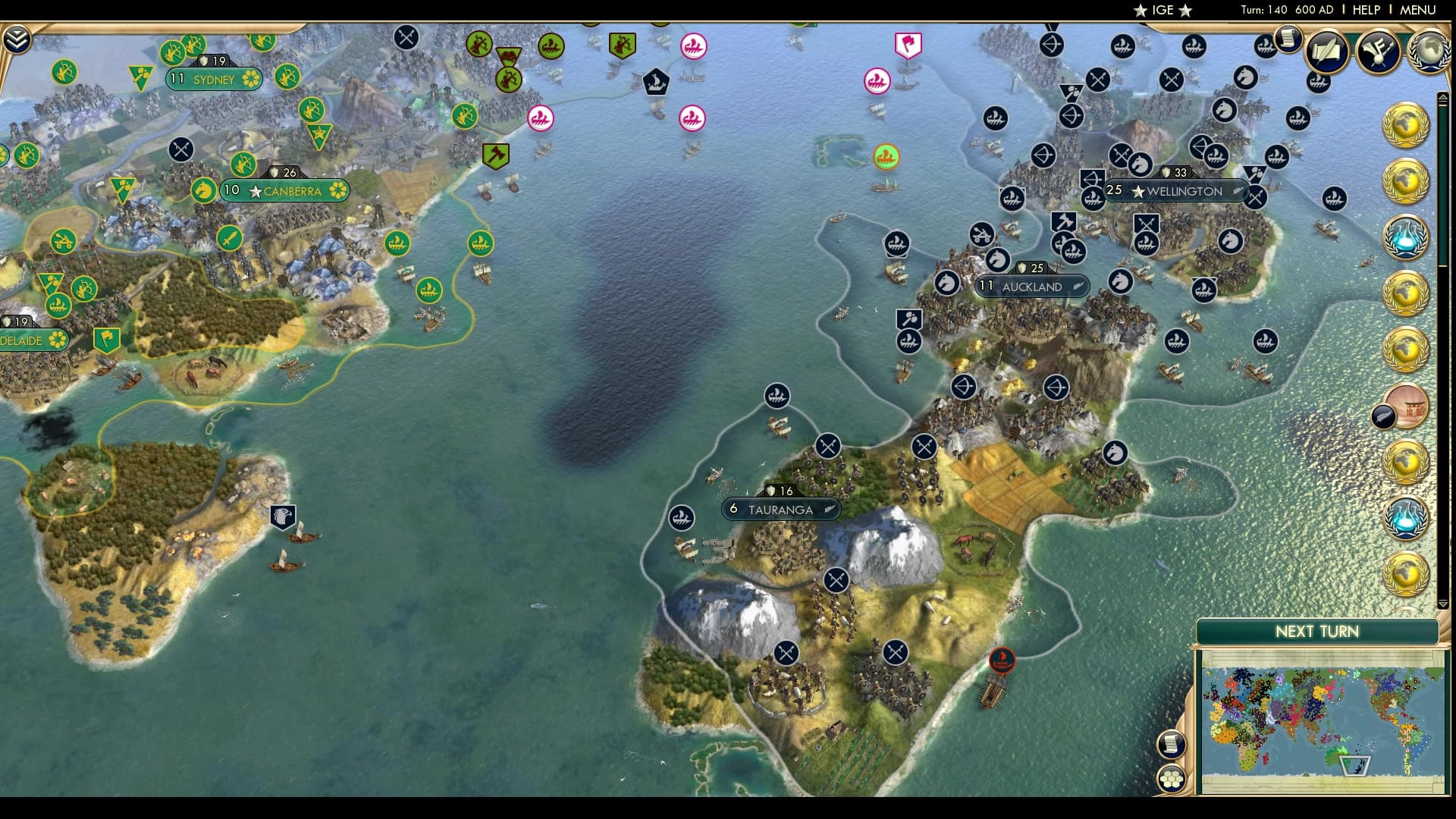
And for the last scene of the episode, we get a nice calming shot of New Zealand, giving me a great chance to explain what the wonder they got does. It is the Itsukushima Shrine, and it gives +20xp to all land and naval units built in the city where it was built, and the amphibious promotion to all land units built there. Overall, quite the nice wonder for the region. As an added bonus, the wonder also gives +3 faith on all sea resources near the city. Wonder or no, New Zealand seems to have militarized quite well. With any luck, this is in preparation for another Coral War, where Seddon would make some actual gains this time.
Additionally, Australia is about to settle Tasmania, and a Tongan settler is heading south as we speak.
That’s all, folks! I personally hope you have enjoyed this part, for I sure enjoyed perusing it. I have been /u/ThyReformer, and you have been awesome!